侵袭性脑膜炎球菌病:2024年年度流行病学报告
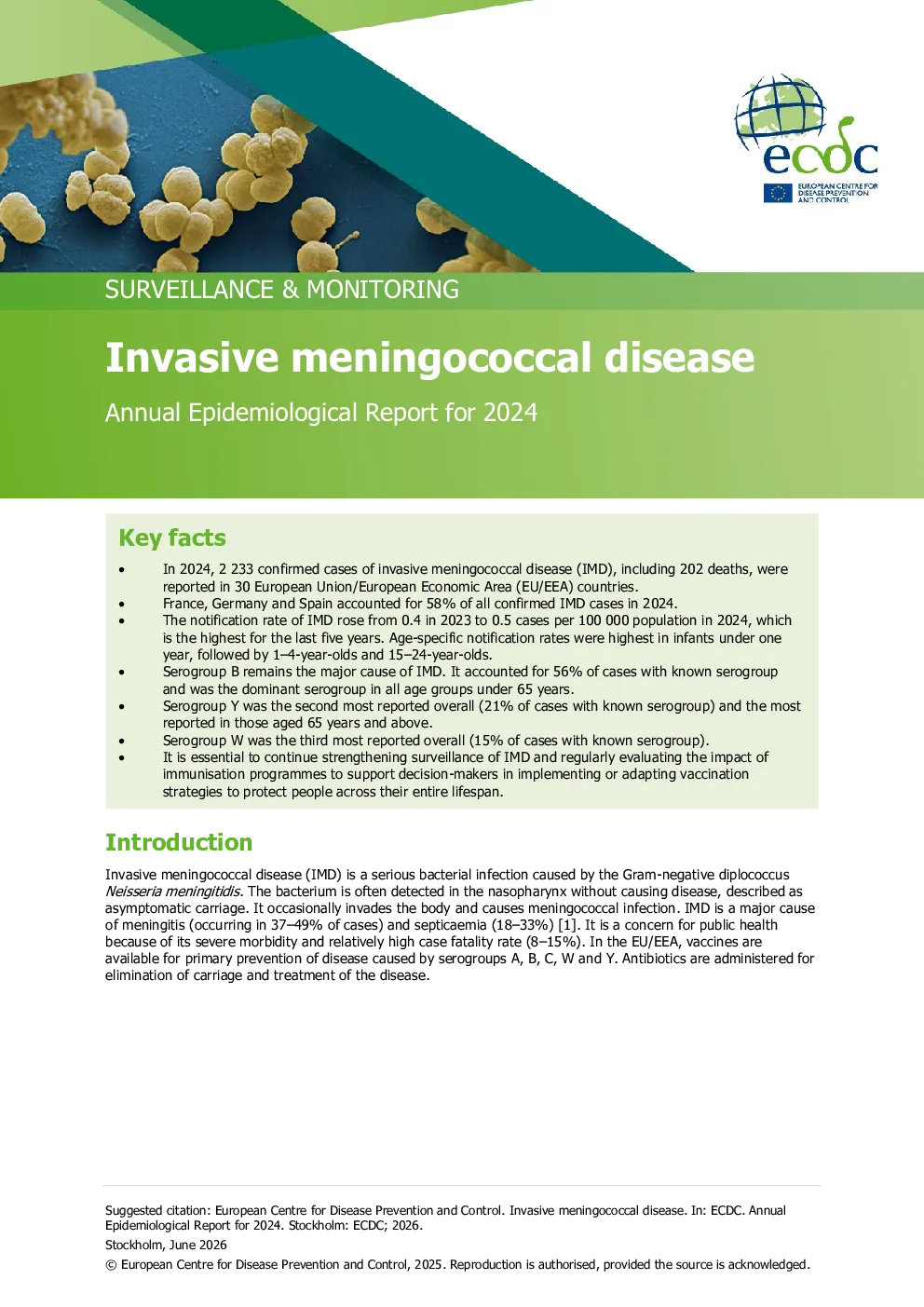
侵袭性脑膜炎奈瑟菌病 2024年流行病学年度报告 关键事实 • 2024年,30个欧盟/欧洲经济区(EU/EEA)国家报告了2233例侵袭性脑膜炎球菌病(IMD)确诊病例,包括202例死亡病例。• 法国、德国和西班牙占2024年所有IMD确诊病例的58%。 • IMD的报告率从2023年的0.4上升至2024年的每10万人0.5例,这是过去五年中最高的。特定年龄组的报告率最高的是1岁以下婴儿,其次是1-4岁儿童和15-24岁人群。 • B群仍为IMD的主要病因。在已知血清群的病例中,其占56%,并且在所有65岁以下年龄组中均为主要血清群。 • Y群是报告第二多的血清群(占已知血清群病例的21%),并且在65岁及以上人群中报告最多。 • W群是报告第三多的血清群(占已知血清群病例的15%)。 • 继续加强IMD监测以及定期评估免疫接种计划的影响,对于支持决策者实施或调整疫苗接种策略以保护人群整个生命周期至关重要。 引言 侵袭性脑膜炎奈瑟菌病(IMD)是由革兰氏阴性双球菌奈瑟氏菌引起的严重细菌感染。该细菌常在鼻咽部被检出但不引起疾病,称为无症状携带。它偶尔侵入人体并引起脑膜炎奈瑟菌感染。IMD是脑膜炎(占病例的37-49%)和败血症(占18-33%)的主要病因[1]。由于其严重发病率和高死亡率(8-15%),它对公共卫生构成威胁。在欧盟/欧洲经济区,有疫苗可用于预防A、B、C、W和Y血清群的疾病。抗生素用于清除携带状态和治疗疾病。 方法 本报告基于2024年数据,该数据于2026年4月7日从EpiPulse病例系统中获取。EpiPulse病例系统是一个用于收集、分析和传播传染病数据的系统;该系统于2024年10月取代了欧洲监测系统(TESSy)。 为获取本报告所用方法的详细描述,请参阅《年度流行病学报告指南》中的“方法”章节[2]。国家监测系统的概述可在网上获取[3]。关于此疾病的补充及可下载数据,可通过欧洲疾病预防控制中心(ECDC)的传染病监测在线图谱获取[4]。 截至2024年,已有三十个欧盟/欧洲经济区国家向欧洲疾病预防控制中心报告了传染病监测数据。大多数国家采用欧盟的确诊病例定义[5]或类似病例定义[3]。 大多数国家报告了来自覆盖全国的综合被动监测系统的数据。比利时报告了其哨点监测系统的数据。保加利亚报告了2024年的汇总数据。 流行病学 2024年,30个欧盟/欧洲经济区国家报告了2,233例IMD确诊病例(见表1)。这是自2020年以来的最高数字。法国、德国和西班牙三个国家占所有确诊病例的58%。爱沙尼亚和列支敦士登报告了零病例。 总体报告率为每10万人0.5例,与2019年观察到的报告率相同(每10万人0.5例)。各国报告率介于≤0.1例(保加利亚、爱沙尼亚、芬兰和列支敦士登)至每10万人1.2例(爱尔兰)(表1,图1)。法国和斯洛伐克的报告率位居第二(每10万人0.9例),随后是克罗地亚、塞浦路斯和荷兰,均报告每10万人0.8例。与2023年相比,几乎所有报告国家在2024年都经历了报告率的上升或稳定,现已恢复至疫情前的水平。与2023年相比,爱沙尼亚、芬兰、拉脱维亚和立陶宛在2024年报告率有所下降。 年龄和性别 2024年,IMD的报病率在幼儿中最高,1岁以下婴儿的报病率为每10万人中6.3例确诊病例,1至4岁儿童的报病率为每10万人中1.38例确诊病例(图2)。15至24岁年龄组的报病率(每10万人中0.83例)位居第三,其次是65岁及以上成年人(每10万人中0.53例)和5至14岁儿童(每10万人中0.38例)。 男性各年龄组的报告率均高于或等于女性,唯老年组(50-64岁及65岁及以上)例外,该组女性的报告率略高于男性。与其他年龄组相比,男婴(不满一岁)的报告率显著高于女婴(男性:每10万人中有7.6例确诊病例;女性:每10万人中有4.9例确诊病例)。病例的总体男女比例为0.99:1。 来源:奥地利、比利时、保加利亚、克罗地亚、塞浦路斯、捷克、丹麦、爱沙尼亚、芬兰、法国、德国、希腊、匈牙利、冰岛、爱尔兰、意大利、拉脱维亚、列支敦士登、立陶宛、卢森堡、马耳他、荷兰、挪威、波兰、葡萄牙、罗马尼亚、斯洛伐克、斯洛文尼亚、西班牙和瑞典的国家报告。 季节性与趋势 IMD通常主要发生在冬季月份,病例数量在夏季最低。2024年,确诊病例数在1月份达到峰值,随后是12月、3月和2月(图4)。与(2020-2023年)的时期相比,确诊病例数在5月份反弹,之后下降,然后在12月再次急剧上升(图4)。 来自奥地利、比利时、塞浦路斯、捷克、丹麦、爱沙尼亚、芬兰、法国、德国、希腊、匈牙利、冰岛、爱尔兰、意大利、拉脱维亚、立陶宛、卢森堡、马耳他、荷兰、挪威、波兰、葡萄牙、罗马尼亚、斯洛伐克、斯洛文尼亚、西班牙和瑞典的国家报告。 来自奥地利、比利时、塞浦路斯、捷克、丹麦、爱沙尼亚、芬兰、法国、德国、希腊、匈牙利、冰岛、爱尔兰、意大利、拉脱维亚、立陶宛、卢森堡、马耳他、荷兰、挪威、波兰、葡萄牙、罗马尼亚、斯洛伐克、斯洛文尼亚、西班牙和瑞典的国家报告。 血清型 2024年报告的2233例确诊IMD病例中,1987例(89%)有记录的血清群。其中大部分属于B群(56%),其次是Y群(21%)和W群(15%)(见表2)。未知血清群的比例(11%)在2024年比2023年(5%)有所增加,但低于2022年(14%)和2021年(16%)。 B血清群在所有年龄段中均占主导地位,但在65岁及以上年龄段,其是继Y血清群之后最常见的血清群。在不满一岁的婴儿中,B血清群占病例的74%;在1至4岁的儿童中,占病例的73%;在5至14岁的儿童中,占病例的72%(图5)。 Y血清群在65岁及以上人群中最占主导地位,占该年龄段病例的39%。Y血清群病例的比例在50-64岁人群中也较高(23%)、15-24岁人群(22%)、25-49岁人群(15%)以及5-14岁人群(12%),使其成为这些年龄段中继B血清群之后最常见的血清群。 W血清群在65岁及以上人群中占主导地位,占该年龄段病例的26%,是该年龄段中第三常见的血清群。 C血清群与其他血清群相比,在所有年龄段病例中持续占比较低。在25-49岁人群中占7%,在1-4岁儿童中占6%。它是2024年整体上记录最少的血清群,占所有已识别病例的4%。 在报告了2020年至2024年血清群数据的国家中,B、W和Y血清群的总体报告率略有上升,其发病率水平超过了2020年观察到的水平。C血清群在2024年的报告率仍然较低,且低于2020年观察到的水平(图6)。 对于B血清型,在比较2020年至2024年期间的报告率时,除1岁以下婴儿外,所有年龄段均观察到增加;最显著的增加出现在5-14岁和15-24岁年龄段。当比较2024年的报告率与2023年时,报告率相对稳定。在五年期间,5岁以下儿童的报告率最高。(图8) 对于W血清型,在2020年至2024年期间,除15-24岁年龄组外,所有年龄组的发病率均有所上升,其中5-14岁年龄组和65岁及以上年龄组的增幅最为显著。在五年期间,5岁以下的儿童显示出最高的报告发病率。(图9) 对于Y血清组,在比较2020年至2024年期间的报告率时,观察到中度增加,尤其是在不满一岁的婴儿和65岁以上的个体中(见图10)。 对于C血清型,2020年至2024年期间,1岁以下婴儿的报告率呈现持续下降趋势。(图8) 来自奥地利、比利时、塞浦路斯、捷克、丹麦、爱沙尼亚、芬兰、法国、德国、希腊、匈牙利、冰岛、爱尔兰、意大利、拉脱维亚、卢森堡、荷兰、挪威、波兰、葡萄牙、斯洛伐克、斯洛文尼亚、西班牙和瑞典的国家报告。 来自奥地利、比利时、塞浦路斯、捷克、丹麦、爱沙尼亚、芬兰、法国、德国、希腊、匈牙利、冰岛、爱尔兰、意大利、拉脱维亚、卢森堡、荷兰、挪威、波兰、葡萄牙、斯洛伐克、斯洛文尼亚、西班牙和瑞典的国家报告。 来源:奥地利、比利时、捷克、丹麦、法国、德国、希腊、匈牙利、爱尔兰、意大利、卢森堡、荷兰、挪威、波兰、葡萄牙、斯洛伐克、斯洛文尼亚、西班牙、瑞典的国家报告。 疫苗接种状态 已报告750例(33%)的疫苗接种情况,其中大多数病例未接种疫苗(79%)。 讨论 侵袭性脑膜炎奈瑟菌病(IMD)在欧洲联盟/欧洲经济区国家仍然罕见,但在所有年龄段都是一种严重且危及生命的疾病。自2020年以来,病例总数呈逐步上升趋势。趋势表明疾病水平已恢复至大流行前的水平,尽管整体报告率仍低于2018年和2019年的报告水平[6,7]。在2023年至2024年期间,所有血清群的报告率保持相对稳定,仅出现微小增长,其中C群与最低报告率相关。含C群的疫苗接种计划持续显示出长效保护作用[8,9]。在研究期间,B群仍然是主要血清群,其水平已恢复至2018–2019年的水平。Y群的IMD发病率出现急剧上升,超过2018–2019年的水平,而W群的发病率有所适度增长,尽管未达到2018–2019年观察到的水平。 自欧盟/欧洲经济区(EU/EEA)开始实施IMD监测以来,B群链球菌一直是婴幼儿病例的主要致病因素。自2014年以来,该群的通知率呈下降趋势,在COVID-19大流行期间尤为显著[7]。1岁以下婴儿的通知率最高,其次是4岁以下的儿童,这为以婴幼儿为主要目标人群的免疫接种计划提供了依据。4CMenB免疫接种计划旨在为个体提供直接的保护,以预防由B群链球菌引起的疾病[10,11],但由于该疫苗并不能阻止个体携带该群细菌或将其传播给他人[12],因此其保护效果仅限于个体层面。 婴儿是疫苗推荐的主要目标群体,因为无论血清群如何,该群体最受IMD疾病负担的影响。截至2026年,已有17个国家为婴儿提供资金支持的IMD疫苗接种计划,覆盖五种可预防疫苗的血清型中的一种或多种。在这些国家中,有10个国家提供MCV4加强疫苗接种计划。奥地利为青少年提供资金支持的基础疫苗接种计划采用MCV4,但未为婴儿提供资金支持的计划。捷克共和国为青少年提供资金支持的基础疫苗接种计划针对B血清群[13](附件1、附件2和附件3)。 虽然B血清群在低龄组中仍占主导地位(图5),但B血清群病例的年龄分布已观察到变化。在2022年至2024年的三年期间,15-24岁的青年占所有报告的B血清群病例的最大比例,而此前最高比例主要见于五岁以下的儿童[4]。此外,英国肯特地区近期发生的针对青年人的IMD B血清群疫情[14]凸显了IMD的严重性和不可预测性,并促使人们基于地方流行病学更广泛地考虑疫苗接种计划。预计即将进行的英国研究,包括一项血清流行率调查和一项危险因素研究[14],可能为欧盟/欧洲经济区各国的公共卫生决策提供重要证据支持。 W组和Y组的监测阳性率也大多在各个年龄段有所上升,并且越来越多的国家已引入疫苗接种计划,使用四价疫苗来预防这些血清组,对象为婴儿和/或青少年。 对青少年及50岁以上年龄组IMD(感染性心内膜炎)的发病率及流行病学进行密切监测仍然至关重要。这有助于为疫苗接种策略提供信息,以便在婴儿之外,将老年人也纳入其中,并可能进行相应调整。 脑膜炎奈瑟菌病的早期临床体征通常表现为非特异性、流感样症状,且可能没有皮疹,这可能导致漏诊、临床管理延误和高死亡率[15]。非典型表现更常见于老年人,其死亡率最高[16-18]。尽管存在这一负担,目前欧盟/欧洲经济区尚无针对老年群体的年龄分级项目。在这种情况下,提高医疗保健从业者对非典型IMD表现的认识也可能改善诊断延误和不良疾病结局,尤其是在老年群体中。 脑膜炎奈瑟菌的流行病学的不确定性凸显了维持高质量监测的必要性。将聚合酶链反应(PCR)、实时聚合酶链反应(RT-PCR)和全基因组测序(WGS)等分子技术整合到监测系统中,对于准确检测和监测流行病学趋势、识别流行血清群以及评估已实施疫苗接种策略的有效性至关重要。欧洲疾病预防控制中心(ECDC)已启动一项关于脑膜炎球菌病(IMD)整合基因组与流行病学监测的试点项目,