您的浏览器禁用了JavaScript(一种计算机语言,用以实现您与网页的交互),请解除该禁用,或者联系我们。 [花旗]:中国经济学2026年下半年展望:人工智能超级周期冲击K型经济 - 发现报告

中国经济学2026年下半年展望:人工智能超级周期冲击K型经济

2026-06-25 花旗 严宏志19905053625
报告封面

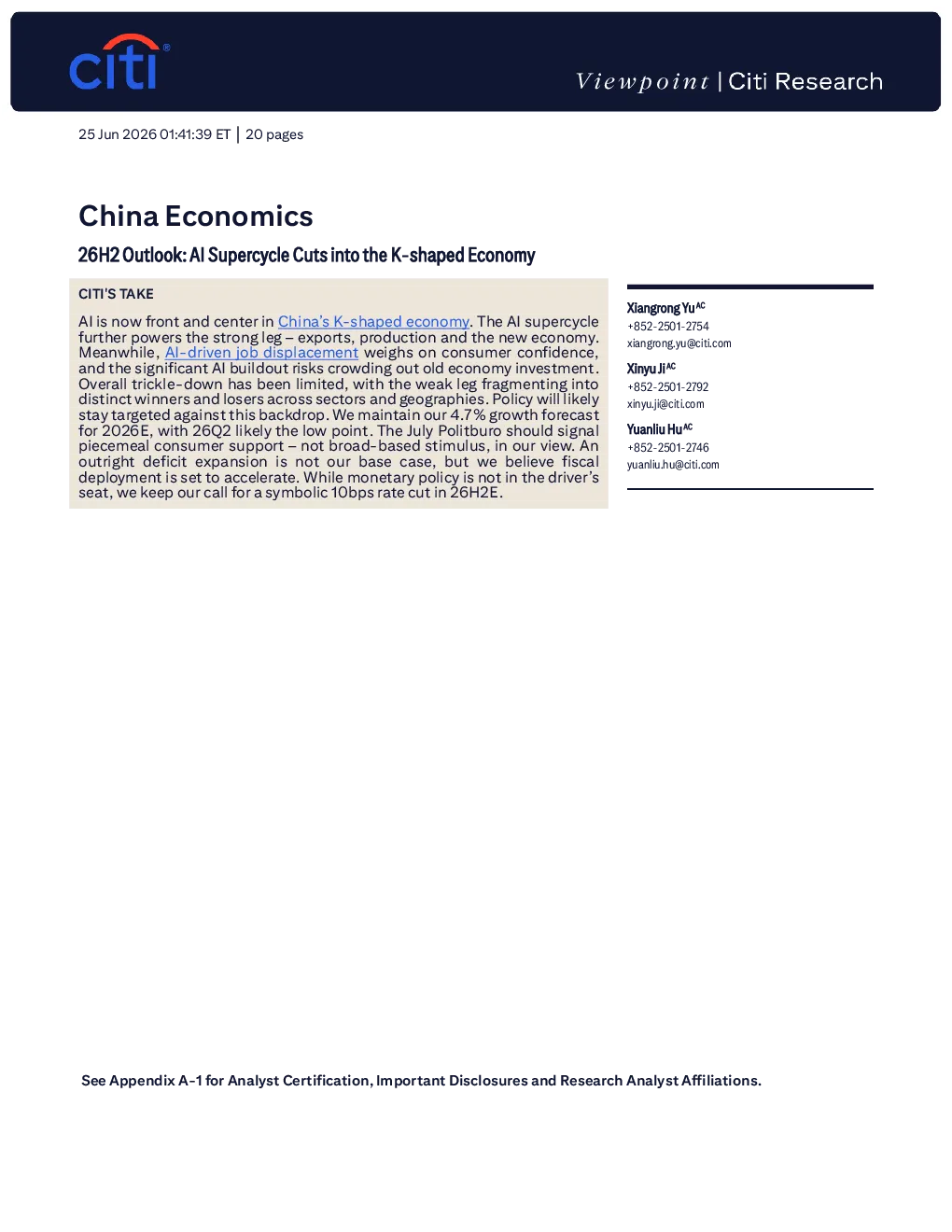
China Economics 26H2 Outlook: AI Supercycle Cuts into the K-shaped Economy CITI'S TAKE Xiangrong YuAC+852-2501-2754xiangrong.yu@citi.com AI is now front and center in China’s K-shaped economy. The AI supercyclefurther powers the strong leg – exports, production and the new economy.Meanwhile, AI-driven job displacement weighs on consumer confidence,and the significant AI buildout risks crowding out old economy investment.Overall trickle-down has been limited, with the weak leg fragmenting intodistinct winners and losers across sectors and geographies. Policy will likelystay targeted against this backdrop. We maintain our 4.7% growth forecastfor 2026E, with 26Q2 likely the low point. The July Politburo should signalpiecemeal consumer support – not broad-based stimulus, in our view. An Xinyu JiAC+852-2501-2792xinyu.ji@citi.com Yuanliu HuAC+852-2501-2746yuanliu.hu@citi.com See Appendix A-1 for Analyst Certification, Important Disclosures and Research Analyst Affiliations. AI has become the defining force shaping China's K-shaped economy.We havecharacterized China’s post-Covid recovery along two dimensions:[1]supplyconsistently outpacing domestic demand, with exports filling the gap; and[2]thenew economy outperforming the old (see: China Outlook 2026: Mind the Gap). TheDeepSeek moment in early 2025 helped materially accelerate the AI-centric new nWidening divergence:The AI supercycle is powering production, exports, andnew economy activity, reinforcing the strong leg of the K. At the same time, AI-driven labor displacement risks – while not yet material – are weighing onconsumer confidence (see: The Macro-Micro Disconnect of AI-Driven New nDomestic fragmentation:The AI supercycle is creating distinct winners andlosers across sectors and geographies, even as overall trickle-down to the oldeconomy has been limited. The weak leg is no longer monolithic – AI-adjacent n“AI-first policy”:Despite the policy rhetoric of “employment-first” and“investing in people”, the “AI+” initiative is clearly the strategic focus in practice.We believe, so long as social stability holds, facilitating the AI transition sits atthe top of the policy hierarchy. With the growth target revised down, the urgency We maintain our growth forecast at 4.7%YoY for 2026E.The AI supercycleanchors the headline number, particularly through supply-side strength. 26Q2 islikely to be a low point in the quarterly trajectory, partly due to the Middle Eastshock and lagging fiscal deployment. On prices, the energy shock has driven the We expect targeted, piecemeal support to domestic demand ahead – not broad-based big stimulus.Structural efforts such as the “Six Networks” initiative areunderway, enabling AI adoption and stabilizing investment. We see a good chance that the July Politburo meeting (held on the 30thin 2025) may signal incrementalmeasures to support consumption and household income. That said, an outrightincrease in the budget deficit or special government bond quota is not our basecase. While monetary policy is not in the driver’s seat, we keep our call for a The AI economy takes off The AI economy is shifting from intangible algorithm development to tangibleinfrastructure buildout.The DeepSeek moment settled a pivotal question – Chinacan innovate in AI. OpenClaw and the rise of agentic AI have since recharged themomentum, further cementing the trend as the most significant technological nToken:China’s daily token usage hit 140trn in March 2026, up from 0.1trn at thebeginning of 2024 (Figure 3). nComputing power:China’s intelligent computing tripled in 2025 vs. 2024,according to MIIT data (Figure 4). nEquity market:AI-related outperformance has rotated from internet giants tosemiconductor manufacturers and materials providers – mirroring the broader AI is now front and center in China’s K-shaped economy.The post-Covid recoveryhas been bifurcated with supply outpacing demand (Figure 6), external demandahead of domestic demand (Figure 7), and the new economy leading the old.The © 2026 Citigroup Inc. No redistribution without Citigroup’s written permission.Note: AI models (Tencent, Meituan, Alibaba, Kuaishou, Baidu, SenseTime,Ubtech, Zhipu and Minimax) and semiconductor supply chains as compiledby Wind. Source: MIIT, news reports, Citi Research A further boost to the strong leg The AI supercycle serves as another boost to exports, as evidenced by the stronggrowth seen so far. Even if export momentum were to subside, we believe China’s Exports: from cyclical strength to structural tailwind China’s export boom this year is more structural than cyclical.Three featuresstand out: nAI hardware:AI-related exports – spanning upstream chips, midstream powerequipment, and downstream personal electronics – accounted for 20.3% ofChina’s total exports in 2025 (Figure 8). Growth accelerated to 34.8%YoY in Jan- same period (Figure 9). With the global AI transition still in its early stages, thisstrength is unlikely to falter soon. nP