您的浏览器禁用了JavaScript(一种计算机语言,用以实现您与网页的交互),请解除该禁用,或者联系我们。 [牛津经济研究院]:退休人群可支配支出如何支撑面向消费者的商业地产 - 发现报告

退休人群可支配支出如何支撑面向消费者的商业地产

房地产 2026-06-19 - 牛津经济研究院 用户432810
报告封面

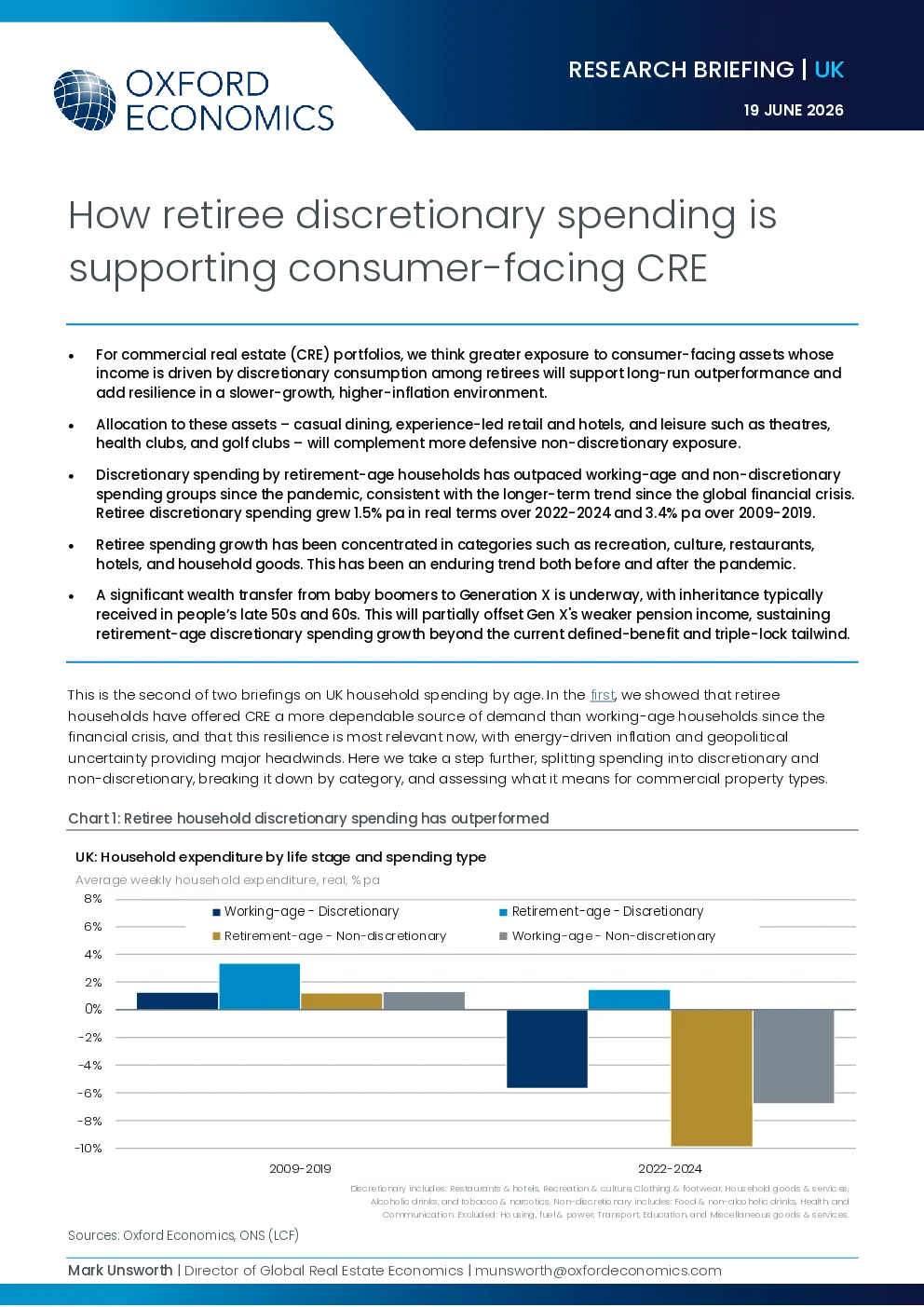
•For commercial real estate(CRE)portfolios,we thinkgreater exposureto consumer-facing assets whoseincome is driven by discretionary consumptionamongretireeswill support long-run outperformance andadd resilience in a slower-growth, higher-inflation environment. •Allocation to these assets–casual dining, experience-led retailandhotels,and leisure such as theatres,health clubs, and golf clubs–willcomplement more defensive non-discretionary exposure. •Discretionary spending by retirement-age households hasoutpacedworking-age and non-discretionaryspendinggroups since the pandemic,consistent with thelonger-termtrendsince theglobal financial crisis.Retiree discretionaryspendinggrew 1.5%pain real termsover 2022-2024and3.4%paover2009-2019. •Retiree spending growthhasbeenconcentrated in categoriessuch asrecreation, culture, restaurants,hotels,and household goods. This has been anenduring trendboth before and afterthe pandemic. •A significant wealth transfer from baby boomers to Generation X is underway, with inheritance typicallyreceived inpeople’slate 50s and 60s. This will partially offset Gen X's weaker pension income, sustainingretirement-age discretionary spending growth beyond the current defined-benefit and triple-lock tailwind. This is the second of two briefings on UK household spending by age. In thefirst, we showed that retireehouseholds have offeredCREa more dependable source of demand than working-age households since thefinancial crisis, and that this resilience is most relevant now, with energy-driven inflation and geopoliticaluncertaintyprovidingmajor headwinds. Here wetakea step further, splitting spending into discretionary andnon-discretionary, breaking it down by category, andassessingwhat it means forcommercialproperty types. Chart1:Retiree household discretionary spending hasoutperformed Retiree’see oleop ovec ese discretionary spending Retiree discretionary spending was the only segment of UK consumption to grow in real termsover 2022-2024, ataround 1.5% a year.As energy and housing costshave weighed on consumption,working-age discretionaryspendingfell by around 5.7% a year, working-age non-discretionary spend by 6.8%, and even retiree non-discretionary spend by 9.9% (Chart 1). Thisresilienceis not a one-off. Over 2009-2019, retiree discretionary spendgrewaround 3.4% a year(with similar performancewithin the retirement cohortbythe 64-74 age group and the75plus age group)against just 1.3% for working-age households, suggestingthe post-pandemic data extends astructural trend rather thanshifting tosomething new. The tailwind is realfor CRE, butfor niche property types Theexpendituregrowth is not spread evenly across the consumer basket. For retireespending, the strengthisinrestaurants and hotels (5.4% a year over 2022-2024), recreation and culture (3.2%), and household goods andservices (2.5%), even as the same households cut clothing (-5.8%) and alcohol and tobacco (-10.0%;Chart2). This pattern of retiree spending is reinforced by a shift in how older householdsuse their time.Freed from workobligations, retirement-age households have always been able to sustain longer stays,off-season travel, andmore frequent short breaks–but with the retirement-age population set to grow from around 13million today tonearly17million by 2040, the aggregatedemandthis generates for hotels and food-and-beverage operators isbecoming structurally more significant relative to the compressed weekend leisure of working-age consumers. There has also been a longer-term shift within discretionary spending. As income and wealth have risen,retirement-age households have moved away from buying more goods and towards paying for experiences,while a greater awareness of health and wellbeing has also supported spending on recreation, culture,andleisure. Chart2:Retiree household spendinghas grown fasterforrecreation, culture, restaurants & hotels From a real estate perspective, strength in these spending categories indicates structural support for turnover incatchments skewed towards wealthy retirement-age households, benefitingconsumer-facing retail, hospitality, and leisure assetssuch ascasual dining and food-and-beverage-led schemes, experience-led retail,hotels,andleisure such as garden centres, theatres, gyms, and golf clubs(Table 1). Many of these property types are niche. They are also operationally intensive, less liquid, and often have limitedalternative use. Even so, they fit a megatrend-led investment strategy that aims to benefit from populationageing without moving directly into more politically sensitive sectors such as healthcare, senior living,and carehomes. Institutional investors have already started to reflect this theme in portfolio strategy.In December 2024, KKR andtheBaupost Groupbought33 Marriott-branded hotels across the UK from the Abu Dhabi Investment Authority foran estimated £900 million. The 6,500-room portfolio includes conference venues, golf and recreation facilities.This mix is suit