从工资到养老金:退休人员支出的演变
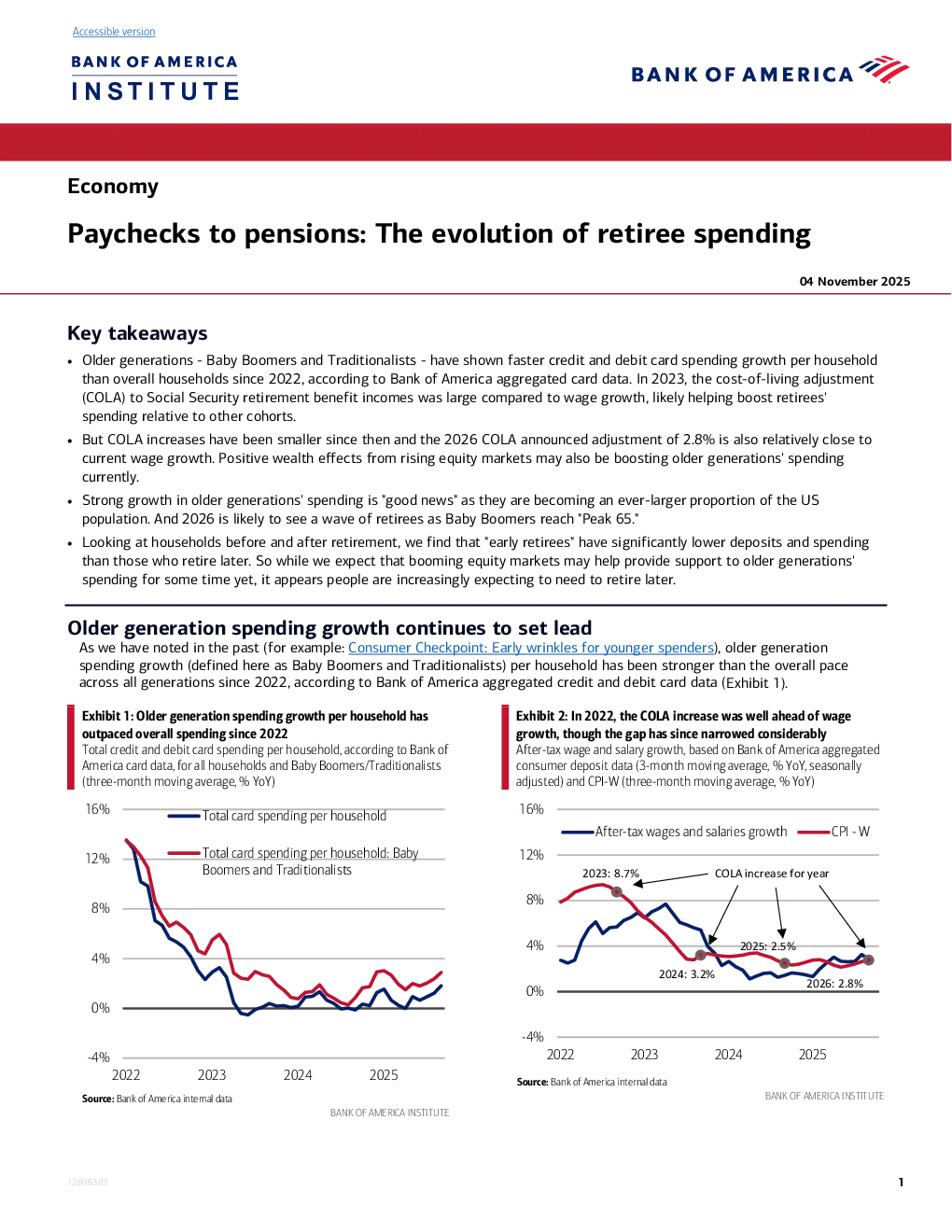
Paychecks to pensions: The evolution of retiree spending 04 November 2025 Key takeaways •Older generations - Baby Boomers and Traditionalists - have shown faster credit and debit card spending growth per householdthan overall households since 2022, according to Bank of America aggregated card data. In 2023, the cost-of-living adjustment(COLA) to Social Security retirement benefit incomes was large compared to wage growth, likely helping boost retirees'spending relative to other cohorts. •But COLA increases have been smaller since then and the 2026 COLA announced adjustment of 2.8% is also relatively close tocurrent wage growth. Positive wealth effects from rising equity markets may also be boosting older generations' spendingcurrently. •Strong growth in older generations' spending is "good news" as they are becoming an ever-larger proportion of the USpopulation. And 2026 is likely to see a wave of retirees as Baby Boomers reach "Peak 65." •Looking at households before and after retirement, we find that "early retirees" have significantly lower deposits and spendingthan those who retire later. So while we expect that booming equity markets may help provide support to older generations'spending for some time yet, it appears people are increasingly expecting to need to retire later. Older generation spending growth continues to set leadAs we have noted in the past (for example:Consumer Checkpoint: Early wrinkles for younger spenders), older generation spending growth (defined here as Baby Boomers and Traditionalists) per household has been stronger than the overall paceacross all generations since 2022, according to Bank of America aggregated credit and debit card data (Exhibit 1). Exhibit1:Older generation spending growthper householdhasoutpaced overall spending since 2022Total credit and debit card spending per household, according to Bank of Exhibit2:In 2022,the COLA increase was wellahead of wagegrowth, though the gap has since narrowed considerablyAfter-tax wage and salary growth, based on Bank of America aggregated America card data, for all households and Baby Boomers/Traditionalists(three-month moving average, % YoY) consumer deposit data (3-month moving average, % YoY, seasonallyadjusted) and CPI-W (three-month moving average, % YoY) Social security retirement benefits are adjusted in January of each year by a cost-of-living adjustment (COLA), which is anchoredto the year-over-year (YoY) change in the third quarterConsumer Price Index for Urban Wage Earners and Clerical Workersindex(CPI-W) in the preceding year. In 2023, there was a large 8.7% COLA increase, and it seemed likely this was helping to supportthe spending of older generations relative to other households (Exhibit 2). In particular, the January 2023 COLA was significantlyhigher than overall after-tax wage and salary growth, according to Bank of America deposit data. But in more recent years, the COLA increase has been more in line with overall after-tax wage growth, reflecting lower CPI-Winflation. And the adjustment effective January 2026, based on the CPI-W inflation rate in the third quarter of 2025, has beenannounced at 2.8%, which again looks unlikely to be a big driver in spending divergences between older generations and theoverall population. As discussed in the October Consumer Checkpoint (Consumer Checkpoint: The tale of two wallets), one potential explanation forthe continued strength of older generation consumer spending could be“wealth effects.”Older cohorts tend to hold moreassets, and they may have increased their spending partly in response to rising equities over 2024 and 2025. Absent a correctionin equity markets, we expect older generations should be able to find support here for some time. The retirement wave is hereThe divergent spending trends across generations are especially important because the US is experiencing a big demographic shift, as a wave of retirees reshapes the economic landscape. According to Census Bureau population projections, the number ofresident Americans (those living, both civilian and Armed Forces, in the United States) turning 65 will peak in 2026, aphenomenon sometimes referred to as“Peak 65”(Exhibit 3). Between 2025 and 2027, over 4.1 million residents per year are expected to reach this milestone. Moreover, the proportion ofUS residents aged 65 and older is expected to rise from 17.3% in 2022 to 20.6% by 2030, according to data from the CensusBureau. Older, wiser and thriftierAs this large share of the population transitions from earning income to relying on retirement savings and benefits, how will its spending evolve? This question is increasingly important for both policymakers and businesses adapting their strategies to anaging population. To understand how spending evolves with age, we first analyze the saving and spending patterns of Bank of America householdsaged 60 to 69 years who receive a regular paycheck deposit into their account but are not yet receiving S