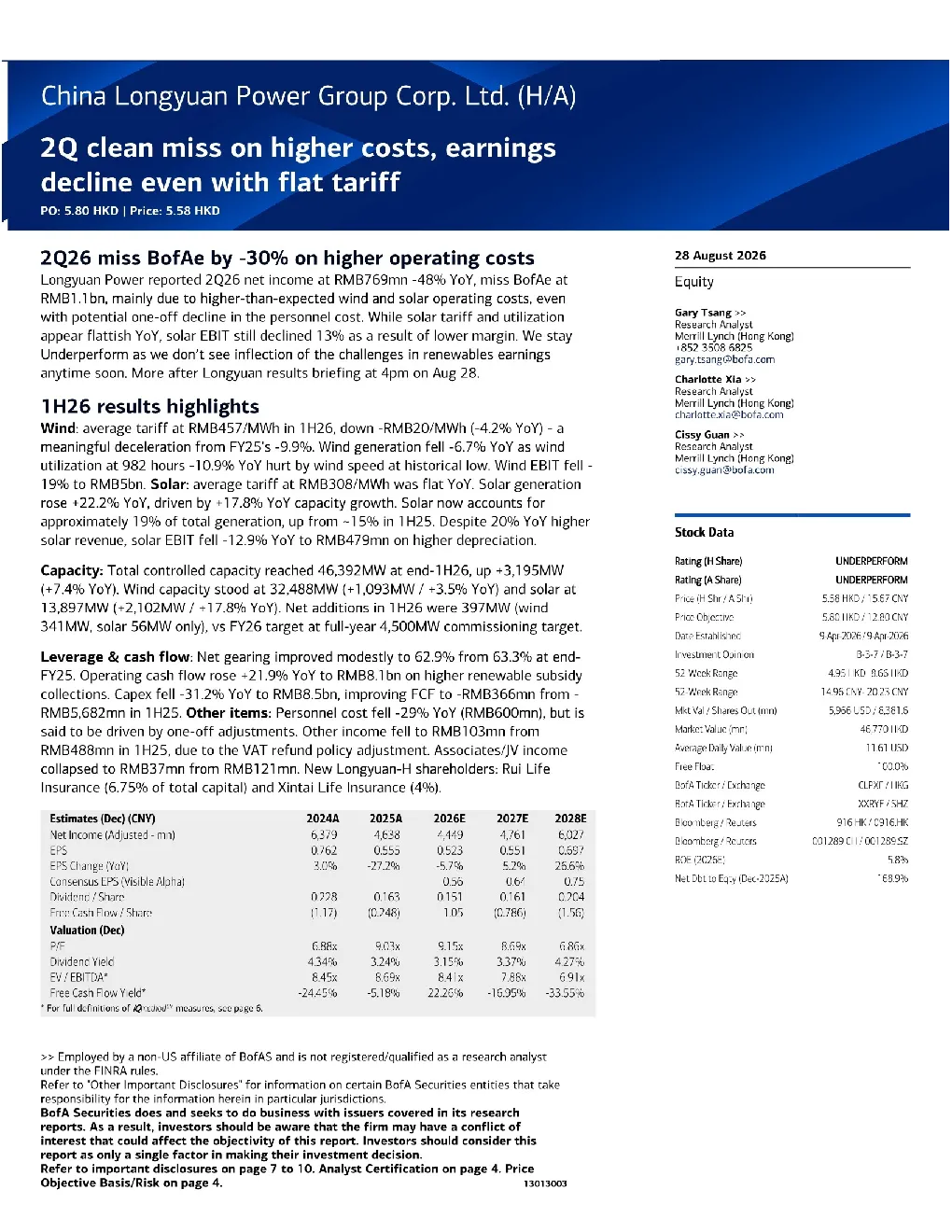
declineeven withflat tariffPO:5.80HKDIPrice:5.58HKD 2Q26 miss BofAe by -30% on higher operating costs RMB1.1bn, mainly due to higher-than-expected wind and solar operating costs, evenwith potential one-off decline in the personnel cost. While solar tariff and utilization Gary Tsang> appear flattish YoY, solar EBIT still declined 13% as a result of lower margin. We stayUnderperformas we don't see inflection of the challenges in renewables earningsanytime soon.More after Longyuan results briefing at 4pm on Aug 28.1H26resultshighlights Research AnalystMerrill Lynch (Hong Kong) +852 3508 6825gary.tsang@bofa.comCharlotte Xia >>Research AnalystMerill Lynch (Hong Kong) charlotte.xia@bofa.comCissy Guan >>Research AnalystMeril Lynch (Hong Kong) meaningful deceleration from FY25's -9.9%. Wind generation fell -6.7% YoY as wind utilization at 982 hours -10.9% YoY hurt by wind speed at historical low. Wind EBIT fell -19%toRMB5bn.Solar:average tariff at RMB308/MWhwasflatYoY.Solar generationrose +22.2% YoY, driven by +17.8% YoY capacity growth. Solar now accounts forapproximately 19% of total generation, up from ~15% in 1H25.Despite 20% YoYhighersolar revenue, solar EBIT fell -12.9% YoY to RMB479mn on higher depreciation.Capacity: Total controlled capacity reached 46,392MW at end-1H26,up +3,195MW cissy.guan@bofa.com Rating (H Share) (+7.4% YoY).Wind capacity stood at 32,488MW (+1,093MW /+3.5% YoY) and solar at13,897MW(+2,102MW /+17.8%YoY).Netadditions in1H26were397MW (wind341MW, solar 56MW only), vs FY26 target at full-year 4,500MW commissioning target.Leverage & cash flow: Net gearing improved modestly to 62.9% from 63.3% at end- FY25. Operating cash flow rose +21.9% YoY to RMB8.1bn on higher renewable subsidycollections. Capex fell -31.2% YoY to RMB8.5bn, improving FCF to -RMB366mn from -RMB5,682mn in 1H25.0ther items: Personnel cost fell-29% YoY (RMB600mn), but issaid to be driven by one-off adjustments. Other income fell to RMB103mn fromRMB488mn in 1H25, due to the VAT refund policyadjustment.Associates/JV incomecollapsed to RMB37mn from RMB121mn.New Longyuan-Hshareholders:Rui LifeInsurance (6.75% of total capital) and Xintai Life Insurance (4%).Estimates (Dec) (CNY)2024A2025A2026E2027E2028E >> Employed by a non-US affiliate of BofAS and is not registered/qualified as a research analystunder the FINRA rules.Refer to 'Other Important Disclosures'for information on certain BofA Securities entities that take responsibility for the information herein in particular jurisdictions.BofA Securities does and seeks to do business with issuers covered in its research reports. As a result, investors should be aware that the firm may have a conflict ofinterest that could affect the objectivity of this report. Investors should consider thisreport as only a single factor in making their investment decision. Refer to important disclosures on page 7 to 10. Analyst Certification on page 4. PriceObjectiveBasis/Riskonpage4.13013003 iQprofile" China Longyuan Power (Group Corp. Ltd. (H/A)Key Income Statement Data (Dec)2024A2025A2026E2027E2028E Alternative Energy Longyuan is the largest wind power generator in China with a total wind power installed capacity of 20,226 MW as of1H20. Its wind farms are mainly located in the threeNortheast provinces, Inner Mongolia, Xinjiang, Hebei, Gansuand the southeast coastal areas. We rate China Longyuan Underperform given 1) tariff drop risk under price competition in market power sales andmore grid parity low tarff project 2) potential scaling backunder tighter financing environment, 3) but Longyuanstands out among peers with lower share of subsidyreceivables, lower leverage ratio and A-share financingplatform. Longyuan 2Q26 result review InRMBmn1Q232Q233Q234Q23 BofA GLOBAL RESEARCH BofAGLOBALRESEARCH China Longyuan Power Group Corp.Ltd. (CLPXF) We determine our price objective of HKS5.8 by using 50/50 PBV vs ROE and DCF valuation. Our DCF based valuation is at HKS6.5 on 5.4% WACC (risk-free rate at 3.0%premium at 7.0%) and 2% terminal growth rate. Our PBV vs ROE valuation is HK$5.1,which is based on 6.0% ROE in 2027 and a target PBV of 0.5x. The government may increase the wind tariff subsidy unexpectedly, if the coal-fired power plant tariff increases significantly, which should benefit Chinese wind farmoperators. Resolving the grid interconnection bottleneck would increase the wind powercapacity and, therefore, be likely to raise its earnings. Wind turbine prices may decreasemore than expected, which would lower wind farm investment. Wind turbine price may increase by more than expected due to synchronized capacity add by wind farm developers. National Renewable Energy Fund may keep delayingsubsidy distribution due to lack of funding, and worsen wind farm developers cash flow.interconnections, companies may bid unprofitably low power tariff to win offshore windprojects, which would lead to losses for the project developers. Interest rates may behiked more than expecte