您的浏览器禁用了JavaScript(一种计算机语言,用以实现您与网页的交互),请解除该禁用,或者联系我们。 [德意志银行]:日本经济观察:AI热潮下的“静默工厂” - 发现报告

日本经济观察:AI热潮下的“静默工厂”

2026-08-19 - 德意志银行 GHK
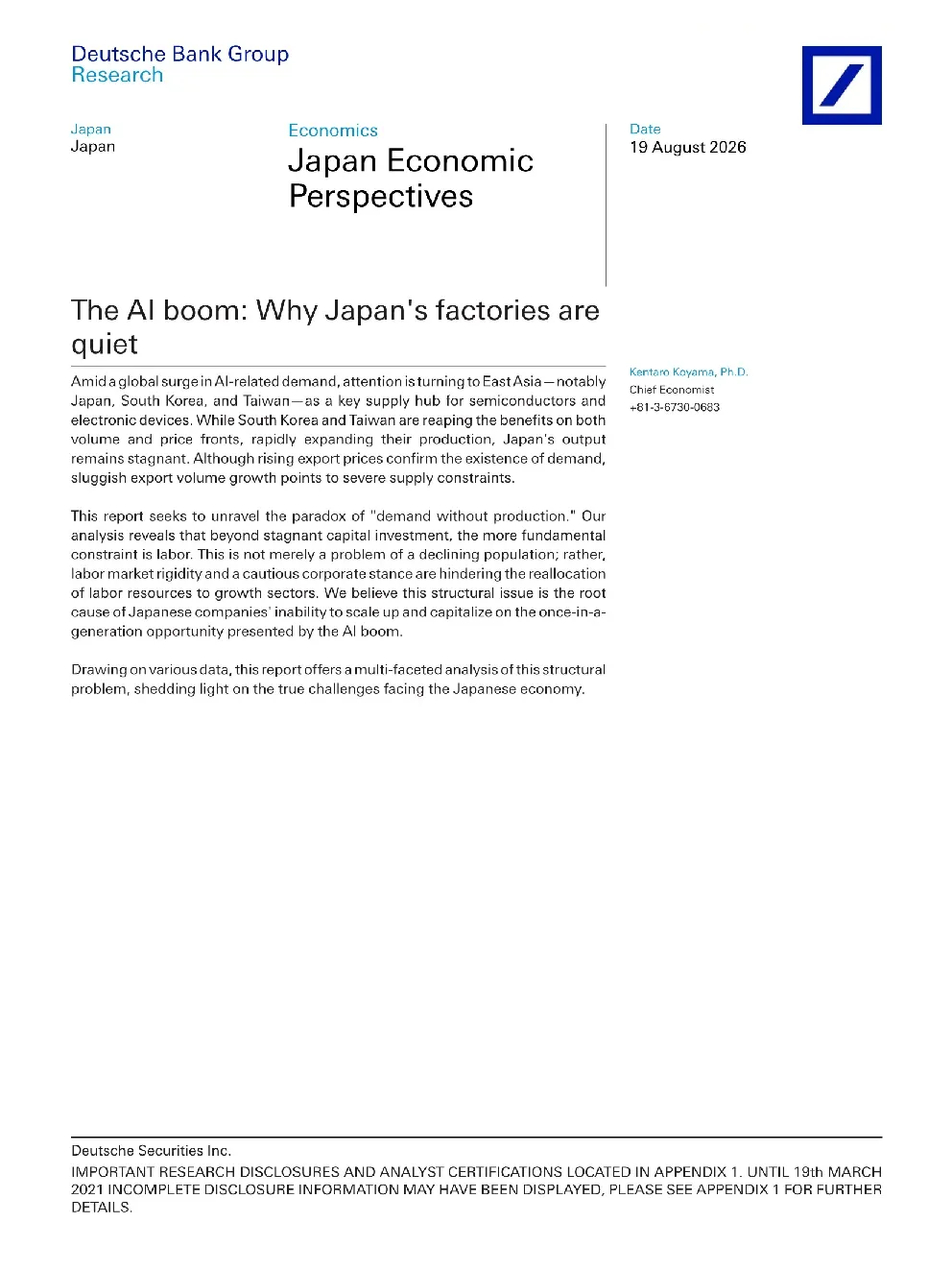
报告封面

Japan Japan Economic Perspectives The Al boom: Why Japan's factories arequiet Chief Economist+81-3-6730-0683 AmidaglobalsurgeinAl-relateddemand,attentionisturningtoEastAsia-notablyJapan,SouthKorea,andTaiwan-asakeysupplyhubforsemiconductorsandelectronicdevices.WhileSouthKoreaandTaiwanarereapingthebenefitsonbothvolume and price fronts,rapidly expanding their production,Japan's outputremains stagnant.Although rising export prices confirmthe existence of demand,sluggish export volumegrowth points to severe supply constraints. This report seeks to unravel the paradox of "demand without production." Ouranalysis reveals thatbeyond stagnant capital investment,the more fundamentalconstraint is labor.This is not merely a problem of a declining population; rather,labormarketrigidityandacautiouscorporatestancearehinderingthereallocationof labor resources to growth sectors.We believe this structural issue is the rootcause of Japanese companies'inabilityto scaleupandcapitalize on the once-in-a-generationopportunitypresentedbytheAlboom. Drawingonvariousdata,thisreportoffers amulti-facetedanalysisofthisstructuralproblem,shedding light on thetrue challenges facing the Japanese economy. Japan Economic Perspectives As Al-related investment accelerates globally,demandfor semiconductors and memoryessential fordata centers is soaring.Thishasplaced Japan,SouthKorea,and Taiwan,allwithstrengthsintheseareas,intheinvestorspotlightaskey supplyhubs. benefiting from the Al boom.Trade data since 2025 shows a marked increase inexportvolumesfromSouthKoreaandTaiwan,whileJapan'shaveremainedlargelyflat (Figure 1). During this period, all three have seen their export prices rise,indicating robust demand for their products (Figure 2). In the electroniccomponentsanddevicescategory,Japan'sexportpricegrowthhasevenoutpacedTaiwan's(Figure3).Evenforintegrated circuits (ICs),where Japan is saidtohaveacomparative advantage,export value has risen sharplywhile export volume hasstagnated (Figure 4). This disparityis also evident in production trends.Whileproduction of electroniccomponents and devices in South Korea and Taiwan has surged since 2024,Japan's outputremains below its 2021peak (Figure5). Theriseinpricesisevidencethat Japaneseproductsareessentialtoglobal supplychainsandpossesspricingpower.Thepossibilitythatthereisnodemandorthatthe JapanEconomicPerspectives production focus toward higher value-added products. The fact that Japan's realexports,based on value-added, continue to rise despite sluggish exportvolumessupportsthiscorporatestrategy (Figure6).In otherwords,Japanese exporters arelow-margin approach. Thequestionthisreportaddressesis:whyis Japan notincreasing itsproduction(and exportvolume)amid anunprecedented Al boom?As a result,while SouthKorea and Taiwanarebenefitingfrombothvolume and price,Japan's gains arelimitedtothepricefront.SouthKorea,inparticular,isoutperformingJapanintermsof both export prices and volumes. The answer to this question highlights the structural challenges facing theJapanese economy and has significant implications for the growth strategypromoted bytheTakachiadministration. 2.Thebottleneck of production constraints:Capital orlabor? A situation whereproduction fails to increasedespite rising demand suggests thepresence of supply constraints in either capital (production facilities)or labor,leadingtoa verticalsupplycurve. 2.1.Stagnant capital investmentanda cautiouscorporatestance capacityindexfortheelectroniccomponentsanddevicesindustryhasstalledsincethe 2008 global financial crisis and has even trended downward in recent years(Figure 7). In contrast, South Korea has consistently expanded its productioncapacity. While South Korea's aggressive capital investment has enabled it to ridethecurrentAlwaveandexpandproduction,Japan'spastunderinvestmentappearsTakachiadministration's emphasis on the importance of investment. Japan Economic Perspectives Thiscautiousstancetowardinvestmentisalsorootedinbitterpastexperiences.Webelieve that in Japan's semiconductor industry, in particular,the memory of large-scale investments inthe2000sleadingtohugelosses and excess capacityduetosubsequent market downturns and price collapses remains deeply ingrained inmanagement.Coupledwithuncertaintyaboutthesustainabilityoffuturedemand,this serves as a factor discouraging large-scale investments to boost production.This is likely one reasonforthe persistent adherence to a low-volume,high-marginstrategy. 2.2.Therealbottleneck:LaborHowever, capital is not the entire problem. Even if production capacity were the main constraint, it would be natural to respond by maximizing the utilization ofexisting facilities. Yet, while the capacity utilization rate for the electroniccomponentsanddevicesindustryhasbeenrisingsince2025,itremainsbelowitspast peaks (Figure 8). This paradox of "having facilities but being unable to runthem" suggests a more severe bottleneck:a shortage of labor to operate theequipment. JapanEconomicPerspectives