您的浏览器禁用了JavaScript(一种计算机语言,用以实现您与网页的交互),请解除该禁用,或者联系我们。 [安徽建筑大学]:基于碳储量变化的长三角地区土地利用碳源汇效应识别及驱动因素分析 - 发现报告

基于碳储量变化的长三角地区土地利用碳源汇效应识别及驱动因素分析

基础化工 2027-06-01 安徽建筑大学 申明华
报告封面

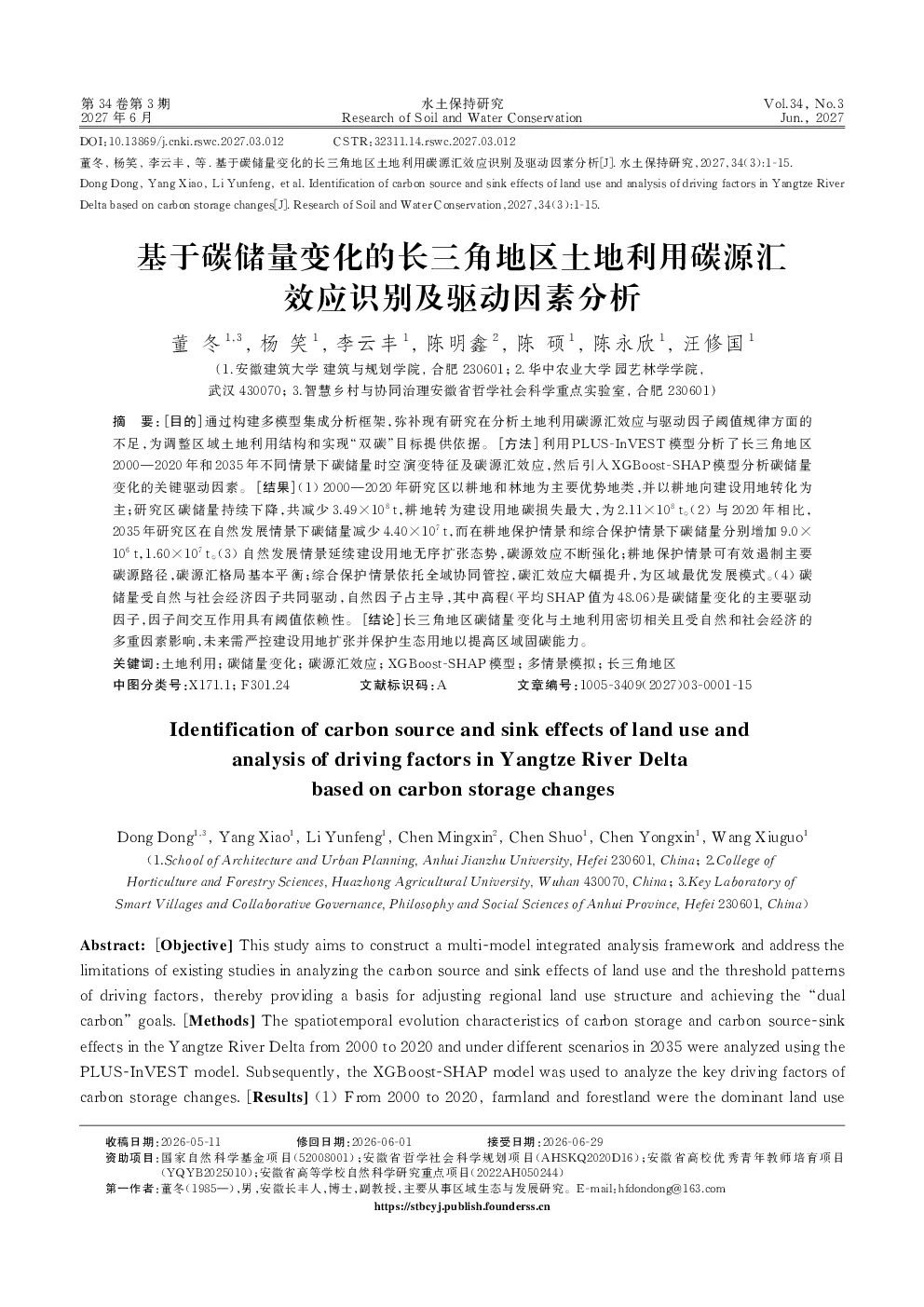
董 冬1,3,杨 笑1,李云丰1,陈明鑫2,陈 硕1,陈永欣1,汪修国1(1.安徽建筑大学建筑与规划学院,合肥230601;2.华中农业大学园艺林学学院,武汉430070;3.智慧乡村与协同治理安徽省哲学社会科学重点实验室,合肥230601) 摘要:[目的]通过构建多模型集成分析框架,弥补现有研究在分析土地利用碳源汇效应与驱动因子阈值规律方面的不 足,为 调 整 区 域 土 地 利 用 结 构 和 实 现“双 碳”目 标 提 供 依 据。[方 法]利 用PLUS-InVEST模 型 分 析 了 长 三 角 地 区2000—2020年 和2035年 不 同 情 景 下 碳 储 量 时 空 演 变 特 征 及 碳 源 汇 效 应,然 后 引 入XGBoost-SHAP模 型 分 析 碳 储 量变化的关键驱动因素。[结果](1)2000—2020年研究区以耕地和林地为主要优势地类,并以耕地向建设用地转化为主;研 究 区 碳 储 量 持 续 下 降,共 减 少3.49×10⁸t,耕 地 转 为 建 设 用 地 碳 损 失 最 大,为2.11×10⁸t。(2)与2020年 相 比,2035年研究区在自然发展情景下碳储量减少4.40×10⁷t,而在耕地保护情景和综合保护情景下碳储量分别增加9.0×10⁶t,1.60×107t。(3)自 然 发 展 情 景 延 续 建 设 用 地 无 序 扩 张 态 势,碳 源 效 应 不 断 强 化;耕 地 保 护 情 景 可 有 效 遏 制 主 要碳源路径,碳源汇格局基本平衡;综合保护情景依托全域协同管控,碳汇效应大幅提升,为区域最优发展模式。(4)碳储量受自然与社会经济因子共同驱动,自然因子占主导,其中高程(平均SHAP值为48.06)是碳储量变化的主要驱动因子,因子间交互作用具有阈值依赖性。[结论]长三角地区碳储量变化与土地利用密切相关且受自然和社会经济的多重因素影响,未来需严控建设用地扩张并保护生态用地以提高区域固碳能力。 关键词:土地利用;碳储量变化;碳源汇效应;XGBoost-SHAP模型;多情景模拟;长三角地区 文章编号:1005-3409(2027)03-0001-15 文献标识码:A Identification of carbon source and sink effects of land use andanalysis of driving factors in Yangtze River Deltabased on carbon storage changes Dong Dong1,3,Yang Xiao1,Li Yunfeng1,Chen Mingxin2,Chen Shuo1,Chen Yongxin1,Wang Xiuguo1(1.School of Architecture and Urban Planning,Anhui Jianzhu University,Hefei230601,China;2.College ofHorticulture and Forestry Sciences,Huazhong Agricultural University,Wuhan430070,China;3.Key Laboratory ofSmart Villages and Collaborative Governance,Philosophy and Social Sciences of Anhui Province,Hefei230601,China) Abstract:[Objective]This study aims to construct a multi-model integrated analysis framework and address thelimitations of existing studies in analyzing the carbon source and sink effects of land use and the threshold patternsof driving factors,thereby providing a basis for adjusting regional land use structure and achieving the“dualcarbon”goals.[Methods]The spatiotemporal evolution characteristics of carbon storage and carbon source-sinkeffects in the Yangtze River Delta from2000to2020and under different scenarios in2035were analyzed using thePLUS-InVEST model.Subsequently,the XGBoost-SHAP model was used to analyze the key driving factors ofcarbon storage changes.[Results](1)From2000to2020,farmland and forestland were the dominant land use types in the study area,with farmlandprimarily converted into construction land.Carbon storage in the study areacontinuously declined,decreasing by a total of3.49×108 t,with the carbon loss caused by the conversion offarmland to construction land being the largest,at2.11×108t.(2)Under the natural development scenario,thecarbon storage in the study area in2035 decreased by 4.40×10⁷ t compared with 2020.Under the croplandprotection scenario and the comprehensive protection scenario,carbon storage increased by9.0×106t and1.60×107 t.(3)The natural development scenario continued the disorderly expansion of construction land,and thecarbon source effect was continuously strengthened.The cropland protection scenario effectively curbed the maincarbon source pathways,and the carbon source and sink pattern was basically balanced.The comprehensiveprotection scenario relied on coordinated management across the entire area and significantly enhanced the carbonsink effect,making it the optimal development model for the region.(4)Carbon storage was driven by bothnatural and anthropogenic factors,with natural factors playing a dominant role.Among them,elevation(averageSHAP value of48.06)was the primary driving factor of carbon storage changes,and the interactions betweenfactors exhibited threshold dependence.[Conclusion]The carbon storage changes associated with land use areaffected by multiple natural and socioeconomic factors in the Yangtze River Delta.In the future,strict control ofconstruction land expansion and protection of ecological land should be implemented to improve the regionalcarbon sequestration capacity. Keywords:land use;carbon storage changes;carbon source and sink effects;XGBoost-SHAP model;multi-scenario simulation;YangtzeRiver Delta 一 生 态 系 统 类 型 难 以 全 面 系 统 地 刻 画 区 域 碳 循 环 过程。在研究方法层面,已有学者通过将InVEST模型与 土 地 利 用 变 化 预 测 模 型 相 结 合,分 析 了 各 情 景 下不同地类变化对碳储量的影响,如熊国来等[13]研究表明PLUS模 型 与InVEST模 型 相 结 合 具 有 良 好 的 互补 性 和 模 拟 能 力,是 开 展 土 地 利 用 变 化 及 碳 储 量 预测 研 究 的 有 效 方 法 并 已 得 到 广 泛 应 用。在 驱 动 机 制识 别 方 面,地 理 探 测 器 等 传 统 方 法 难 以 深 入 解 析 因子 间 复 杂 的 非 线 性 响 应 及 交 互 作 用,而 已 有 研 究 表明[14],NDVI、高程及坡度等自然环境因素与GDP、人口 密 度 等 社 会 经 济 因 素 均 与 碳 储 量 呈 显 著 非 线 性 关系。随着机器学习技术的发展,XGBoost等算法在高维 非 线 性 数 据 的 处 理 中 优 势 显 著,结 合SHAP值 解释 框 架,显 著 增 强 预 测 准 确 性 的 同 时 又 可 定 量 评 估关 键 驱 动 因 子 的 作 用 贡 献,能 够 更 全 面 地 理 解 自 然环境和社会经济因素对碳储量的综合影响。 陆 地 生 态 系 统 碳 循 环 在 调 节 全 球 气 候 中 扮 演 关键角色,其通过植被光合作用与土壤碳储存过程形成的“碳汇”效应,可有效缓解大气CO2浓度上升趋势[1]。然而,工业化进程加速导致的土地利用变化和城市扩张等人类活动,是导致陆地生态系统碳循环失衡进而导 致 温 室 气 体 浓 度 增 加 的 主 要 原 因[2]。与 此 同 时,土地 利 用 与 气 候 变 化 的 相 互 作 用 可 能 引 发 生 态 系 统 碳平 衡 的 非 线 性 突 变[3]。作 为 全 球 碳 排 放 重 点 国 家 之一,中 国 提 出 并 推 进“双 碳”战 略 目 标,同 步 开 展 新 一轮环境治理体系构建与国土空间规划优化工作[4]。在此背景下,深入探究基于碳储量变化的土地利用碳源汇效应将对促进区域“双碳”目标实现具有重要意义。 碳 源 汇 效 应 反 映 了 生 态 系 统 对 大 气 二 氧 化 碳 吸收 与