减少加纳的森林砍伐:选定土地利用变化的成本效益分析
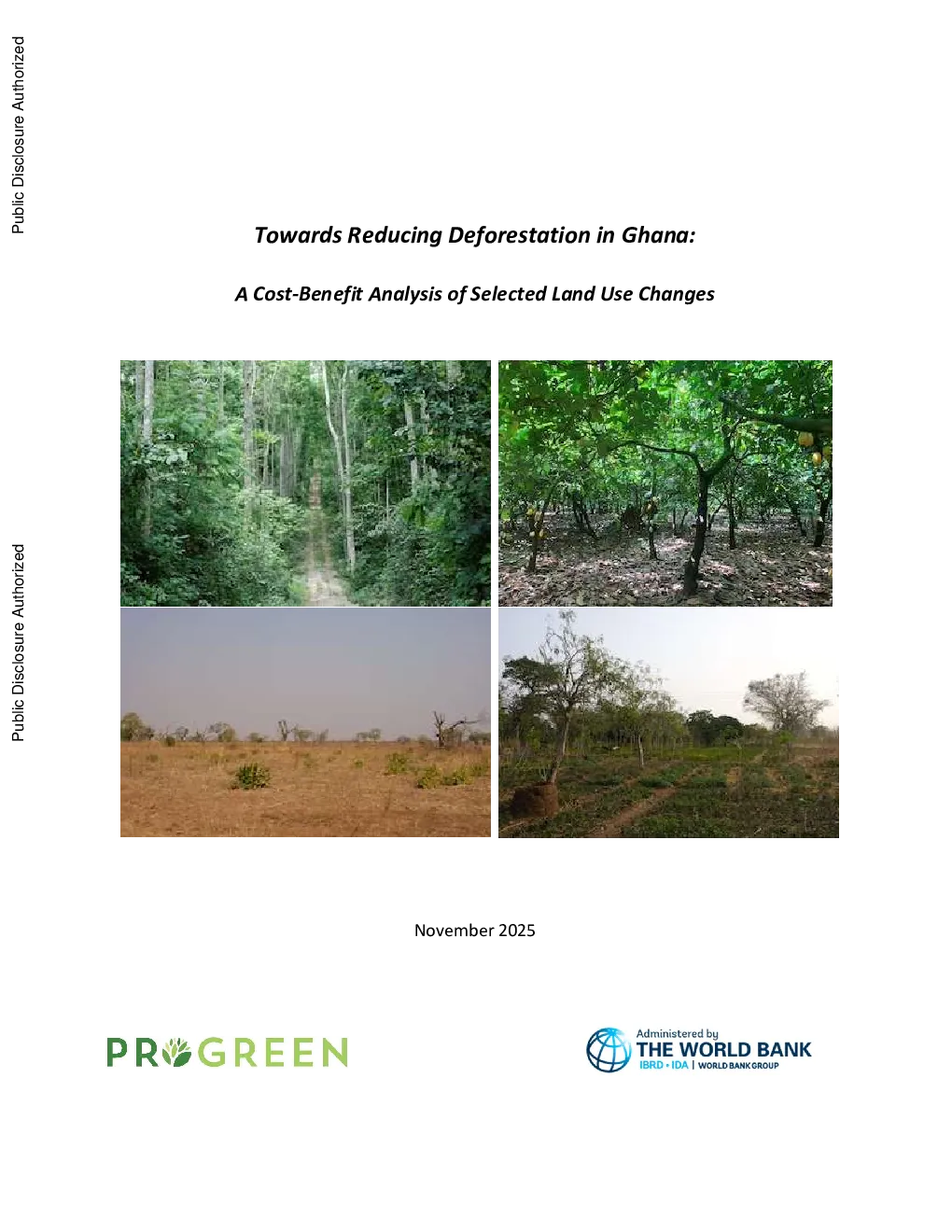
A Cost-Benefit Analysis of Selected Land Use Changes © [2025] The World Bank1818 H Street NW, Washington DC 20433 Telephone: 202-473-1000; Internet:www.worldbank.org Some rights reserved. This work is a product of The World Bank with external contributions. The findings, interpretations, and conclusionsexpressed in this work do not necessarily reflect the views of the Executive Directors of The World Bank or the The World Bank does not guarantee the accuracy, completeness, or currency of the data included in this work and doesnot assume responsibility for any errors, omissions, or discrepancies in the information, or liability with respect to the useof or failure to use the information, methods, processes, or conclusions set forth. The boundaries, colors, denominations,links/footnotes and other information shown in this work do not imply any judgment on the part of The World Bank Nothing herein shall constitute or be construed or considered to be a limitation upon or waiver of the privileges andimmunities of The World Bank, all of which are specifically reserved. Rights and Permissions The material in this work is subject to copyright. Because The World Bank encourages dissemination of its knowledge, thiswork may be reproduced, in whole or in part, for noncommercial purposes as long as full attribution to this work is given. Attribution—Please cite the work as follows: “World Bank. [2025]. Towards Reducing Deforestation in Ghana: A Cost-Benefit Analysis of Selected Land Use Changes. © World Bank.” Any queries on rights and licenses, including subsidiary rights, should be addressed to World Bank Publications, TheWorld Bank, 1818 H Street NW, Washington, DC 20433, USA; fax: 202-522-2625; e-mail:pubrights@worldbank.org. Cover photo: © Lesya Verheijen / World Bank. Further permission required for reuse. Table of Contents ACKNOWLEDGEMENTSACRONYMS AND ABBREVIATIONSEXECUTIVE SUMMARY1.INTRODUCTION2.SCOPE3.METHODOLOGY4.ESTIMATED IMPACTS OF DEFORESTATION5.RESULTS OF THE COST-BENEFIT ANALYSIS5.1.PRA BASIN5.2.V 6.CONCLUSIONS Acknowledgements Thisreport was prepared by a team led by Olamide Bisi-Amosun(Natural ResourcesManagement Specialist) and composed of Lelia Croitoru (Senior Environmental Economist), AlexEssilfie (Hydrologist), Emmanuel Obuobie (Senior Hydrologist), and Lesya Verheijen (Senior The report was produced under the overall guidance of Robert R. Taliercio (Division Director,Ghana) and Ellysar Baroudy (Practice Manager, SAWEO). The team would like to acknowledge the kind cooperation of Isaac Acquah (EnvironmentalProtectionAuthority)and constructive feedback provided by Stefano Pagiola(Senior The team would also like to acknowledge the generous support provided by the PROGREEN Trust Acronyms and Abbreviations CBACost-Benefit AnalysisGDPGross Domestic Producthahectarem3cubic meter Executive Summary Ghana’s forests cover about 31 percent of the country’s area. They sustain the livelihoods of 2.5 millionpeople and meet the energy needs of 54 percent of the national population. In addition, they provideimportant ecosystem services for the entire country, such as sediment control, and for the globalcommunity, such as carbon sequestration and biodiversity. Despite their importance, many of theseforests are being lost due to conversion to other land uses. The impacts are alarming: the cost of Aware of forests’ importance to the national economy, the Government of Ghana made impressive effortsto reduce deforestation and improve forest management.To support these efforts, this study estimatesthe financial and economic profitability of selected land use changes and to provide recommendationsfor conserving the most valuable forest areas. Specifically, it values in monetary terms the net benefitsfrom selected land use changes for the farmer (financial analysis) and for the nation (economic analysis). Scope and method The study focuses on the country’s two main hydrological basins, Pra and Volta. In the Pra basin, theexpansion of monoculture-based (mono) cocoa has contributed significantly to forest loss, biodiversitydecline, and water resource depletion. In the Volta basin, agricultural expansion (such as, maize), charcoalproduction, and urbanization have been the main deforestation causes. Thus, the study focuses on theconversion of closed forests to mono cocoa in the Pra basin, and to maize in the Volta basin. It is important The valuation relies on theCost-Benefit Analysis (CBA) method to estimate the net benefits from theselected land use changes from the farmer and national perspectives. The CBA is conducted for a periodof 30 years, to account for the long-term benefits provided by forests and cocoa and the long-term Key findings The results show that: -Conversion of closed forests to mono-cocoa in the Pra basin and to maize in the Volta basin isfinancially attractive for farmers, who earn net benefits estimated at US$1,300/ha in Pra andUS$1,200 in Volta, in net present value terms (