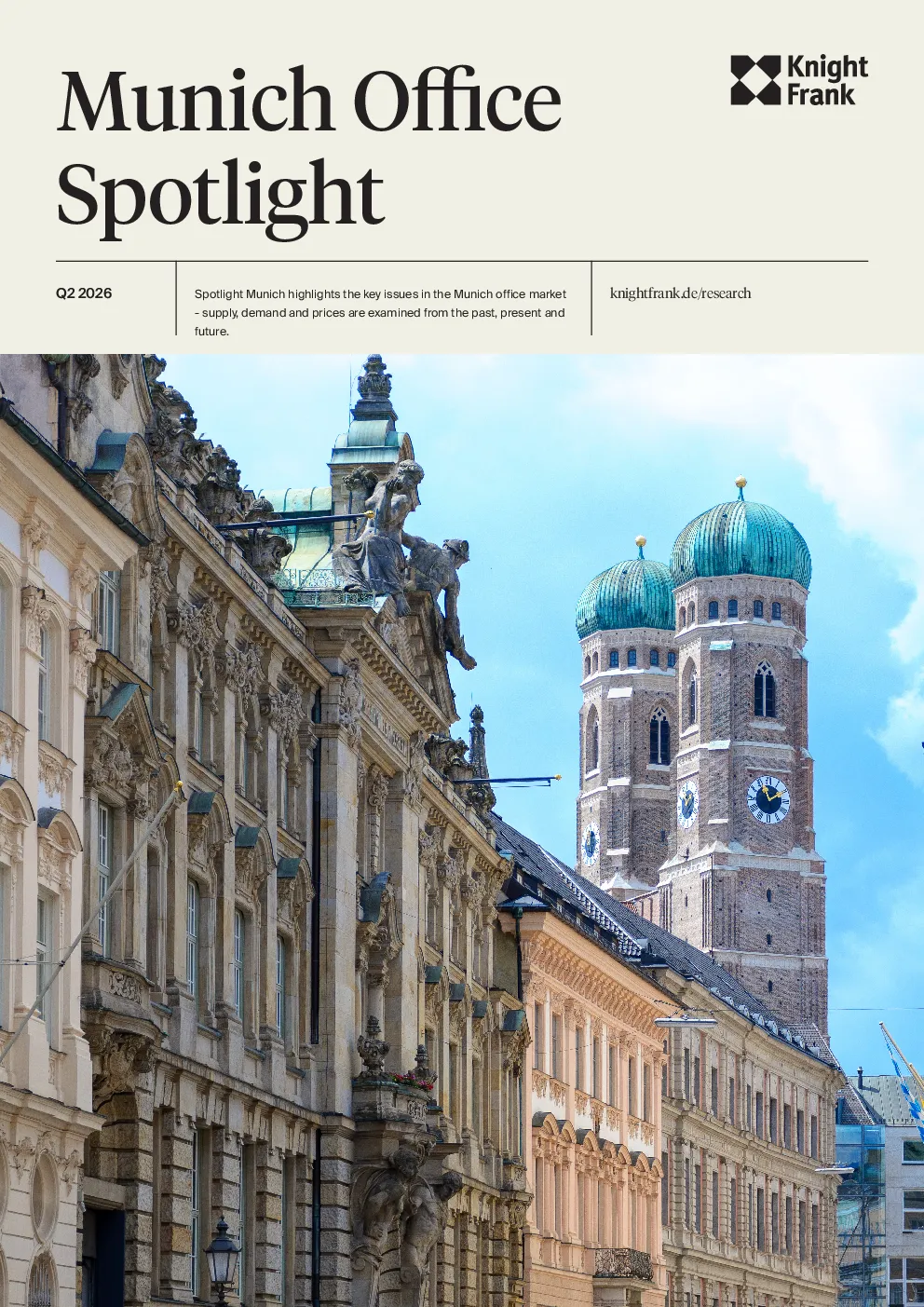
Q2 2026 knightfrank.de/research Spotlight Munich highlights the key issues in the Munich office market- supply, demand and prices are examined from the past, present andfuture. Overview leasing market Munich’s office leasing market gained further momentum in the second quarter of 2026, buildingon the solid start to the year. Take-up reached approximately 170,400 sqm in Q2, bringing totaltake-up in the first half of the year to 327,000 sqm, significantly above the previous year’s level(256,000 sqm). The result was supported by both several large-scale transactions and stabledemand within the mid-sized segment of up to 3,000 sqm, which accounted for around 47% ofall lease deals. 327,000 Take-up in sqm (H1) The largest transactions in H1 2026 included: 8.1 •29,500 sqm occupied by Apple (owner-occupier) on Seidlstraße•23,000 sqm leased by JetBrains in Tucherpark•21,500 sqm leased by E.ON SE at An den Brücken•10,000 sqm leased by NXP Semiconductors at AER•7,400 sqm leased by Bavarian Nordic at the Life Science Center Vacancy rate in %58.00 Technologyand industry-related occupiers once again proved particularly active,furtherreinforcing Munich’s position as one of Germany’s most dynamic office markets. Prime rent in €/sqm/month Demand remains clearly focused on central and well-connected locations. Modern, ESG-compliant office space with high specification standards continues to attract the greatest interest,while older stock in peripheral areas faces increasing pressure. This growing differentiation byquality has a stronger influence on market dynamics than a traditional cyclical recovery. 172,000 Completions in sqm (H1) 697,800 Rental growth also confirms the ongoing flight-to-quality trend. Prime rents reached €58.00/sqm/month at mid-year, while average rents remained stable at €28.00/sqm/month. In certainpremium locations and for high-quality office space, higher rental levels are already beingachieved, indicating further upside potential in the prime segment. Under construction in sqm Overall, Munich’s office leasing market presents a stable to positive picture at mid-year. Demandremains selective but is clearly focused on quality, location and future-proof assets. As a result,market performance in the coming quarters is likely to be determined less by the overall volumeof available space and more by the marketability of the space on offer. OUTLOOK Munich’s office leasing market is expected to maintain a stableto slightly positive trajectory during the second half of 2026.Occupier activity is likely to remain driven by technology, industrialandknowledge-based companies,while demand continuesto focus on modern, ESG-compliant office space in centrallocations. Against the backdrop of several active large-scalerequirements, an annual take-up volume of around 600,000 sqmappears achievable. At the same time, the increasing divergence between high-quality premium space and older stock is expected to becomeeven more pronounced. While the overall vacancy rate is likelyto remain stable at an elevated level, the limited supply in primelocations and continued strong demand for high-quality officespace support the prospect of further rental growth. Prime rentsare therefore expected to exceed €60.00/sqm/month during thecourse of the year and continue their upward trajectory. Investment Market Overview Munich’s investment market records a transaction volume of approximately €1.11 billion in thefirst half of 2026, representing an increase of around 23% year-on-year (H1 2025: €900 million).Compared to other German gateway cities, Munich remains one of the stronger markets in termsof transaction volume, although market activity continues to be driven primarily by a limited numberof larger transactions. Market activity remains concentrated on a small number of large-scaledeals. Key transactions include the sale of the Alte Akademie as well as further core transactionsin prime city-centre locations. Despite the still-challenging financing environment, buyer andseller expectations are gradually converging, supporting transaction activity compared withprevious years. Nevertheless, the market remains selective, with investment decisions continuingto be strongly influenced by asset quality, location and income security. With approximately €678million, representing nearly 61% of total transaction volume, office properties remain the dominantasset class. Investor demand is primarily focused on high-quality core and core-plus assets inestablished locations offering stable long-term rental income and modern building specifications.In addition, logistics, hotel and mixed-use assets are increasing their share of investment activity,while demand for secondary properties and less established locations remains subdued. Pricing remains broadly stable overall. While geopolitical uncertainty and changing financingconditionscontinue to influence market sentiment,significant price corrections have notmaterialised. The pr