慕尼黑办公室焦点2025年第四季度
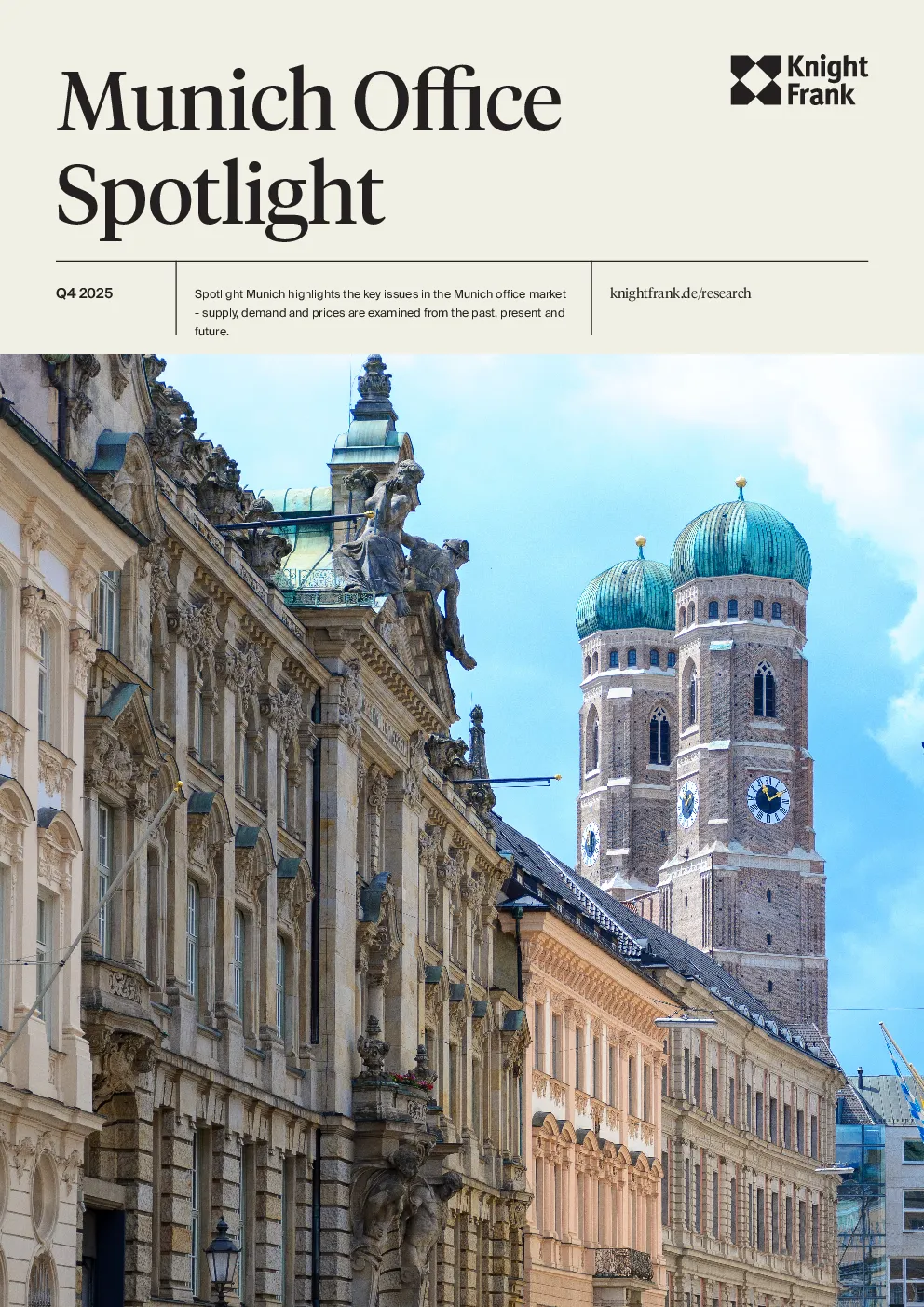
Q4 2025 knightfrank.de/research Spotlight Munich highlights the key issues in the Munich office market- supply, demand and prices are examined from the past, present andfuture. Overview leasing market The Munich office market regained momentum in the fourth quarter of 2025, recordingtake-up of approximately 170,000 sqm, the strongest quarterly result of the year. Totalannual take-up reached around 576,000 sqm, representing a decline of approximately 5%compared with the previous year and standing about 6% below the five-year average.In a comparison of Germany’s seven largest office markets, Munich ranked second behindFrankfurt. Despite the year-on-year decrease, occupier demand proved resilient and broadlybased across all size brackets. 576,000 Take-up [sqm] (Q1-Q4 2025) 8.0 Annual take-up was underpinned by several sizeable transactions, including: Vacancy rate [%] 33,000 sqm leased by Siemens AG at “PANDION OFFICEHOME Beat”12,400 sqm leased by Penguin Random House at “SUN”12,300 sqm leased by Schaeffler at “Tomorrow” 55.00 Tenant activity over the course of the year was predominantly concentrated in centrallocations. CBD West emerged as the most active submarket, accounting for approximately18% of total take-up, followed closely by CBD East with just under 17%. The old townsubmarket ranked third, capturing around 8% of overall demand. Ongoing preference forwell-connected, centrally located space continues to underpin rental levels across theinner-city markets. Prime rent [€/sqm/month] 187,000 Completions [sqm] (Q1-Q4 2025) The vacancy rate in Munich edged down marginally to 8.0% at year-end, equivalent toapproximately 1.85 million sqm of vacant space. This suggests that the prolonged phase ofvacancy expansion is beginning to stabilise, with the market likely having reached its cyclicalpeak. Demand for modern, high-quality office accommodation remains firm, supportinga stable prime rent of €55.00 per sqm per month. The average rent increased slightly to€28.30 per sqm per month. 585,000 Under construction [sqm] OUTLOOK Followinga strong year-end and a broad-based recovery inleasing activity, the outlook for the Munich office market in 2026is cautiously optimistic. The robust fourth-quarter performanceand Munich’s continued strength in the national context highlightthe market’s solid fundamentals. Central locations are expectedtoremain the primary focus of occupier demand,althoughleasing activity is also showing signs of extending into non-coresubmarkets. On the supply side, early indicators point towards a moderationin vacancy growth. The recent stabilisation in the vacancy ratesuggests a gradual easing of market pressures. At the same time,competitionfor modern,well-specified office space remainsintense, which is expected to support prime rents and may allowfor selective rental growth. Overall, the Munich office market entersthe new year with resilient occupier demand, stabilising supplydynamics and supportive underlying conditions. Overview investment market The Munich investment market benefited from an exceptionally strong year-end in 2025.Transaction volume in the fourth quarter alone totalled approximately €1.12bn, accounting foraround 44% of the annual volume. Overall, investment turnover for 2025 reached approximately€2.54bn, representing an increase of around 2% year-on-year, while remaining slightly belowthe five-year average. The pronounced uplift in activity during the final quarter was primarily driven by several largesingle-asset transactions. Market activity was significantly shaped by the sale of the formerSigna assets “Oberpollinger” and “Corbinian” in Munich’s city centre, both of which weretransacted at three-digit million euro price levels and made a substantial contribution to thestrong year-end performance. These exceptional transactions injected additional momentuminto the investment market towards the end of the year and offset the comparatively subduedtransaction activity seen earlier in 2025. At the same time, the market is showing increasingalignment between buyers and sellers for high-quality core and premium assets. Office properties remained the dominant asset class over the full year 2025, accounting forapproximately 42% of total transaction volume. Compared with the third quarter, however, theoffice share declined slightly and continues to sit below historic market levels. The retail sectorranked as the second-largest asset class with a share of around 33%, driven in particular by thedisposals of “Sporthaus Schuster”, “Hirmer flagship store” and “Oberpollinger” in the secondhalf of the year. The hotel sector accounted for approximately 11% of total volume and remainedstable. Light industrial and logistics assets played a more marginal role, contributing around4%. Overall, investment activity was broadly diversified across multiple asset classes.Investor caution remains evident amid the current financing environment and continues toinfluence price disco