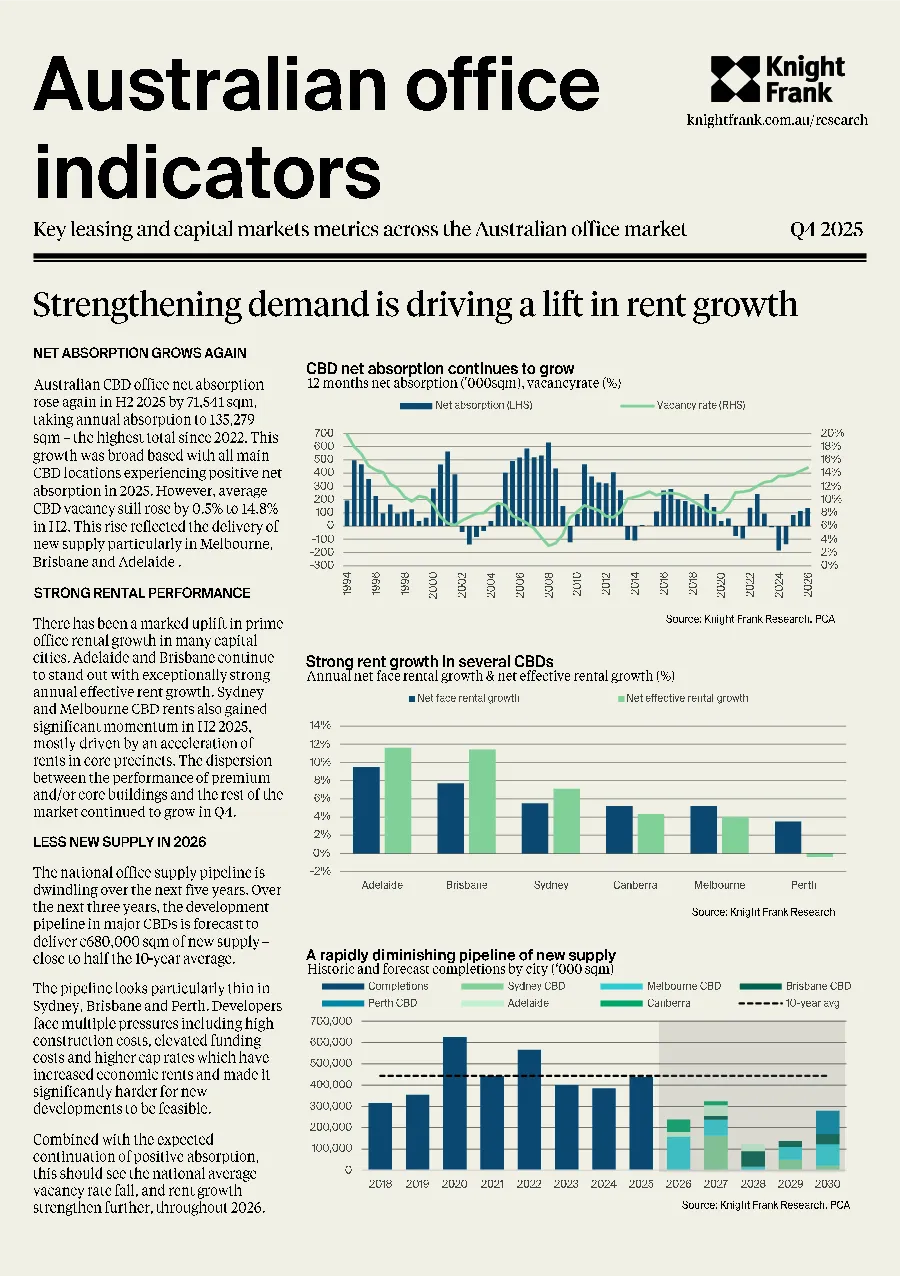
Key leasing and capital markets metrics across the Australian office market Strengthening demand is driving a lift in rent growth NET ABSORPTION GROWS AGAIN Australian CBD office net absorptionrose again in H2 2025 by 71,541 sqm,taking annual absorption to 135,279sqm–the highest total since 2022. Thisgrowth was broad based with all mainCBD locations experiencing positive netabsorption in 2025. However, averageCBD vacancy still rose by 0.5% to 14.8%in H2. This rise reflected the delivery ofnew supply particularly in Melbourne,Brisbane and Adelaide . STRONG RENTAL PERFORMANCE There has been a marked uplift in primeoffice rental growth in many capitalcities. Adelaide and Brisbane continueto stand out with exceptionally strongannual effective rent growth. Sydneyand Melbourne CBD rents also gainedsignificant momentum in H2 2025,mostly driven by an acceleration ofrents in core precincts. The dispersionbetween the performance of premiumand/or core buildings and the rest of themarket continued to grow in Q4. LESS NEW SUPPLY IN 2026 The national office supply pipeline isdwindling over the next five years. Overthe next three years, the developmentpipeline in major CBDs is forecast todeliver c680,000 sqm of new supply–close to half the 10-year average. The pipeline looks particularly thin inSydney, Brisbane and Perth. Developersface multiple pressures including highconstruction costs, elevated fundingcosts and higher cap rates which haveincreased economic rents and made itsignificantly harder for newdevelopments to be feasible. Combined with the expectedcontinuation of positive absorption,this should see the national averagevacancy rate fall, and rent growthstrengthen further, throughout 2026. Key data points Sales volumes rise Transaction activity lifts in Q4 and Sydney CBD core yields tighten further •CBD office investment activity rose to $2.4 billion of closed transactions in Q4 2025. Activity was driven by Sydney, with the saleof both a 25% stake in Grosvenor Place to CSC for $430 million and a 50% stake to GPT for $860 million–a combined sale value of$1.3 billion.Several significant sales also occurred in Melbourne includingTrustCapitalselling 750 Collins St to GPT for $383million, and PAG selling Flinders Gate for $254.5 million to Dexus. In Brisbane,Aravestbought a 50% stake in Central Plaza Onefor $222.5 million from ISPT. It is estimated that around $0.5 billion of Q4 transactions remain under contract. •CBD office transaction volumes totalled $5.4 billion in 2025, below the $7.1 billion recorded in 2024. However, increasing investorconfidence that asset valuations have stabilised will likely foster greater confidence and drive a continued pick-up in dealmomentum across all cities in 2026. •In precincts leading the rebound, including the Sydney CBD Core, rising confidence in the market outlook has reduced thenumber of high-quality assets being listed. Owners are beginning to see early signs of capital growth and are therefore holdingoffsales until valuations recover from their cyclical lows. Investors seeking to deploy capital may need to look beyond the core. •Average prime yields tightened slightly further in the Sydney CBD core in Q4by 5 bps while other precincts remained steady,highlighting the underlying strength for best-in-class CBD assets.Average prime yields were largely unchanged across all otherCBD locations in Q4 2025, confirming that core asset values have stabilised in these markets with the next move likely to beup. Positive absorption continues Demand strongest for high quality CBD assets and core locations •In H2 2025 there was positive net absorption of 71,541 sqm across the Australian CBD markets, which took yearly absorption forthe past 12 months to 135,279 sqm–the strongest since H1 2022. The sustained recovery in net absorption signifies growingdemand for office space and the improved sentiment throughout most CBD markets. •All capital cities recorded positive absorption over the last 12 months, driven by a slowing supply pipeline and increased tenantdemand. Tenants seeking high-end contiguous space are increasingly aware of the looming shortage of new stock. This is bringingforward tenant demand as they look to secure new space well-ahead of their current lease expiry. •The ‘best and the rest’ thematic continues to prevail, with a focus on high quality, well-located premises that have the bestamenity for employees, if not on the doorstep, then immediately adjacent in the precinct. •Demand for newly built product remains high nationally as occupiers are still focused on delivering new workplaces which willencourage high productivity, collaboration, employee wellbeing and are well-credentialled with high ESG ratings. •The clear divergence in performance by location also persists, particularly in Sydney and Melbourne where the core CBD precinctshave been outperforming for some time. However, positive absorption has now spread to neighbouring markets includingSydney’