您的浏览器禁用了JavaScript(一种计算机语言,用以实现您与网页的交互),请解除该禁用,或者联系我们。 [亚洲开发银行]:亚洲开发银行2026年7月亚洲展望报告:能源市场动荡下的脆弱前景 - 发现报告

亚洲开发银行2026年7月亚洲展望报告:能源市场动荡下的脆弱前景

2026-07-08 亚洲开发银行 一抹朝阳
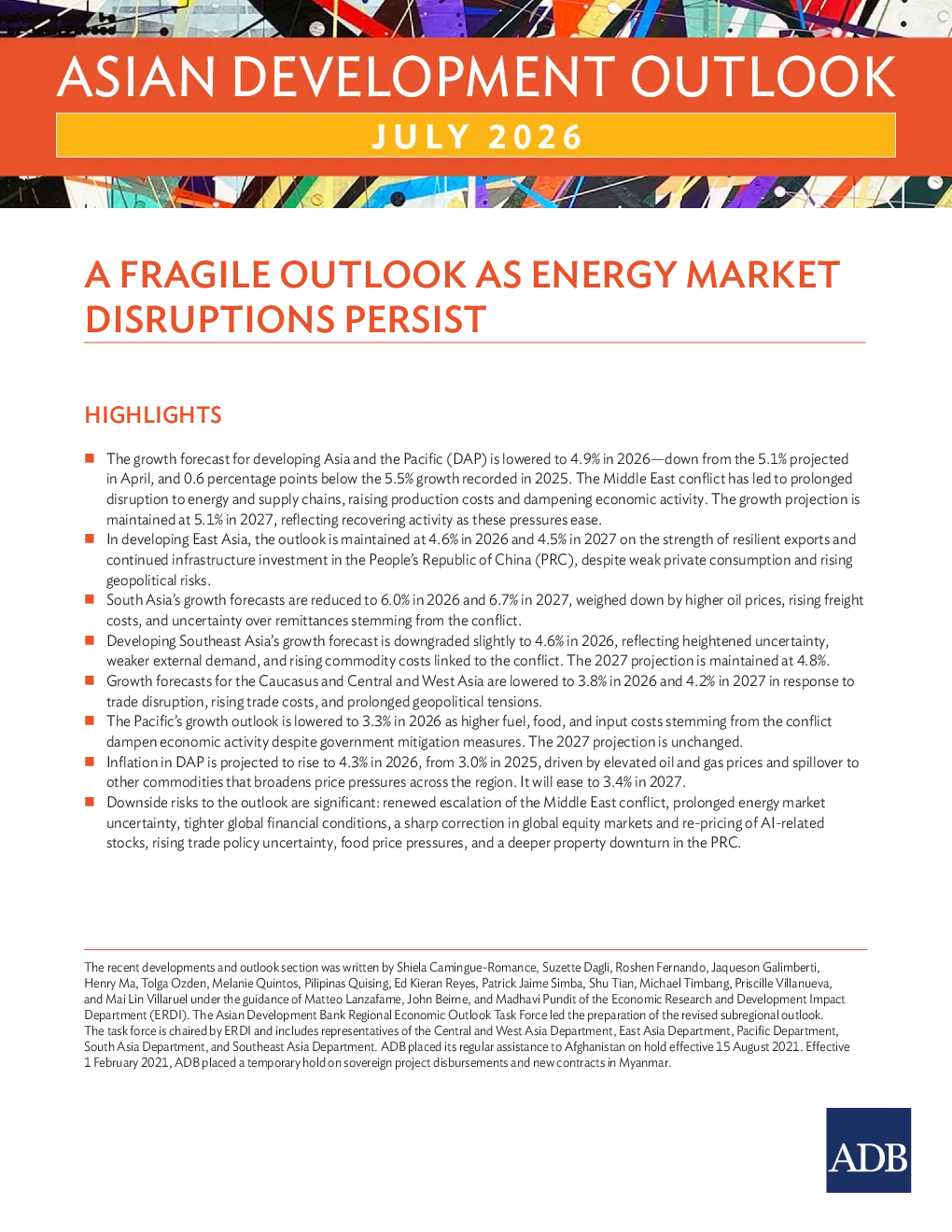
报告封面

J U L Y2 0 2 6 A FRAGILE OUTLOOK AS ENERGY MARKETDISRUPTIONS PERSIST HIGHLIGHTS „The growth forecast for developing Asia and the Pacific (DAP) is lowered to 4.9% in 2026—down from the 5.1% projectedin April, and 0.6 percentage points below the 5.5% growth recorded in 2025. The Middle East conflict has led to prolongeddisruption to energy and supply chains, raising production costs and dampening economic activity. The growth projection ismaintained at 5.1% in 2027, reflecting recovering activity as these pressures ease. „In developing East Asia, the outlook is maintained at 4.6% in 2026 and 4.5% in 2027 on the strength of resilient exports andcontinued infrastructure investment in the People’s Republic of China (PRC), despite weak private consumption and risinggeopolitical risks.„South Asia’s growth forecasts are reduced to 6.0% in 2026 and 6.7% in 2027, weighed down by higher oil prices, rising freightcosts, and uncertainty over remittances stemming from the conflict.„Developing Southeast Asia’s growth forecast is downgraded slightly to 4.6% in 2026, reflecting heightened uncertainty,weaker external demand, and rising commodity costs linked to the conflict. The 2027 projection is maintained at 4.8%.„Growth forecasts for the Caucasus and Central and West Asia are lowered to 3.8% in 2026 and 4.2% in 2027 in response totrade disruption, rising trade costs, and prolonged geopolitical tensions.„The Pacific’s growth outlook is lowered to 3.3% in 2026 as higher fuel, food, and input costs stemming from the conflictdampen economic activity despite government mitigation measures. The 2027 projection is unchanged.„Inflation in DAP is projected to rise to 4.3% in 2026, from 3.0% in 2025, driven by elevated oil and gas prices and spillover toother commodities that broadens price pressures across the region. It will ease to 3.4% in 2027.„Downside risks to the outlook are significant: renewed escalation of the Middle East conflict, prolonged energy marketuncertainty, tighter global financial conditions, a sharp correction in global equity markets and re-pricing of AI-relatedstocks, rising trade policy uncertainty, food price pressures, and a deeper property downturn in the PRC. 2ASIAN DEVELOPMENT OUTLOOK JULY 2026 Recent Developments and Outlook As the crisis evolved, the most direct impacts from risingglobal commodity prices were to drive up inflation acrossdeveloping Asia and the Pacific (DAP).Headline inflation inthe region rose from 2.9% in January to 4.1% in May 2026, drivenby higher global energy prices and second-round effects on inputand transport costs from supply chain disruption (Figure 1).Excluding the People’s Republic of China (PRC), regional inflationwas much higher at 7.6%during the same month, reflectingpersistently elevated price pressures in Türkiye and broad-basedincreases in more than half of the region’s economies. The Middle East conflict evolved into a major energyshock, leaving global oil markets highly exposed to supplydisruptions.At its peak in March, the crisis removed more than10 million barrels per day of oil supply from global markets,making it one of the largest supply shocks in modern history(Box 1). Brent crude oil prices surged from about $71/barrelbefore the conflict escalated on 28 February to a peak of about$144/barrel in early April. Prices moderated to $98/barrelin early June, reflecting alternative crude sourcing, weakerdemand, and the expectation that energy flows and shippingconditions would gradually normalize. Prices eased furtherfollowing the announcement of a framework agreement on14 June, hovering below $80/barrel, as previously trappedvessels exited the Strait of Hormuz, easing concerns aboutnear-term supply disruptions. The shock was transmitted through producer prices and,increasingly, food and core inflation.Energy inflation surgedin April and May, raising costs across energy-intensive sectorsand pushing up producer prices across major economies. Inthe PRC, higher energy costs liftedproducer price inflation to a46-month high of 3.8% in May, while wholesale price inflationin India recorded an even steeper increase to 9.7% in May, a43-month peak.Since March, governments across the regionhave introduced measures to limit pass-through to consumerprices, including fuel subsidies, tax cuts, price controls, releasesfrom strategic petroleum reserves, and energy conservationpolicies. Inflationary pressures have nonetheless broadenedbeyond energy. Higher input and logistics costs are feedingthrough to food and core inflation, while higher fertilizer pricesare adding to food price pressures. Food inflation rose in 15 of 19regional economies with data from March to April 2026. SinceJanuary, food inflation has increased markedly in South Asia anddeveloping Southeast Asia, while remaining high in the Caucasusand Central and West Asia. Core inflation has risen most indeveloping Southeast Asia and remains elevated in South Asia. The conflict could leave persistent scars on en