您的浏览器禁用了JavaScript(一种计算机语言,用以实现您与网页的交互),请解除该禁用,或者联系我们。 [花旗]:克服僵局2.0:破解电力瓶颈以驱动AI与能源安全 - 发现报告

克服僵局2.0:破解电力瓶颈以驱动AI与能源安全

公用事业 2026-06-29 花旗 SaintL
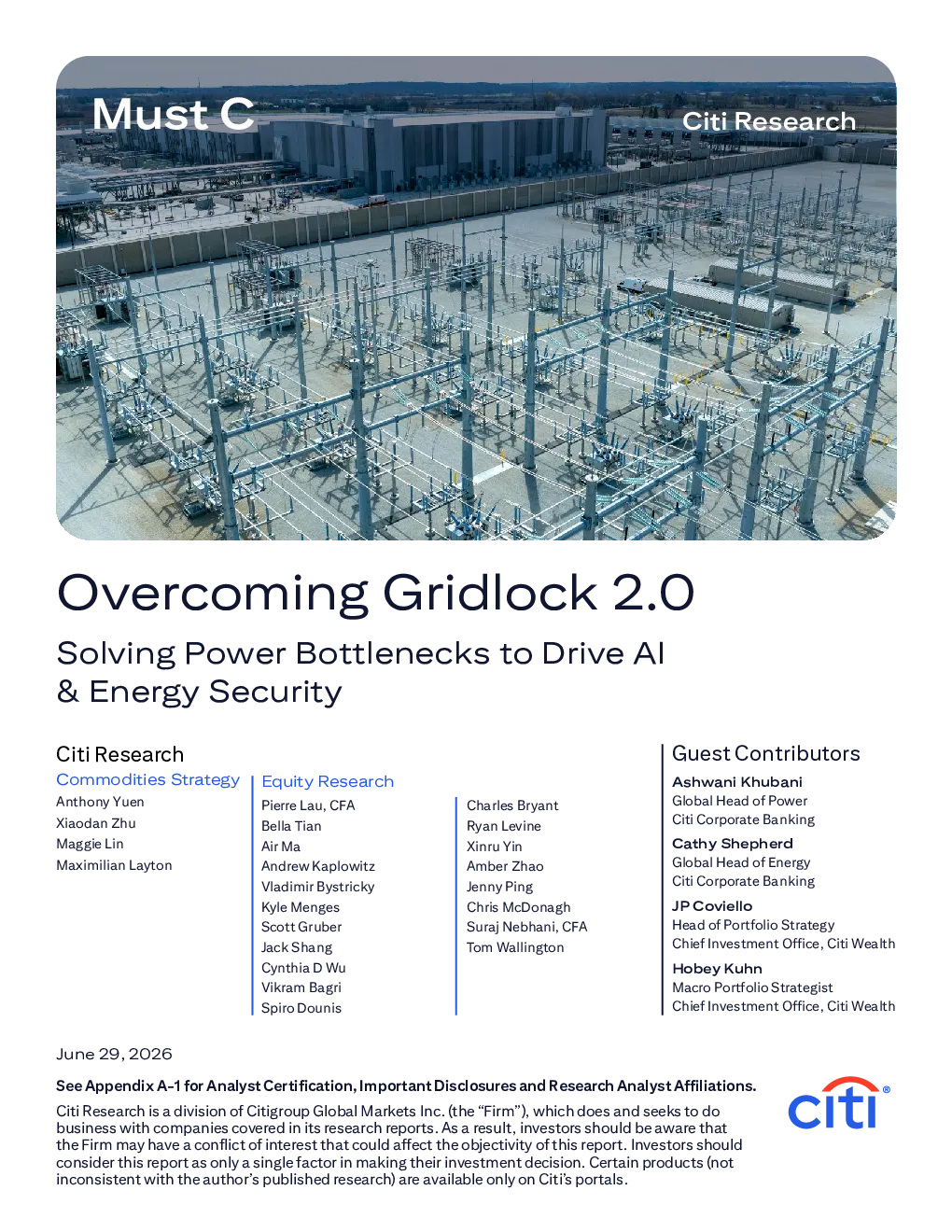
报告封面

Solving Power Bottlenecks to Drive AI& Energy Security Guest Contributors Citi Research Commodities Strategy Equity Research Ashwani KhubaniGlobal Head of PowerCiti Corporate Banking Anthony YuenXiaodan ZhuMaggie LinMaximilian Layton Pierre Lau, CFABella TianAir MaAndrew KaplowitzVladimir BystrickyKyle MengesScott GruberJack ShangCynthia D WuVikram BagriSpiro Dounis Charles BryantRyan LevineXinru YinAmber ZhaoJenny PingChris McDonaghSuraj Nebhani, CFATom Wallington Cathy ShepherdGlobal Head of EnergyCiti Corporate Banking JP CovielloHead of Portfolio StrategyChief Investment Office, Citi Wealth Hobey KuhnMacro Portfolio StrategistChief Investment Office, Citi Wealth June29, 2026 SeeAppendixA-1forAnalystCertification,ImportantDisclosuresandResearchAnalystAffiliations. Citi Research is a division of Citigroup Global Markets Inc. (the “Firm”), which does and seeks to dobusiness with companiescoveredin its researchreports. As a result, investors should be awarethatthe Firm may havea conflict ofinterest that couldaffect the objectivity of this report. Investors shouldconsider this reportas only a single factor in making their investment decision. Certain products (notinconsistent with the author’s published research) are available onlyon Citi’s portals. Contents 34799121819Executive SummaryAconversation withCitiBankingAI & Energy SecurityOvercomingGridlockThedrivers:AIandenergysecurityComplications:Not justaboutsupplyingpowerPowerinfrastructure equipment:Opportunitiesandsupply-chainbottlenecksPowerinfrastructure equipmentprospects—afocusontransformersPowergenerationequipment:Opportunitiesandsupply-chainbottlenecksNatural gasinfrastructure:Whythe U.S.needsmoreRegional powermarket views:U.S.,Europe,China,AustraliaActionable ideasAconversation withCitiWealth2637405153 Executive Summary Slowly, then suddenly.Demand for power, infrastructure, and generationequipment continues to rise, driven primarily by the U.S.-focused AI datacenter buildout. The Middle East conflict has sharpened focus on energysecurity. As countries seek to reduce import dependence andlimitexposure to price spikes, the reaccelerated adoption of renewables,batteries, and electric vehicles (EVs)willalso raisepowerequipmentdemand. However, grid expansion appears unable to keep pace withstrong demand and supply growth,constrained by equipment supply-chain challenges and well-meaning permitting frameworks in manyregions. Thus, speed-to-power is driving a shift from centralized networkstoward more distributed systems that bypass grid-connection delays.“Bring-your-own-generation” (BYOG), particularly U.S. natural gas–basedsupply, continues to gain traction. This report examines global powermarkets and explores solutions to ease grid constraints and accelerate AIdeployment and energy security transitions. AI is transformational and needs substantial power capex. Some cautionthatcertainaspects of AI look like a bubble. Our stance is thatpower is stillvery much needed as theJevons Paradox (Fortune, April 28)takes hold,and we see the related capex being utilized in the future. Moreover, energy security is now top-of-mind for many countries.This isthe top concern in the latestInternational Energy Agencyreport onSoutheast Asia. Unlike imported oil and natural gas, renewable energysources are typically domestically located. But relying on importedequipment for renewables introduces its own set of national securityconsiderations. Expanding the share ofelectric vehicles (EVs), which arepowered largely by domestically generated power, helps to cut oil imports.Even if AI power growth were to slow, renewables, EVs and distributedgeneration still require more of certain types of infrastructure equipment. And yet, the power grids needed to facilitate the AI and energy securitytransformations are typically enormous and slow to improve afterdecades of electrification and economic growth.Speed-to-power ispushing the evolution of the grid. Our prior study,Overcoming Gridlock:Powering Our Future (May 2024),had explored solutions, but powerdemand growth has materialized much stronger than expected.Thedemand surge in power infrastructure equipment has strained supplychains and extended the wait time. Grids will still expand, butconsumersof power cannot wait. Thus, speed-to-power concerns drive demand for power generationequipment:frommore efficient combined cycle gas turbines; to smaller,less efficient reciprocating engines, aeroderivative turbines and fuel cells;to the use of renewables and energy storage systems. Much of the above-listed generation equipment demanded in the U.S. requires naturalgassupply,whichcould lead to a further boom in the U.S. midstream space. This report draws on experts across the firm to examine this megatrend—Research (global commodities, utilities, industrials, materials and U.S.midstream), and Q&As with Banking and Wealth—for a holistic study. Anthony Yuen Head of Energy StrategyCommodities Research AConversationwith