伯恩斯坦能源电力:钠离子电池会成为太阳能基础负荷供电的关键吗?
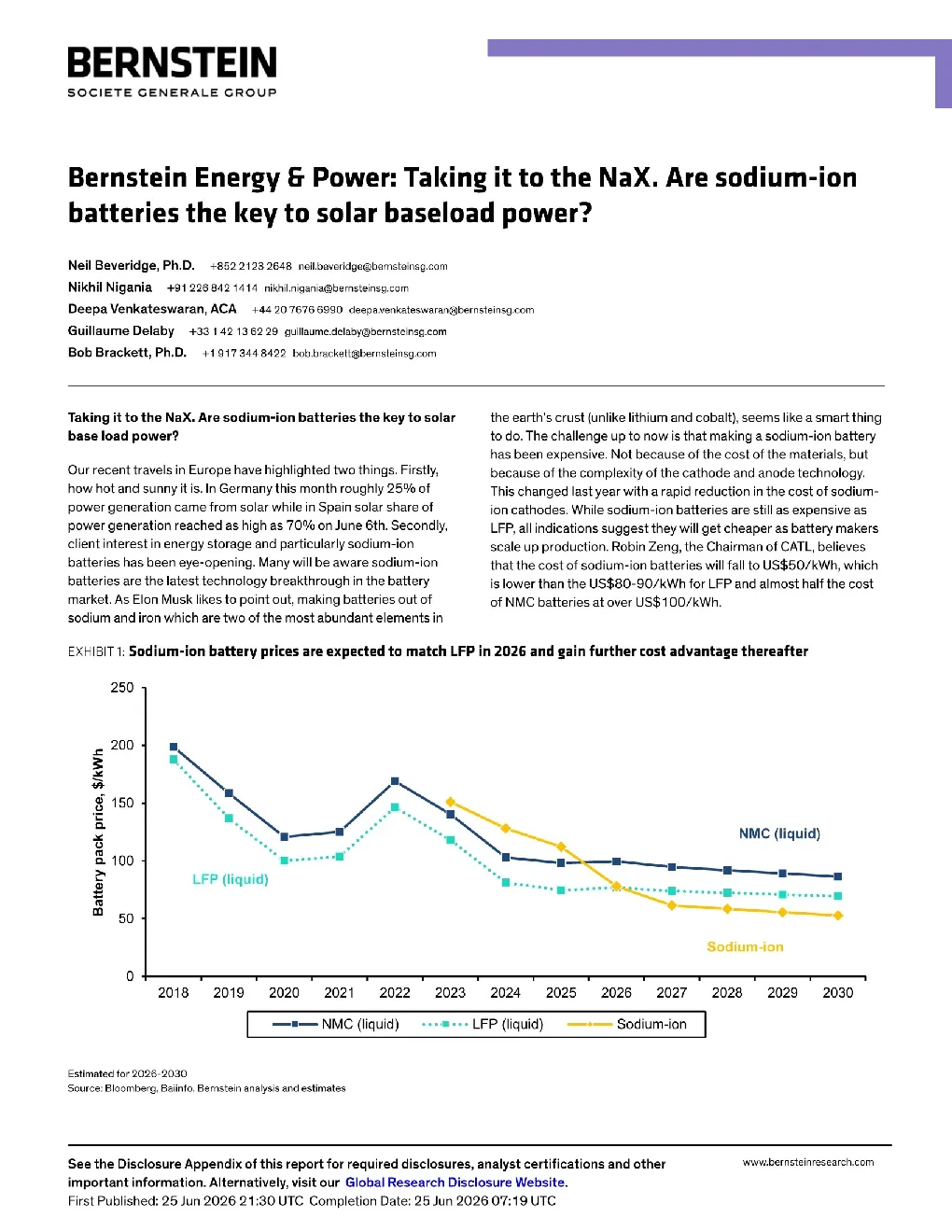
Nikhil Nigania+91226 8421414 nikhil.nigania@bernsteinsg.comDeepa Venkateswaran,ACA+442076766990 deepa.venkateswaran@bernsteinsg.comGuillaumeDelaby+33142136229guillaume.delaby@bernsteinsg.comBob Brackett, Ph.D.+19173448422 bob.brackett@bernsteinsg.com to do. The challenge upto now is that making a sodium-ion batteryhas been expensive.Notbecause ofthecostofthematerials,butbecauseof the complexityof the cathodeandanodetechnology.This changed last year with a rapid reduction in the cost of sodium-ion cathodes.While sodium-ion batteries are still as expensiveasLFP, all indications suggestthey will get cheaper as battery makersscaleupproduction.RobinZeng,the Chairmanof CATL,believesthat the cost of sodium-ion batteries will fall to US$50/kWh,whichis lowerthan theUS$80-90/kWhfor LFPandalmosthalfthecostofNMCbatteriesatoverUS$100/kWh. baseload power?Our recent travels in Europe have highlighted two things. Firstly how hot and sunny it is. In Germany this month roughly 25% ofpowergeneration camefromsolarwhile in Spain solar shareofpower generation reached as high as 70% on June6th.Secondly,client interest in energy storage and particularly sodium-ionbatteries has been eye-opening.Many will be aware sodium-ionbatteries are the latesttechnologybreakthrough in thebatterymarket. As Elon Musk likes to point out,making batteries out ofsodiumandironwhicharetwoofthemostabundant elements in comparedtolithiumcarbonateatoverUss20,o00/t,thecostsavings areobvious.Buttheadvantagesofsodium-ionbatteriesgo beyond just cost. Firstly,the number of cycles that can beachievedwith sodium-ion batteries are twice that of LFP.Whilean LFP battery may be capable of 6,000-8,000 cycles, a Na-ionbattery can achieve 15,000 cycles. This means it is possible tochargeanddischargeabatterytwiceadayfor2Oyears,allowingthemto be paired directly with solar and wind overthe life of theprojectwithnoreplacementneeded.Italsomeans thaton a Us$/kWh/cycle basis, Na-ion could be one third the cost of LFP.Secondly,Na-ionbatteries arelowertemperature, whichmeans to temperatures of around 200deg C.Thirdly,Na-ion batterieshavebetterperformanceatlowtemperatures.AccordingtoCATLenergyretention isgreaterthan92%attemperaturesaslowas-20deg C.Finally, while Na has a lower energy density than Li, theoverall energy density of Na-ion batteries is getting close to LFP.The CATLNaxtra battery has an energy density of 185Wh/kg at thepack level, which approaches that of LFP(190-210Wh/kg)makingNa-ion batteries a serious challengerin the more price-sensitivemassvehiclemarket. UssW1000/kWfora solarmodule,this meansthatsolarplus 20hoursofbatterystorage(20xUS$150/kW=US$3000/kw)couldcostas muchas a combined cyclegas fired power plant CCGT(US$4000/kW).But assuming thatthe cost ofNa-ion batteries falls toas lowas Uss5o/KW,then solarplusbatterystoragecouldbeevencheaper.Itcouldbepossibleinthenearfuturethatthecostofsolarplus 48 hours of Na-ion storage could be as cheap as a gas-firedpower plant. On our analysis,the break-even gas price for solar (US$550/kW)pairedwithaNa-ionESSsystem(US$100/KWh)andaCCGTUS$2,500/kWcouldbeaslowasUS$5/mscf.AtaCCGTwithacostofUSs4000/kwthebreakevencouldbeaslowat US$2/mscf. This is not to say that 12 hours of storage would suffice ineverylocation, but the cheaperbattery storagebecomesthehigherthepenetrationcouldbe. Thekey benefit which Na-ion batteries bring is lower cost.Webelievethatthiscansignificantlyenhancethepenetrationofrenewable energyand substantially increasethetotaladdressablemarketforbatteries.As everyoneknows,solarandwind poweris cheap, but not when the sun doesn't shine or the wind doesn'tblow.Theonlywaytomakerenewablepowercheaperandmoreeffective isto reduce energystorage costs.While lithium-ionbatteries are the obvious way to do this, the problem is the high costof storage. In 2020, it was not uncommon for a BESS to cost US$500/kwh.This means that 1kW of capacitywith4hour storagewouldcost Uss200o,which isalmostthe samecostas a combinedcycle gas turbine plant (US$2000/kw). Today, the cost of ESShasfallenalongwithLFPbatterycoststoaroundUS$150/kW(batteryplus inverterandbalanceofplant).Atthesametime,giventhedemandgrowthforgasturbines,thecapital costofagas-firedpowerplanthas increased toas highasUss4000/kW.Assuming Already in the UAE, Masdar is developing the world first baseloadpower project with solar and storage. In the project, solar will bepairedwith19GWhofbatterystoragetoprovidecontinuousbaseload solarpowerfora1GWof powerwitha99.7%power reliability.Asbattery storage costs come down,longer duration solar plusbatteryprojects could emergeasmore serious competitorstogas solar and wind in the grid, but it will help lower power prices andcould lead to a significant expansion of battery storage.As of lastyeartherewas almost 5,000GW ofcombined installed solar andwind capacity worldwide. By 2030,we think this number could reach close to10,000GW.1GW of battery capacity with a duration of 10 hours this could amount to a cumulative demand of 100,000GWh