多边开发银行支持循环经济创造就业研究
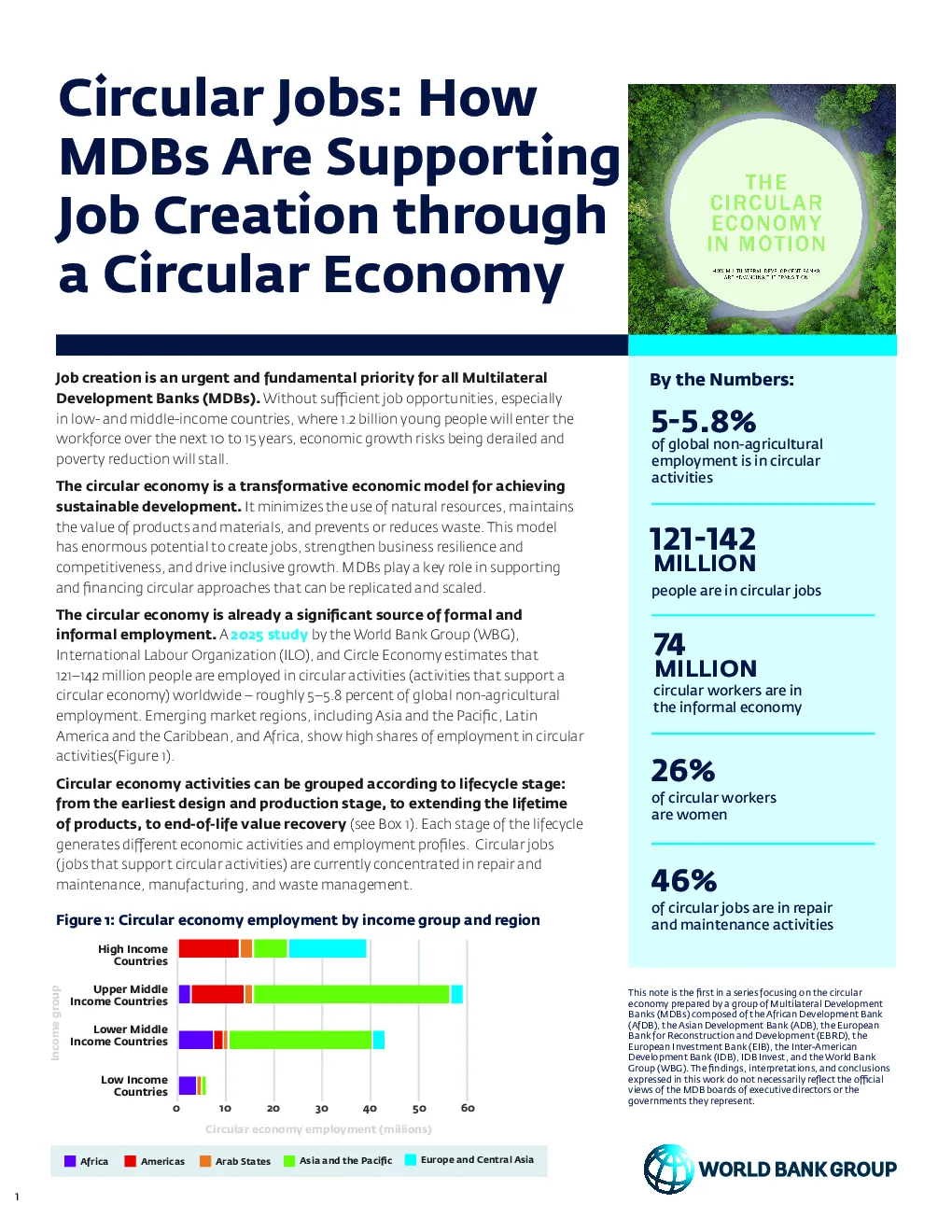
Job creation is an urgent and fundamental priority for all MultilateralDevelopment Banks (MDBs).Without sufficient job opportunities, especiallyin low- and middle-income countries, where 1.2 billion young people will enter the By the Numbers: 5-5.8%of global non-agriculturalemployment is in circularactivities The circular economy is a transformative economic model for achievingsustainable development.It minimizes the use of natural resources, maintainsthe value of products and materials, and prevents or reduces waste. This modelhas enormous potential to create jobs, strengthen business resilience and 121-142MILLIONpeople are in circular jobs The circular economy is already a significant source of formal andinformal employment.A2025 studyby the World Bank Group (WBG),International Labour Organization (ILO), and Circle Economy estimates that121–142 million people are employed in circular activities (activities that support a circular workers are inthe informal economy74MILLION 26%of circular workersare women Circular economy activities can be grouped according to lifecycle stage:from the earliest design and production stage, to extending the lifetimeof products, to end-of-life value recovery(see Box 1). Each stage of the lifecyclegenerates different economic activities and employment profiles. Circular jobs 46% of circular jobs are in repairand maintenance activities This note is the first in a series focusing on the circulareconomy prepared by a group of Multilateral DevelopmentBanks (MDBs) composed of the African Development Bank(AfDB), the Asian Development Bank (ADB), the EuropeanBank for Reconstruction and Development (EBRD), theEuropean Investment Bank (EIB), the Inter-AmericanDevelopment Bank (IDB), IDB Invest, and the World Bank BOX 1: CIRCULAR ECONOMY LIFECYCLE CATEGORIES Notably, jobs in repair, maintenance,refurbishment, and remanufacturing activities account for nearly half of all circular jobs globally.1 Circular Design and Production:Design phase ofproducts/assets/services that incorporates circulareconomy strategies or principles, including the reduction While the circular transition will require re-skilling and adaptation in some industries tomitigate displacement, the scale of the untappedopportunity is significant.Today, only 7.6 percentof jobs in manufacturing and 3.1 percent of jobs inconstruction contribute to a circular economy . ILOestimates suggest that recycling steel, reprocessing Circular Use:Lifetime extension of products and assetssuch as through repair, refurbishment, reuse, retrofitting, Value Recovery:Collection, sorting and aggregation toenable circularity of end-of-life products and materials. +Circularity Enablers:Products, services, businessmodels, platforms, and tools that enable circularity acrossdifferent segments of the materials lifecycle, including UNLOCKING THIS JOB POTENTIAL REQUIRES COORDINATED ACTION Realizing this potential will require addressing structural challenges, including informality and gender disparities. More than half of existing workers in non-agriculture circular activities — over 74 million globally — operate informally,without contracts, safety protections, or social coverage (Figure 2). Women participate across all segments but remain Circular jobs are only as durable as the business modelsthat create them.Across the circular economy — fromdesign and production, through repair and remanufacturing,to collection, sorting, and recycling — businesses face systemicchallenges that suppress job creation and quality: virgin materialprice advantages that undercut recyclers, underdeveloped recognition frameworks are powerful enablers of job creation.Ensuring women are not left behind in the circular transition —and have the skills to access emerging circular jobs — is equallycritical. The 1.2 billion young people entering labor markets indeveloping countries over the next decade represent both a Transitioning to a circular economy creates opportunity industries.Workers and enterprises in sectors such assingle-use packaging, extractives, and fast fashion face realdisplacement risk as circular alternatives scale and regulatoryrequirements tighten. Governments need adjustmentmechanisms alongside their circular economy strategies: The circular economy can be a powerful jobs engine— with the right investment in human capital.By establishing quality standards for aggregated recycled content— developed with direct input from recyclers — and equippingcollectors with the training to meet them, emerging marketscan unlock higher and more stable revenue streams for their THE ROLE OF MDBS MDBs play a key role in supporting transitions to a circular economy, working alongside governments, developmentpartners, and the private sector.MDBs bring the depth of analytical expertise, advisory services, and investment across the At the knowledge and research level, MDBs are building the evidence base that markets and governments need. This includ