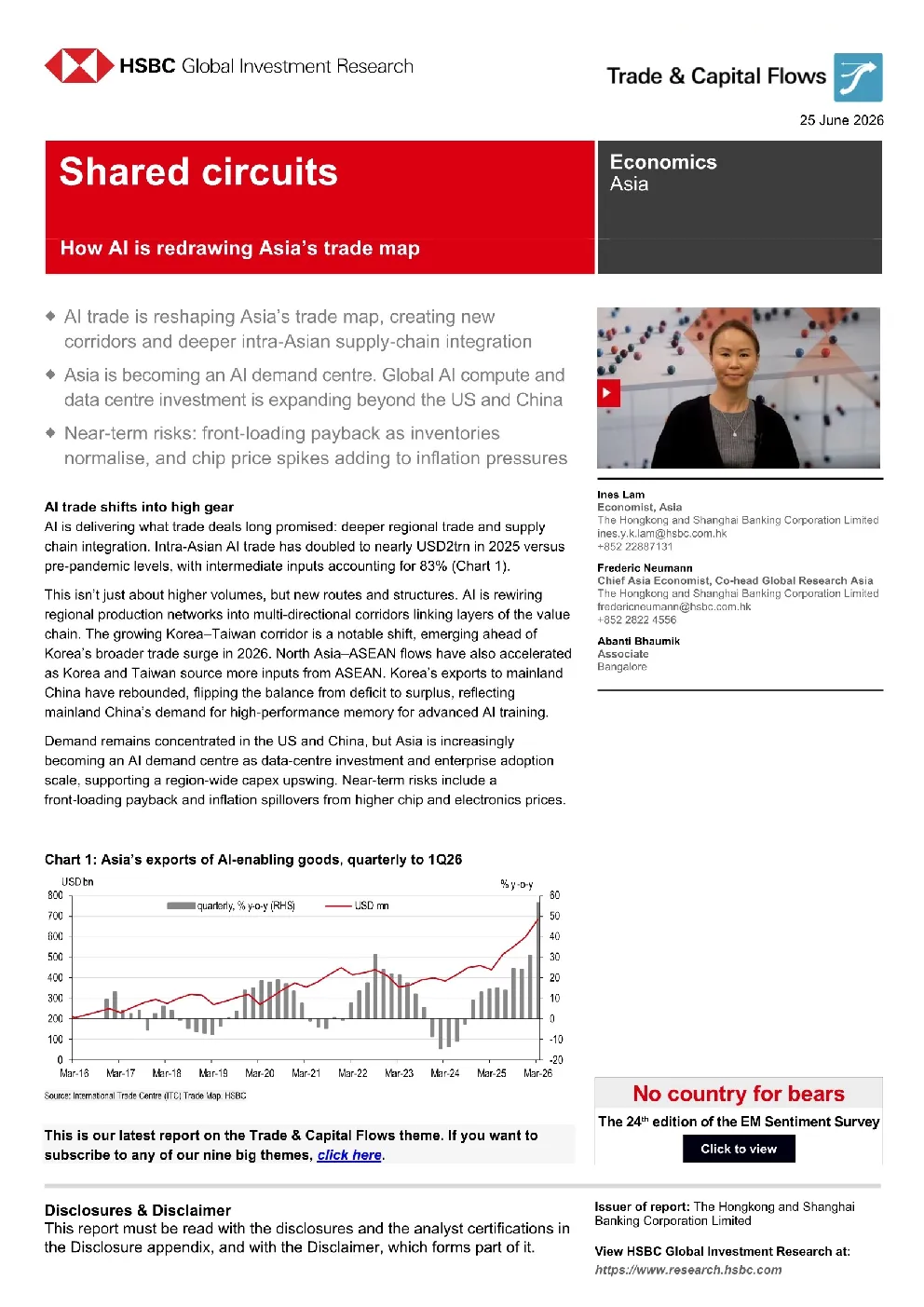
Shared circuits How Al is redrawing Asia's trade map corridors and deeper intra-Asian supply-chain integration Asia is becoming an Aldemand centre.Global Al computeanddata centre investment is expanding beyond the US and China Near-termrisks:front-loading payback as inventoriesnormalise, and chip price spikes adding to inflation pressures Economist,AsiaThe Hongkong and Shnghai Banking Corporation Limitedines.y.k.lam@hsbc.com.hk+85222887131FredericNeumann Al trade shifts into high gearAl is delivering what trade deals long promised:deeper regional trade and supply chain integration. Intra-Asian Al trade has doubled to nearly USD2trn in 2025 versuspre-pandemic levels, with intermediate inputs accounting for 83% (Chart 1). Chief Asia Economist, Co-head Global Research Asia The Hongkong and Shanghai Banking Corporation Limitedfredericneumann@hsbc.com.hk+852 2822 4556Abanti Bhaumik This isn't just about higher volumes, but new routes and structures. Al is rewiringregional production networks into multi-directional corridors linking layers of the valuechain. The growing Korea-Taiwan corridor is a notable shift, emerging ahead ofKorea's broadertrade surge in 2026.North Asia-ASEANflows have also acceleratedas Korea and Taiwan sourcemore inputs fromASEAN.Korea's exports to mainlandChina have rebounded, flipping the balance from deficit to surplus, reflectingmainland China's demand for high-performance memory for advanced Al training. AssociateBangalore Demand remains concentrated in the US and China, but Asia is increasinglybecominganAl demand centreasdata-centre investment andenterpriseadoptionscale,supporting a region-wide capex upswing.Near-termrisks include afront-loading payback and inflation spillovers from higher chip and electronics prices. Nocountryforbears The 24th edition of the EM Sentiment Survey This is ourlatest report on theTrade&Capital Flows theme.If you wanttosubscribetoany of our ninebigthemes,click here Click to view Issuer of report: The Hongkong and ShanghaiBankingCorporationLimited Disclosures&Disclaimer This report must be read with the disclosures and the analyst certifications inthe Disclosure appendix, and with the Disclaimer, which forms part of it. ViewHSBCGlobal InvestmentResearchat:https://www.research.hsbc.com To analyse the Al trade value chain in more detail, we used the World Trade Organization's definition of"Al-enabling goods1", which encompasses a basket of 105 goods at the HS 6-digitlevel,groupedintothreeindicativecategories:rawmaterialsandprocessedchemicals(17)intermediateinputs(74)andequipment(14).Thesecategoriesarebasedonanon-exhaustivelist of HS codes and may include items not exclusively used in the Al value chain. Unlessotherwise stated, trade values are sourced from ITC Trade Map and HSBC calculations.The composition of Al trade helps explain why Asia's position has become so entrenched. Intermediate inputs,comprising processed orpartiallymanufactured goods,thatfeed intodownstreamAlhardware,are the largest category,accounting for73%of total Al-enabling tradevalue in2025.Equipment represents a further26%, whilerawmaterials and chemicals makeupjust 1%.Asia's dominance is most pronounced in intermediate inputs (Chart 2),reflecting theregion's scale, supplier density and tightly linked production ecosystems. intermediate inputs over the past decade. The bigger shift has been the rise of the rest of Asia. Asian economiesexcluding China gained 9 percentage points, from 46.2% in 2015 to 55.2% in 2025 (Chart 2). Thesegains have come largely at the expense of developed economies, such as the Us and Europe,as wellas Japan, consistent with the“China plus one"or dual supply chain strategy across multiple industries. is evident The transfer of market share in equipment trade from China to the rest of Asia is evident: non-China Asia's share rose sharply to 42.9% in 2025, from 23% in 2015. signalling a morediversified exportlandscapeandawidersetofAsianproductionbases.Bycontrast,theUSandEurope have seen a relative decline in market share across allthree categories over the pastdecade.Oneexceptionisupstream:Europehasgainedshareinrawmaterialsandprocessedchemicalsused inAl-enablingproducts.Evenso,withupstreamgoodsrepresentingonly1%oftotal Al trade value, the strategic weight of the supply chain remains downstream, where Asiacontinues to be the indispensable hub of global Al trade. Asia's lead is broadening Asia's share in global Altrade rose from 62% in 2015to69%in2025 At the country level, Table 1 shows some dramatic shifts in market share across the Al-enablingvalue chain between 2015 and 2025. Asia's dominance isn't just growing. It's becoming morebroad-based, with different economies gaining ground in different parts of the supply chain andstrengthening their positions in distinct product segments 7.2% in 2015 to 13.5% in 2025. Several ASEAN economies, particularly Vietnam, Malaysia andthe Philippines, also posted moderate gains.In equipment, the shift i