您的浏览器禁用了JavaScript(一种计算机语言,用以实现您与网页的交互),请解除该禁用,或者联系我们。 [PitchBook]:Anthropic:S1有望为AI定价(英)2026 - 发现报告

Anthropic:S1有望为AI定价(英)2026

信息技术 2026-06-23 PitchBook 张东旭
报告封面

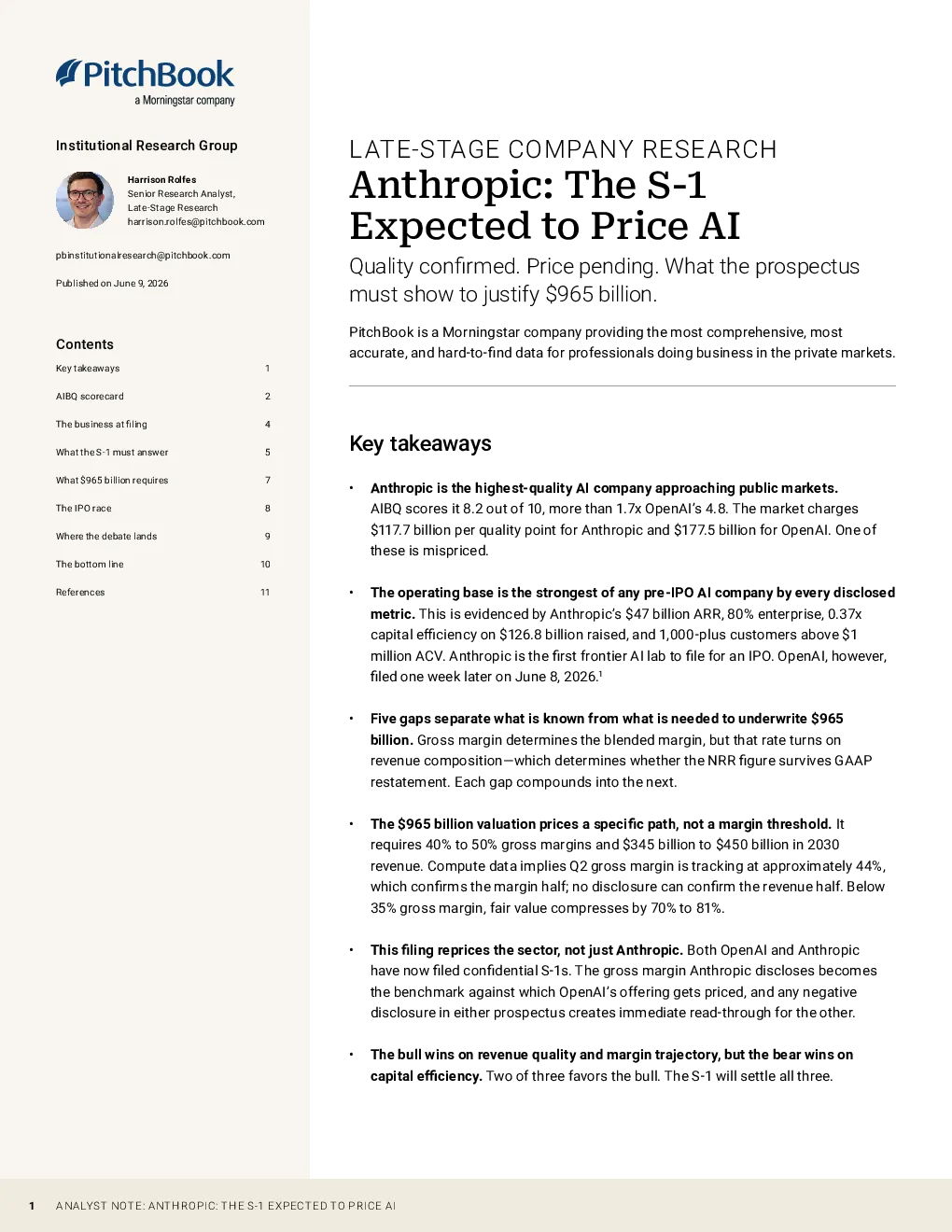
LATE -S TAGE C OM PAN Y RE S E ARCHAnthropic: The S-1Expected to Price AI Institutional Research Group Harrison RolfesSenior Research Analyst,Late-Stage Researchharrison.rolfes@pitchbook.com pbinstitutionalresearch@pitchbook.com Quality confirmed. Price pending. What the prospectusmust show to justify $965 billion. Published on June 9, 2026 PitchBook is a Morningstar company providing the most comprehensive, mostaccurate, and hard-to-find data for professionals doing business in the private markets. Key takeaways •Anthropic is the highest-quality AI company approaching public markets.AIBQ scores it 8.2 out of 10, more than 1.7x OpenAI’s 4.8. The market charges$117.7 billion per quality point for Anthropic and $177.5 billion for OpenAI. One ofthese is mispriced. •The operating base is the strongest of any pre-IPO AI company by every disclosedmetric.This is evidenced by Anthropic’s $47 billion ARR, 80% enterprise, 0.37xcapital efficiency on $126.8 billion raised, and 1,000-plus customers above $1million ACV. Anthropic is the first frontier AI lab to file for an IPO. OpenAI, however,filed one week later on June 8, 2026.1 •Five gaps separate what is known from what is needed to underwrite $965billion.Gross margin determines the blended margin, but that rate turns onrevenue composition—which determines whether the NRR figure survives GAAPrestatement. Each gap compounds into the next. •The $965 billion valuation prices a specific path, not a margin threshold.Itrequires 40% to 50% gross margins and $345 billion to $450 billion in 2030revenue. Compute data implies Q2 gross margin is tracking at approximately 44%,which confirms the margin half; no disclosure can confirm the revenue half. Below35% gross margin, fair value compresses by 70% to 81%. •This filing reprices the sector, not just Anthropic.Both OpenAI and Anthropichave now filed confidential S-1s. The gross margin Anthropic discloses becomesthe benchmark against which OpenAI’s offering gets priced, and any negativedisclosure in either prospectus creates immediate read-through for the other. •The bull wins on revenue quality and margin trajectory, but the bear wins oncapital efficiency.Two of three favors the bull. The S-1 will settle all three. AIBQ scorecard The AI Business Quality (AIBQ) framework scores frontier AI companies acrossfive weighted dimensions: capital efficiency (20%), revenue quality (25%), computeindependence (15%), governance optionality (20%), and moat durability (20%).Anthropic is the highest-quality business in the Frontier Five by a wide margin. At8.2 out of 10, the AIBQ composite is more than 1.7x OpenAI’s 4.8 and trails onlyDatabricks’ 8.9. The post-S-1 range is 7.5 to 8.8. Three of five dimensions depend ondisclosures that do not yet exist. Revenue quality scores a 9.2 and is the highest score in the Frontier Five. Enterpriserevenue is at 80% of the mix, with more than 1,000 customers above $1 million annualcontract value (ACV), and net revenue retention (NRR) conservatively estimated at140%, with the upper bound at 170% until the S-1 shows cohort-level data. At 140%,existing customers compound the base without net-new logos. That mechanicalquality separates Anthropic from consumer-weighted AI businesses where retention isbehavioral rather than contractual. The risk: If organic NRR after stripping Google andAmazon falls below 120%, this dimension revises down materially. Moat durability scores a 9.0. Claude Opus 4.8 leads SWE-bench Pro at 69.2% versusGPT-5.5’s 58.6%,2, 3a 10.6-point gap on the benchmark most correlated with real-world coding performance. OpenAI no longer reports SWE-bench Verified scores;independent evaluations show Opus 4.8 leading across all difficulty tiers understandardized conditions.4But the moat is not the benchmark. It is Claude Code: $2.5billion (and growing) annual recurring revenue (ARR) and 54% of enterprise coding,5and it is embedded in CI/CD pipelines and compliance frameworks at a depth that amodel swap does not dislodge. That depth is also a concentration risk; if enterprisecoding plateaus or fragments across specialized tools, the revenue base narrowsbefore it diversifies. Benchmark leads have a six- to 12-month half-life, but switchingcosts do not. Open-weight models from Meta and DeepSeek narrow the benchmarkgap on this cycle, but they do not replicate the enterprise integration layer or support infrastructure that drives retention at the $1 million-plus ACV tier. Anthropic itselfmerges more than 80% of its production code through Claude, with engineers shipping8x more code per day than in 2021 to 2024,6representing the strongest internalvalidation of the enterprise value proposition. This score assumes the retentionarchitecture is holding rather than the benchmark lead persisting. Compute independence scores an 8.0. This was revised from 5.0 in February afterthe SpaceX S-1 confirmed the Colossus deal, with $1.25 billion per month throughMay 2029, more than 220,000 graphics pro