您的浏览器禁用了JavaScript(一种计算机语言,用以实现您与网页的交互),请解除该禁用,或者联系我们。 [奥纬咨询]:为什么传统市场对海湾合作委员会的未来很重要 - 发现报告

为什么传统市场对海湾合作委员会的未来很重要

文化传媒 2026-06-18 奥纬咨询 Andy Yang 杨敏
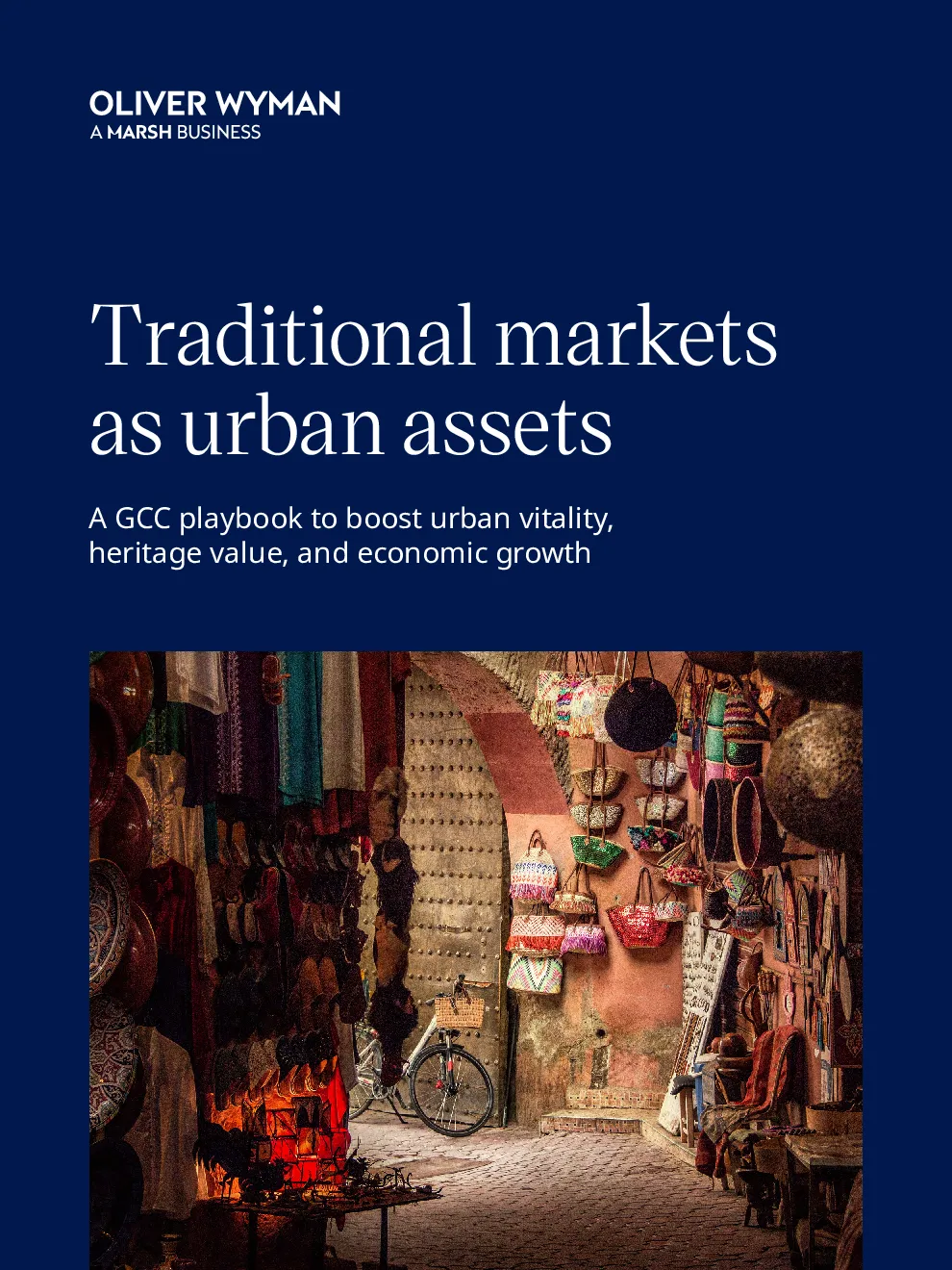
报告封面

A GCC playbook to boost urban vitality,heritage value, and economic growth Traditional markets or souqs should not be nostalgicrelics. They should be multipurpose assets that, whenintentionally designed and well-run, advance inclusive Benchmarks across the GCC and globally show that well-run traditional markets can deliver economic, cultural, This report combines three key inputs: a benchmark of 30 traditional markets, a globalconsumer survey of more than 2,000 respondents, and interviews with investors and operators The following roadmap translates the insights gathered into a practical approach for GCCgovernments, using tactical urbanism — temporary, low-cost pilots — to validate demand,refine operating models, and de-risk investment before scaling across cities such as Abu Dhabi, WHY MOVENOW Evidence, demand, and This chapter sets out why traditional markets merit renewed investment today, supported bystrong performance, proven demand, and delivery models that reduce risk. When markets are 1. Attractive investment economics:Well-run traditional markets deliver attractive andresilient returns, creating a compelling case for both public and private investment. In London,rental income from actively managed markets consistently outperforms comparable districts Interviews with GCC-based investors and operators indicate a strong appetite for such models,provided risks are clearly managed and roles are well defined. Investors tend to favor scalablemarket investments that can be replicated across multiple sites, rather than one-off, large-scalebespoke developments, particularly where active management and clear operating standards 2. Footfall that endures:Istanbul’s Grand Bazaar in Turkey welcomes up to400,000 visitorsaday — evidence that when heritage, easy access, and a strong vendor mix align, crowds areboth large and reliable. That consistency lifts the surrounding district: it fuels spending on 3. Livelihoods that grow:Souq Suwaiqah in Saudi Arabia’s Madinah has trained 3,000 womenin recent years, showing how a revived heritage market can double as an inclusion engine —building skills, micro enterprise, and diversified household income at city scale.The program 4. Consumer sentiment:Our research shows that people are drawn to traditional markets for For GCC leaders, the message is simple: treat traditional markets as investable public realmassets. Done well, markets become cultural anchors, tourism gateways, and community hubs Exhibit 1:Traditional markets deliver multiple cityoutcomes Cultural and heritage anchorServe as living representations of heritage in a modernizing city Economic engineEnable grassroots economic participation and support diverse business ecosystems Navigational landmarkTraditional markets can act as gateways to historic districts or heritage sites GCC heritageadvantage GCC cities already have strong foundations to build on — authentic places, well-known market •Leverage proven anchors and extend them.Sites such as Doha’s Souq Waqif, Souq AlMubarakiya in Kuwait, Jeddah’s Al Balad souqs, Abu Dhabi’s Mina Market, Al Ain’s historic souqareas, and Madinah’s Souq Suwaiqah offer recognizable locations, vendor bases, and heritageappeal. A key move is to first focus on upgrading existing market anchors — raise comfort •Connect anchors into heritage corridors that drive flow and spend.Link market hallsand retail streets to historic districts, trails, and major assets such as mosques, museums,and waterfronts, so visitors naturally move and engage across a wider area. Add clear In short, GCC cities aren’t starting from scratch. By prioritizing anchored sites and stitchingthem into heritage corridors and adjacent anchors, they can turn recognized heritage areas into WHAT WORKSBEST Setting the ambition for A critical starting point for traditional markets regeneration is the explicit definition of theirintended role and ambition within the city. International experience shows that traditionalmarkets can occupy a wide spectrum of roles, ranging from symbolic or niche cultural attractions In some cities, markets operate as multi-functional spaces combining retail, tourism,placemaking, and local services, while in others they remain peripheral, ad-hoc, or legacy assetswith limited impact beyond their immediate surroundings. Examples such as Istanbul’s GrandBazaar or Bangkok’s neighborhood markets illustrate intermediate models with strong identity Importantly, the ambition selected for traditional markets has direct implications on how theyare planned, governed, and delivered. Higher-ambition models require intentional spatialdistribution to ensure equitable access across neighborhoods, strong integration with urbanand strategic policy (including mobility, public realm, and local economic development), and Accordingly, the value proposition of traditional markets will be defined by the ambitionselected and will shape their social, cultural, and economic impact on the city,