您的浏览器禁用了JavaScript(一种计算机语言,用以实现您与网页的交互),请解除该禁用,或者联系我们。 [世邦魏理仕]:2026大型零售物业(LFR)前景洞察报告 - 发现报告

2026大型零售物业(LFR)前景洞察报告

商贸零售 2026-06-09 世邦魏理仕 Yàng
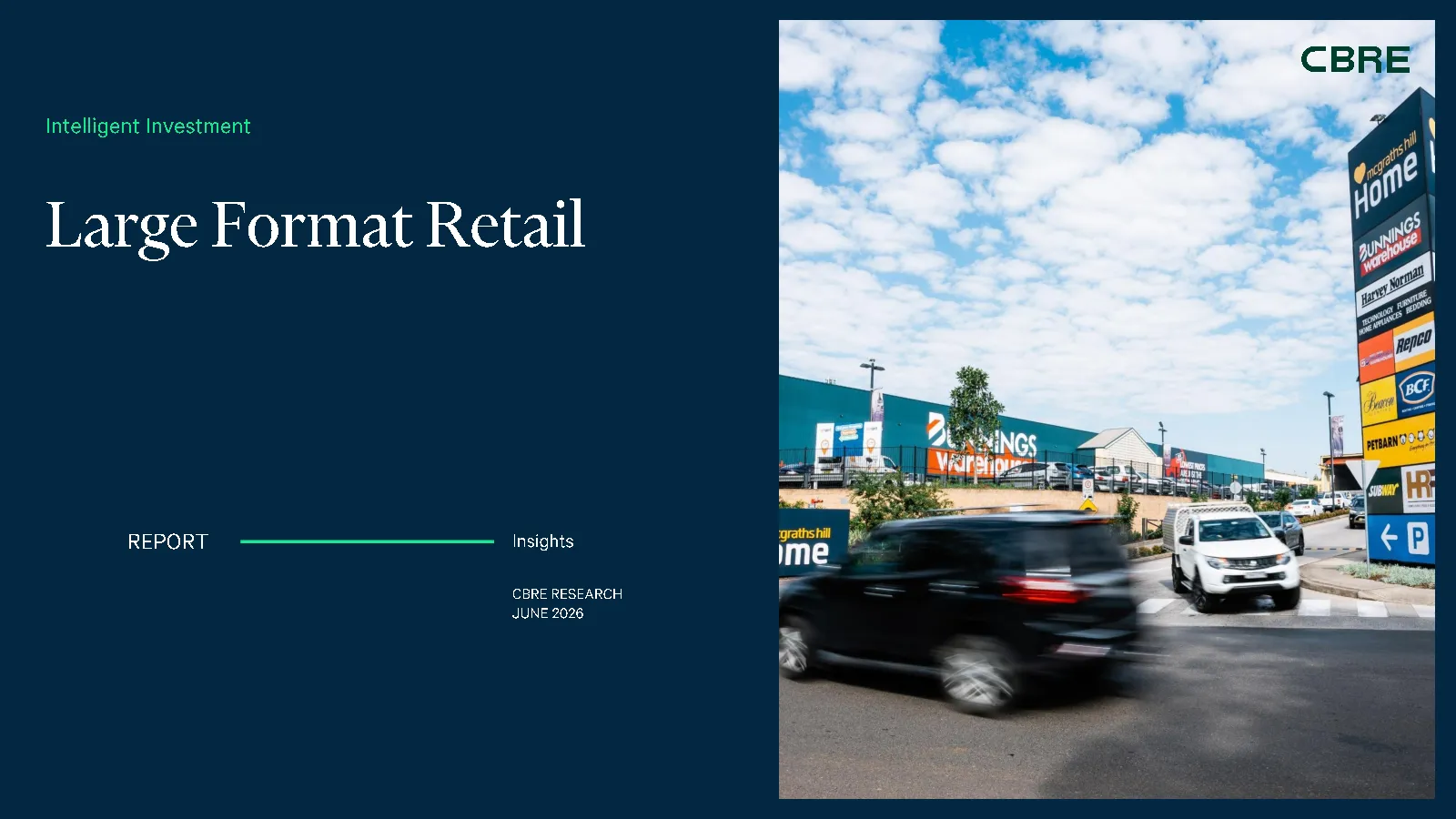
报告封面

Large Format Retail Intelligent InvestmentIntelligent Investment Large Format Retail (LFR) Outlook Still low penetration Supply constrained Booming spend CBRE forecasthousehold goodssales will growto $94bn by end of the decade,+70% throughthe 2020s. A triple boost of population growth,jobs growth and income growth will help togrow the retail base. New supply fell to a 10-year low in 2025. LFR GLA per capita is 0.22 sqm, around 1/3rdoflevels in the US and Australian shoppingcentres. Although we forecast an improvement in 2026,much of the forward pipeline remains stuck inapprovals. Elevated construction costs andinterest rates are likely to delay or derailprojects, keeping completions well belowhistorical norms over the next 5 years. Vacancy has already fallen to low single digitsand 72% ofcentresnationally exhibit sub 2%vacancy. In addition, rising home values have seen anacceleration in household goods spend acrossWA, QLD and SA. For developers, we view Sydney, Canberra andRegional QLD/NSW/VIC amongst markets thatare still relatively under-penetrated. Occupier diversity Rent growth Investment returns The Top 20 occupiers have over 3,250 storesnationally. Diversity of occupier is alsoevidenced by 33% of space take-up by Furnitureshops, 19% by Hardware/Garden, 12% byElectrical and 11% by Homewares. LFR had posted sector leading investmentreturns of +12.8% pa over the past 10 yrs. Rentgrowth combined with cap rate compression todeliver exceptional results. Rents are up 21% nationally since 2020, withSydney leading at 31%. Vacancy has tightened further, falling to 2.8%.This continues to place upward pressure onrents and CBRE forecast ~5% pa to 2030. Looking ahead, CBRE forecast investmentreturns could be ~11% pa, lead by rent growth.There is still scope for modest cap ratecompression of ~10bps over the next 3 years. More recently, Pet products and Gyms haveopted to take-up space in LFR. We also seescope for ongoing growth in penetration by food& liquor occupiers. For context, leading LFR tenants haveexperienced Sales and EBIT growth of nearly50% since 2019 while margins are broadlystable at 12%. Investment returns Large Format Retail had posted sector leadinginvestment returns of +12.8% pa over the past 10yrs, supported by cap rate compression andrising rents. Unlike many other sectors, LFR benefits fromminimal incentives, helping to sustain a strongincome yield. Looking ahead, CBRE forecast investmentreturnsarelikely to average nearly 11% pasupported by strong income and rent growth. Our forecast is for mid single digit rent growth,lead by Brisbane and Perth. There is also scopefor modest cap rate compression of ~10bps overthe next three years. Demand triple boost The demand for consumer facing real estate is expected to benefit from the triple boost of risingpopulation, rising jobs and rising income. Collectively, this wealth effect will add ~$1,000bn ofincome over the next decade, a significant proportion of which is likely to be directed towardshousing, living, retail & leisure. FIGURE 2 Triple boost of population, jobs and income Jobs, jobs, jobs Rising income & wealth Population growth The employment market has been particularly robust, adding 2.8mworkers between 2020 and 2025. We see employment growing byanother 2.9m to 2035. We see average annual income increasing from $105,000currently to $144,000 pa by 2035. Immigration is likely to contribute to two-thirds of Australia’spopulation growth, from 27.6m in 2025 to 32.0m by 2035. Share of spend (estimate)FIGURE 4 Consistent sales LFR categories account for between 20%-25% ofall retail sales. Spend on household goodsincreased at mid-single digits over the pastdecade. Furnishings account for 27%, Electronics 37%and Hardware 36% of spend. Robust employment conditions and rising homevalues have seen an acceleration in Householdspend across Western Australia, Queenslandand South Australia. Housing We view a robust housing development pipelineand home values as conducive to spend onhousehold goods. In recent times, there have been 170,000-180,000 new homes built in Australia. A newresident typically spends between $15,000-$50,000 furnishing their home. It all depends onneeds such as coffee machines, bed linen, styleof dining etc. Increasing home values have also encouragedowners to renovate their properties. Separately,the wealth effect of rising home values has beena tailwind for upgrades to home furnishing. Over the last 15 years, home value appreciationhas been most noticeable in Sydney (+7.1% pa),Brisbane (+6.0% pa) and Adelaide (+5.5% pa). Near-term, CBRE expect more modest homevalue and apartment supply outcomes. FIGURE 7 Occupiers The Top 20 occupiers have over 3,250 storesnationally. Diversity of occupier is alsoevidenced by 33% of space take-up by Furnitureshops, 19% by Hardware/Garden and 12% byElectrical and 11% by Homewares. More recently, pet products and gyms haveopted to take-up space in LFR. We