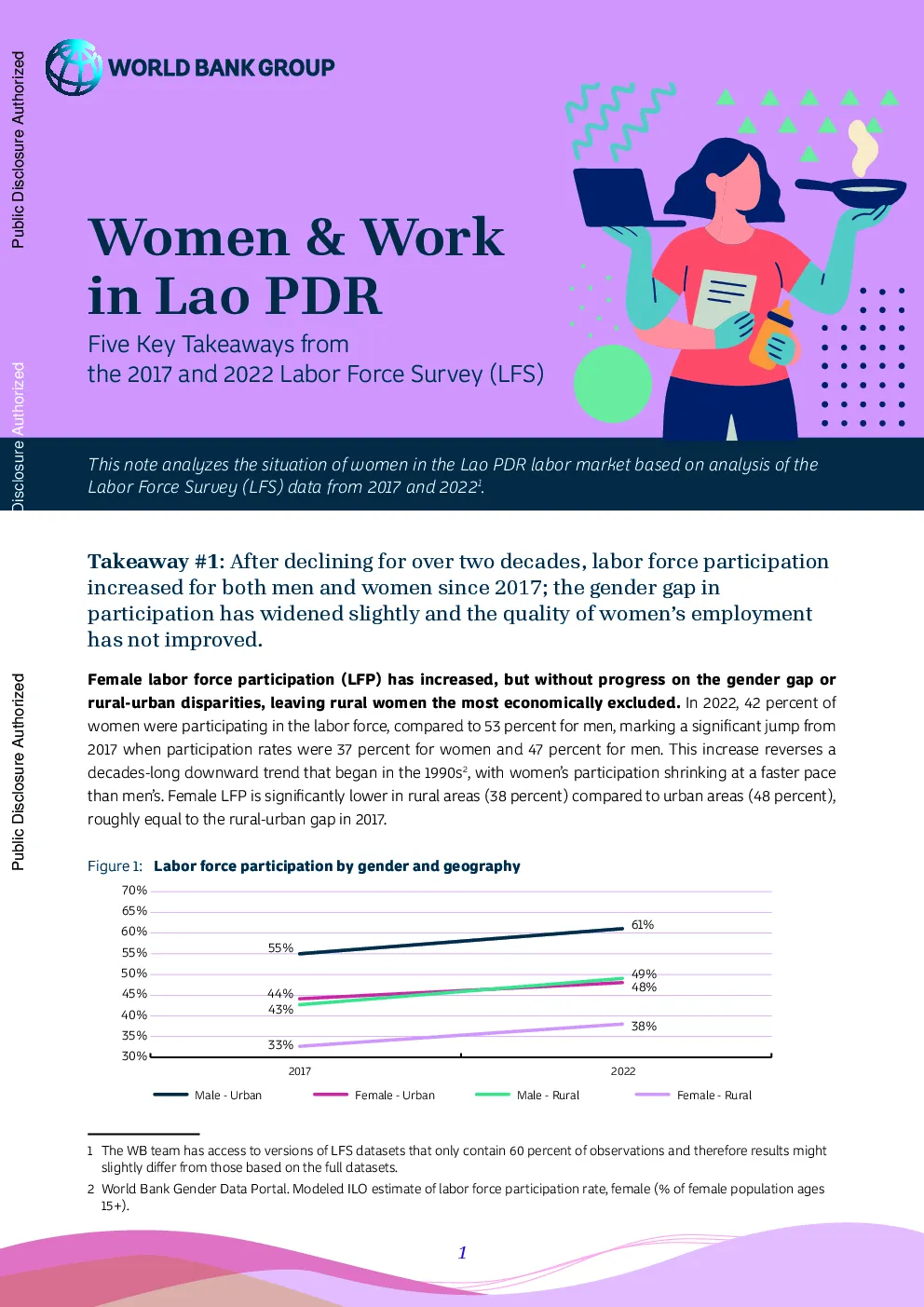
Five Key Takeaways fromthe 2017 and 2022 Labor Force Survey (LFS) This note analyzes the situation of women in the Lao PDR labor market based on analysis of theLabor Force Survey (LFS) data from 2017 and 20221. Takeaway #1: After declining for over two decades, labor force participationincreased for both men and women since 2017; the gender gap inparticipation has widened slightly and the quality of women’s employmentPublic Disclosure Authorized Female labor force participation (LFP) has increased, but without progress on the gender gap orrural-urban disparities, leaving rural women the most economically excluded.In 2022, 42 percent ofwomen were participating in the labor force, compared to 53 percent for men, marking a significant jump from2017 when participation rates were 37 percent for women and 47 percent for men. This increase reverses a Among women who work, nearly three quarters (74 percent) are engaged in vulnerable types ofemployment, as contributing family workers or own account workers;the share of women in theformal sector is small and has showed signs of recent decline.Most women are either contributing familyworkers (40 percent) or own-account workers (34 percent), both of which are classified as vulnerable formsof employment. In contrast, only 27 percent of men are contributing family workers. Between 2017 and 2022women experienced a modest shift from contributing family work (42 percent to 40 percent) to own-account Women who are engaged in wage employment earn about 20 percent less than men.The hourly wagefor women in employment work is 15,539 kip ($0.73), compared to 19,388 kip ($0.91) for men, highlighting apersistent gender wage gap. The widest pay gap is for women of 55 years and older. This disparity remainsconsistent across geographic areas, with women in urban areas earning only slightly more (15,740 kip) than Takeaway #2: Rural women, adolescent girls and women with disabilities Men and women participate equally across sectors of the labor market in both rural and urbanareas.In rural areas, agriculture is the dominant sector of work for both women (75 percent) and men (73percent), while the service sector predominates in urban areas (57 percent for women and 49 percent for Almost 7 out of 10 young women are inactive (67 percent) and unemployment, at 5 percent, is significantlyhigher than for all other age groups. Among those who are employed, half work as contributing family workers,compared to 37 percent of older women, and they are less likely to be own-account workers or employees. Womenwith disabilities face significant barriers to education,employment,and economicindependence.An estimated 1.7 percent of women live with a disability—similar to the rate among men—disabilities are more prevalent among adult women (2.6 percent), those from the poorest households (2.4percent in the lowest quintile), and those in rural areas (1.8 vs. 1.4 percent in urban areas). Women with disabilitieshave notably lower literacy and schooling, with 73 percent having no education compared to 26 percent of Takeaway #3: Reducing the gender gap in human capital could lead to betterlabor market outcomes, as higher education is linked to higher employment Education and skills are key drivers of FLFP, with inactivity rates decreasing as education levels rise. Inactivity is highest among women with no education (74 percent) and gradually declines to 56 percent forthose with primary education, 54 and 56 percent respectively for lower and upper secondary education and23 percent for those with tertiary education. Vocational training also has a positive impact, with an inactivity The gender gap in employment remains consistent among individuals with education levels up tosecondary school but disappears for those with tertiary education.Among working age individuals withno formal education, the share of females in employment is 9 percentage points lower than the male ones, andthis disparity remains relatively unchanged at higher education levels up to upper secondary. However, the gap Women are disadvantaged by higher rates of illiteracy and lower access to education and skillstraining opportunities. In 2022, female literacy, at 82 percent, was lower than male literacy at 88 percent.However, there has been progress since 2017, largely driven by improvements in rural areas, where femaleliteracy increased from 71 percent to 77 percent (compared to a rise from 89 percent to 91 percent in urban areas).Despite these gains, barriers to girls’ education remain, 27 percent of women have no education, significantly Takeaway #4: FLFP is also restricted by the substantial amount of timewomen spend on unpaid domestic work, with childcare being the most time- Women are underemployed but overworked. Employed women (aged between 15 and 65) are more likelythan their male counterparts to work less than 40 hours a week, with 31 percent of women and 25 percentof men experiencing underemployment. This issue is more