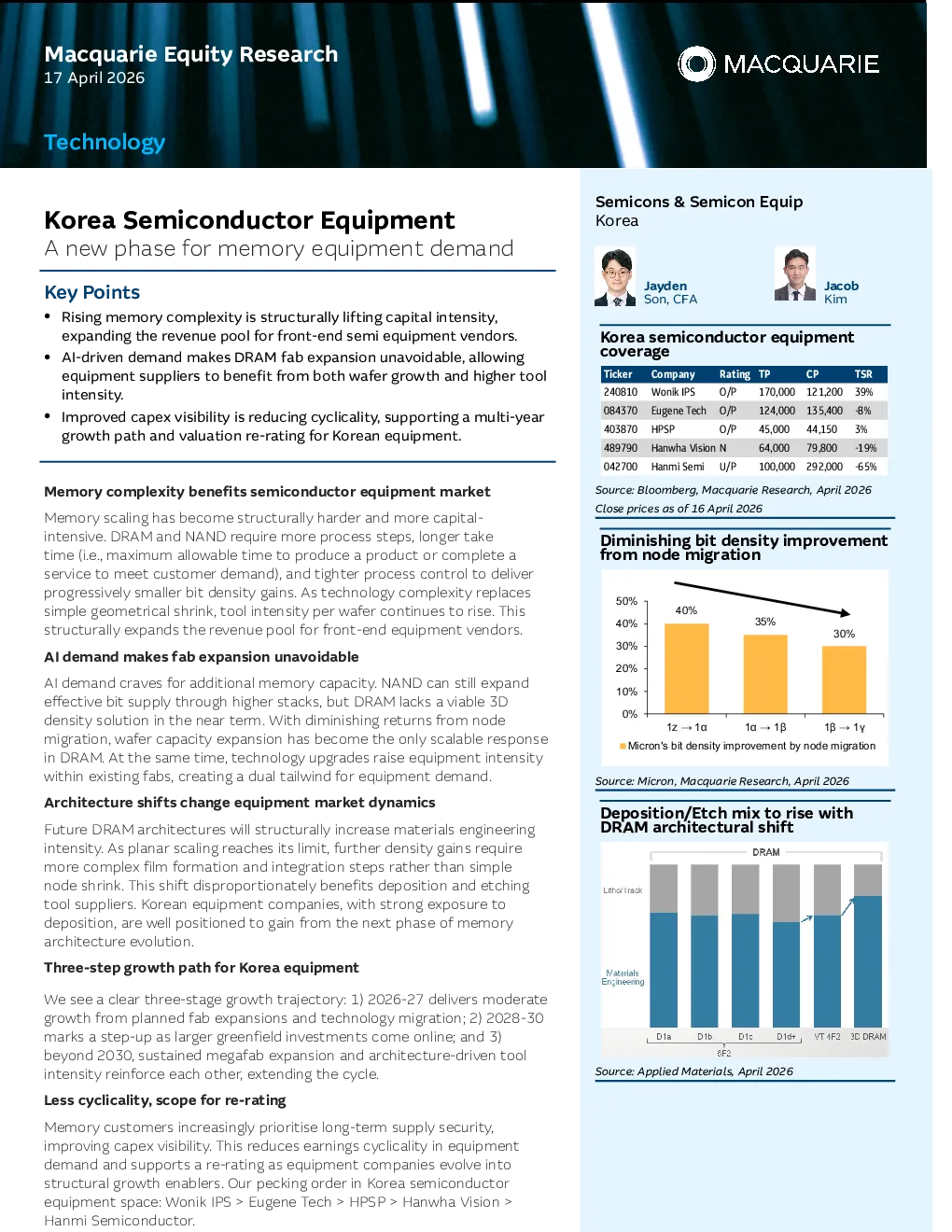
Technology Semicons & Semicon EquipKorea Korea Semiconductor EquipmentA new phase for memory equipment demand JaydenSon, CFA JacobKim Key Points• Rising memory complexity is structurally lifting capital intensity,expanding the revenue pool for front-end semi equipment vendors.•AI-driven demand makes DRAM fab expansion unavoidable, allowingequipment suppliers to benefit from both wafer growth and higher toolintensity.•Improved capex visibility is reducing cyclicality, supporting a multi-yeargrowth path and valuation re-rating for Korean equipment. Korea semiconductor equipmentcoverage Memory complexity benefits semiconductor equipment market Memory scaling has become structurally harder and more capital-intensive. DRAM and NAND require more process steps, longer taketime (i.e., maximum allowable time to produce a product or complete aservice to meet customer demand), and tighter process control to deliverprogressively smaller bit density gains. As technology complexity replacessimple geometrical shrink, tool intensity per wafer continues to rise. Thisstructurally expands the revenue pool for front-end equipment vendors. AI demand makes fab expansion unavoidable AI demand craves for additional memory capacity. NAND can still expandeffective bit supply through higher stacks, but DRAM lacks a viable 3Ddensity solution in the near term. With diminishing returns from nodemigration, wafer capacity expansion has become the only scalable responsein DRAM. At the same time, technology upgrades raise equipment intensitywithin existing fabs, creating a dual tailwind for equipment demand. Source: Micron, Macquarie Research, April 2026 Architecture shifts change equipment market dynamics Future DRAM architectures will structurally increase materials engineeringintensity. As planar scaling reaches its limit, further density gains requiremore complex film formation and integration steps rather than simplenode shrink. This shift disproportionately benefits deposition and etchingtool suppliers. Korean equipment companies, with strong exposure todeposition, are well positioned to gain from the next phase of memoryarchitecture evolution. Three-step growth path for Korea equipment We see a clear three-stage growth trajectory: 1) 2026-27 delivers moderategrowth from planned fab expansions and technology migration; 2) 2028-30marks a step-up as larger greenfield investments come online; and 3)beyond 2030, sustained megafab expansion and architecture-driven toolintensity reinforce each other, extending the cycle. Less cyclicality, scope for re-rating Memory customers increasingly prioritise long-term supply security,improving capex visibility. This reduces earnings cyclicality in equipmentdemand and supports a re-rating as equipment companies evolve intostructural growth enablers. Our pecking order in Korea semiconductorequipment space: Wonik IPS > Eugene Tech > HPSP > Hanwha Vision >Hanmi Semiconductor. Executive summary A structurally better cycle for memory equipment Memory manufacturing has entered a phase in which scaling delivers diminishing bit-density gains at rising cost. In both DRAM and NAND, each technology step now requiresmaterially more process steps, tighter margins and longer cycle times, while deliveringsmaller incremental density benefits than in prior generations. Node shrink alone no longerprovides a low-cost path to growth. Instead, memory production increasingly relies on toolintensity rather than geometry. As process complexity surges, equipment value per waferrises structurally, reshaping the long-term opportunity set for WFE suppliers. Rising capital intensity is no longer cyclical DRAM and NAND are converging toward similar investment intensity, yet neither achievesthe historical density gains that once justified rapid node migration. DRAM faces acutedifficulty in preserving capacitance while shrinking cell area, forcing taller, more complexcapacitor structures and tighter integration control. NAND stacking continues, but eachincremental layer compounds deposition, etch and integration complexity. Process countsincrease, takt time lengthens, and effective output depends as much on manufacturingexecution as nominal capacity. This dynamic lifts tool content per wafer and structurallyexpands the WFE revenue pool. Architecture shift reshapes WFE mix Memory architecture change will drive the next leg of equipment growth. DRAM still relieson node shrink because technical barriers delay a full 3D transition, supporting a higherlithography share in the near term. Once DRAM moves beyond planar limits toward4F²and ultimately 3D architectures post-2030, materials engineering intensity rises sharply,favouring deposition and etch. NAND already has crossed this threshold. As stacks growtaller, materials engineering dominates over lithography, while wafer bonding emerges asa critical enabler of scalable manufacturing. Korean vendors with strength in deposition,advanced cleaning, and interfacial c