您的浏览器禁用了JavaScript(一种计算机语言,用以实现您与网页的交互),请解除该禁用,或者联系我们。 [安联研究]:AI资本开支周期:在战争冲击下仍具韧性 - 发现报告

AI资本开支周期:在战争冲击下仍具韧性

金融 2026-03-25 安联研究 ShenLM
报告封面

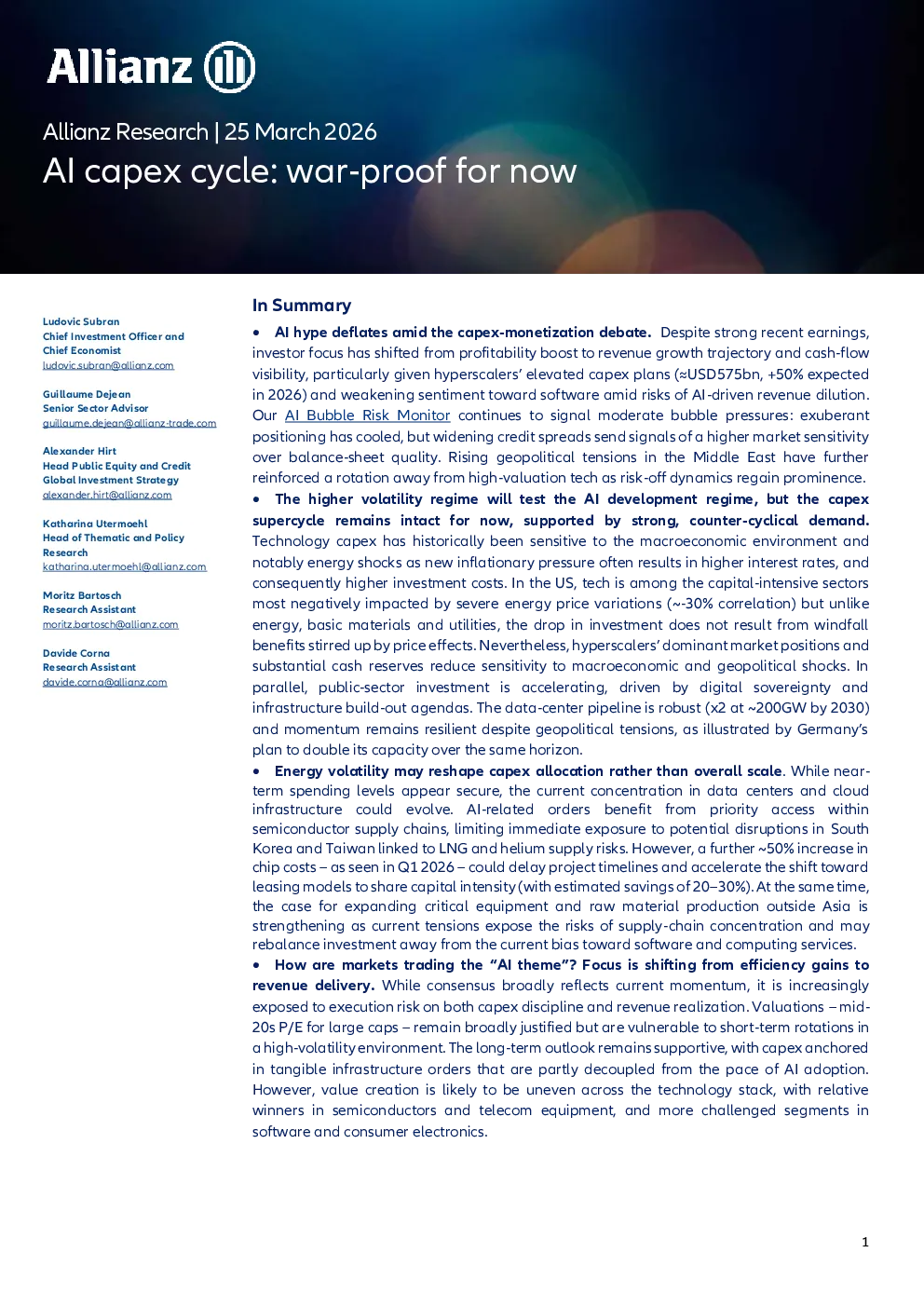
Allianz Research|25March2026AIcapexcycle:war-proof for now In Summary Ludovic SubranChief Investment Officer andChiefEconomistludovic.subran@allianz.com •AI hypedeflatesamidthecapex-monetization debate.Despite strong recent earnings,investor focus has shiftedfromprofitabilityboost to revenue growth trajectoryand cash-flowvisibility, particularly given hyperscalers’ elevated capex plans (≈USD575bn, +50% expectedin 2026) and weakening sentiment toward software amid risks of AI-driven revenue dilution.OurAI Bubble Risk Monitor continues to signal moderate bubble pressures: exuberantpositioning has cooled, but widening credit spreads send signals of a higher market sensitivityover balance-sheet quality.Rising geopolitical tensions in the Middle East have furtherreinforced a rotation away from high-valuation tech as risk-off dynamics regain prominence. Guillaume DejeanSenior Sector Advisorguillaume.dejean@allianz-trade.com AlexanderHirtHead Public Equity and CreditGlobal Investment Strategyalexander.hirt@allianz.com •The higher volatility regime will test the AI development regime, but the capexsupercycleremains intact for now,supported by strong,counter-cyclical demand.Technology capexhas historically beensensitive tothemacroeconomicenvironment andnotably energy shocksas new inflationary pressure often resultsin higher interest rates,andconsequentlyhigher investment costs. Inthe US,techis amongthecapital-intensive sectorsmost negatively impacted by severe energy price variations(~-30% correlation) butunlikeenergy, basic materials and utilities,the drop in investment does not result from windfallbenefits stirredup by price effects.Nevertheless, hyperscalers’ dominant market positions andsubstantial cash reserves reduce sensitivity to macroeconomic and geopolitical shocks. Inparallel,public-sector investment is accelerating,driven by digital sovereignty andinfrastructure build-out agendas. The data-center pipeline is robust(x2 at~200GW by 2030)and momentum remains resilient despite geopolitical tensions, as illustrated by Germany’splan to double its capacity over the same horizon. Katharina UtermoehlHead of Thematic and PolicyResearchkatharina.utermoehl@allianz.com Moritz BartoschResearch Assistantmoritz.bartosch@allianz.com Davide CornaResearch Assistantdavide.corna@allianz.com •Energy volatility may reshape capexallocation rather than overall scale. While near-term spending levels appear secure, the current concentration in datacenters and cloudinfrastructurecould evolve.AI-related orders benefit from priority access withinsemiconductor supply chains, limiting immediate exposure to potential disruptions inSouthKorea and Taiwan linked to LNG and helium supply risks. However, a further ~50% increase inchip costs–as seen in Q1 2026–could delay project timelines and accelerate the shift towardleasing models to share capital intensity (with estimated savings of 20–30%). At the same time,the case for expanding critical equipment and raw material production outside Asia isstrengthening as current tensions expose the risks of supply-chain concentration and mayrebalance investment away from the current bias toward software and computing services.•Howaremarkets tradingthe“AI theme”?Focus is shifting from efficiency gains to revenue delivery.While consensus broadly reflects current momentum, it isincreasinglyexposed to execution risk on both capex discipline and revenue realization. Valuations–mid-20s P/E for largecaps–remain broadly justified but are vulnerable to short-term rotations ina high-volatility environment.The long-term outlook remains supportive, with capex anchoredin tangible infrastructure orders that are partly decoupled from the pace of AI adoption.However, value creation is likely to be uneven across the technology stack, with relativewinners in semiconductors and telecom equipment, and more challenged segments insoftware and consumer electronics. AIcycle:capex monetization debatesteals the showduring last earnings season TheQ4 2025earnings season confirmed thefundamentalresilienceand growthof the globaltechnology sector.The NYSE FANG+ Index–our preferred gauge for tech and tech‑enabled growth companies–showedrobustfinancialperformancein the most recent quarter. Aggregate resultsextended on previous strong delivery onexpectations, with revenues rising by roughly+17% year‑on‑year and earnings by around+25%. Each of theleadingtech firms exceeded estimates,on average byabout 0.5% on sales and 1.6% on earnings acrossallconstituents.Corporate guidance remained constructive,best highlightedby Meta’s 5-10% upward revision to its sales outlook.Software companies also highlighted the fundamental potential of AIamidamplified concerns aboutthepotentialcannibalization of traditional service lines in areas such as legal, consulting and financial services. AI capexis setto continueincreasingfurther in 2026,alongsideinvestors’ concerns.AI capex remains the definingmarket debate in 2026 as technology leader