黄金市场评论:攀登火山
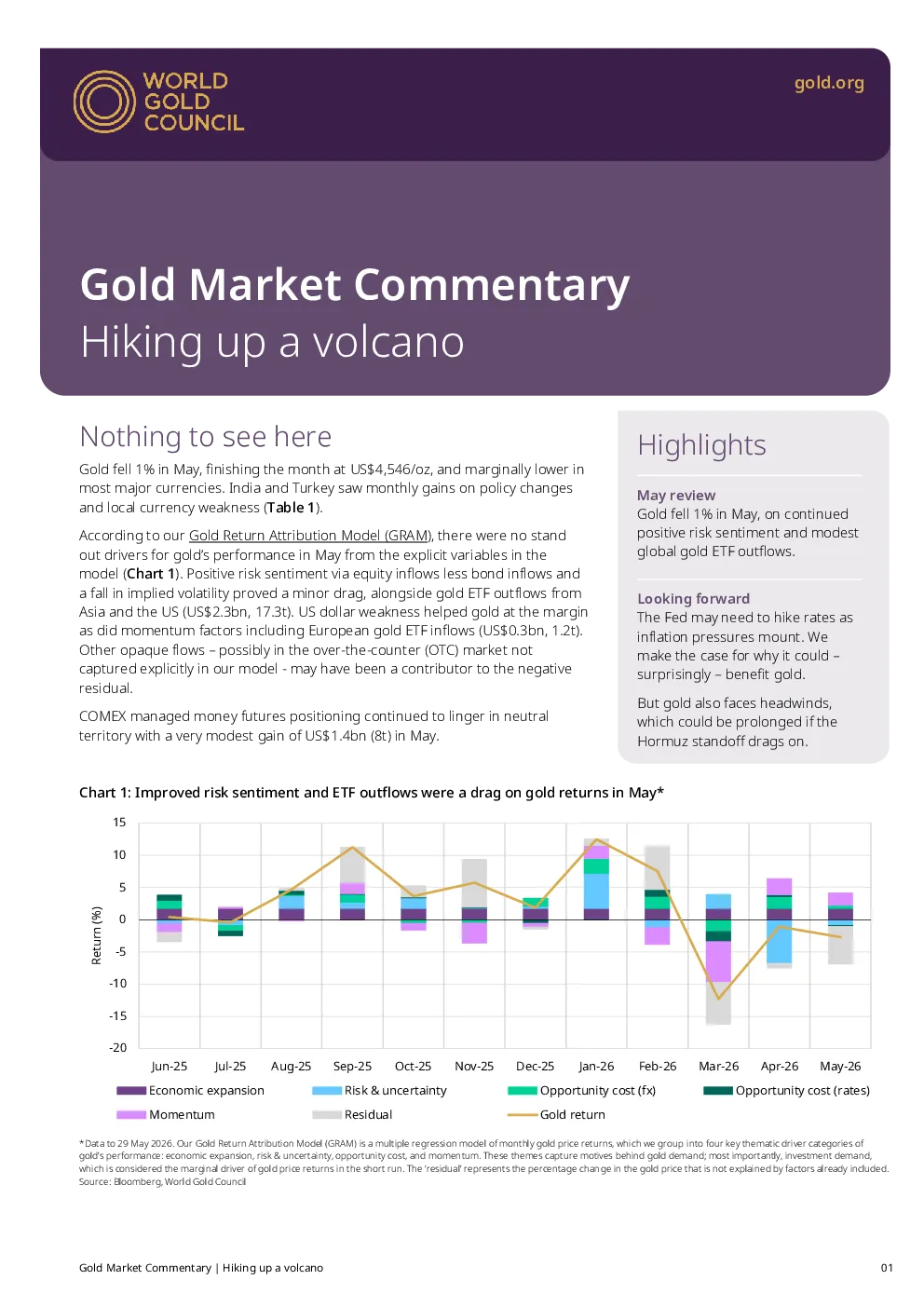
黄金市场评论 攀登火山 这里没什么好看的 亮点 5月份黄金下跌了1%,以每盎司4546美元的价格结束当月,并且在大多数主要货币中略有下跌。印度和土耳其因政策变化和当地货币疲软而录得月度涨幅(表1)。 可能进行审查 5月份,黄金下跌了1%,这得益于持续看好的风险情绪以及适度规模的全球黄金ETF资金流出。 根据我们的黄金回报归因模型(GRAM),5月份黄金表现并无突出的驱动因素,模型中的显性变量未能解释(图表1)。股票资金流入大于债券资金流入带来的正面风险情绪,以及隐含波动率的下降,构成轻微拖累,同时亚洲和美国的黄金ETF资金流出(23亿美元,173吨)也起到了作用。美元走弱在边缘上对黄金有所帮助,而动量因素,包括欧洲黄金ETF资金流入(3亿美元,12吨),也发挥了作用。其他不透明的资金流动——可能是在我们模型未明确捕捉的场外交易(OTC)市场——可能对负残差有所贡献。 期待 美联储可能需要加息,因为通胀压力正在加大。我们论证了为什么这——出人意料地——可能对黄金有利。 但黄金也面临逆风,如果霍尔木兹对峙持续下去,这种逆风可能会持续更长时间。 COMEX管理资金期货的仓位继续维持在中间地带,5月份仅小幅上涨14亿美元(80万公吨)。 我们的观点是,当金价上涨时,这可能会反直觉地有利于黄金。以下是我们的论点: 登山 • 数据:黄金在加息时超过50%的情况下表现超出预期。其加息后的中位数一个月(21天)回报率——经调整以剔除长期平均21天回报率0.84%——为正值。 • 美联储今年晚些时候可能需要加息,而这可能给风险资产和经济带来麻烦。至于加息和黄金的反应,历史表现则喜忧参半。 • 值得注意的先例表明,当时的情况与现在相似,并且在那几次场合,黄金对加息作出了积极反应。 • 重要的是政策利率本身,而是市场如何解读紧缩对增长、通胀可信度、金融稳定和美元的影响。 但黄金也面临短期利空,而重大的石油冲击可能会延长低迷状态。 在2024年开始的、颇具争议的降息周期之后,市场已转向强劲的可能性,即年底及以后可能加息,同时经济保持坚挺并面临传导型通胀压力。这可能会通过贴现率压低风险资产,并增加家庭和企业的借贷成本。 • 这次可能不同:在之前的周期中,加息往往标志着政策可信度以及经济正常化。然而,如今加息却可能越来越多地标志着: 资源民族主义抬头,持续通胀压力加剧 美國及海外均面臨財政壓力 传统观点认为,较高的政策利率会通过更高的实际收益率和更强的美元来压制黄金。但证据并不一致。历史上,加息并未对收益率、美元或黄金产生统一的反应。 更多 divergent FOMC 观点带来的政策失误风险、政治压力以及对再次出错(的)恐惧。 • 关注美元:从历史上看,美元对黄金命运的重要性要高于对利率的重要性。中期的增长和收益率趋同,以及远离美国资产的多元化推动,为美元走弱前景指明了相当清晰的路径,对此市场普遍达成共识。 涨价前后的累计调整回报* • 其他因素也很重要:来自中国、印度和央行的需求结构上对美国利率不那么敏感,可能在当前低迷期之外提供支撑。 • 风险资产脆弱性:高利率可能成为股市的压垮稻草。除了贴现率的机械重估外,万得研究指出,过去几年中,长期国债收益率即使只是相对温和的上涨,也反复动摇了短期股市反弹。 • 2023年3月22日:美联储加剧了银行体系的紧张状况。长期利率大幅下跌,因为市场加速预期美联储将暂停加息并最终放松货币政策。6 目前银行体系没有明显的紧张迹象,但对私人信贷的担忧正在加剧。 何时以及为何远足有利于黄金 历史上存在显著先例,黄金表现超出预期,实现了上涨(见图3): • 2006年6月29日:这是周期中的最后一次加息;住房市场正在放缓,增长担忧加剧。黄金也处于一个早期阶段,受到近期获得解放的中国投资市场、黄金ETF的推出以及商品繁荣所驱动的、对利率不敏感的购买行为的推动。换句话说,美联储是在加息过程中进入脆弱阶段,而“其他因素”也很重要——就像今天一样。 可能出什么问题? 我们的观点并非认为金价上涨本身就意味着看涨。 历史上,如果加息( hikes)有助于强化美元、推高实际收益率并提振市场情绪(如图4所示),那么通常对黄金不利。如果加息周期实质性地提升了市场对美联储信誉的评估,黄金可能面临进一步的压力。 • 2017年3月15日:选举后的再通胀交易和做多美元的仓位变得拥挤。此次加息被解读为鸽派,相对预期而言,长期利率下降。即便仓位目前处于中性,今日美元走弱的观点依然强劲且普遍存在。 此外,一些近期的逆风依然存在。 部分实体市场似乎有所疲软,印度、韩国出现折扣,并有零星证据显示日本也有销售。5月份全球黄金ETF资金流入表现平平。随着霍尔木兹海峡对峙持续,官方部门进行零星掉期交易或出售的可能性依然存在。从技术角度看,黄金仍显脆弱——其价格徘徊在200日移动平均线附近,呈现出一个看似下降的通道。 • 2018年12月19日:市场将此次加息解读为政策失误,导致股票市场急剧抛售,长期利率暴跌。在目前情况下,鉴于美联储内部可能更加分裂且存在政治化风险,出现政策失误的可能性并非零。 • 2022年11月2日:一场激进的徒步旅行周期与日益增长的市场脆弱性相碰撞。英国LDI危机已 destabilised 债券市场,随后美元达到峰值。5 目前,由于财政担忧和长期通胀担忧,G10国家长期债券收益率正在上涨。黄金在应对地缘政治峰值方面有着良好的记录。 徒步后金与利率及美元*的相关性 涨价前后的累计调整回报* 3.美联储加息后,股市上涨但美元下跌——事件回顾 | 商业 | 卫报4. 投资者警惕政策失误,此前曾为加息放缓欢呼 | 路透社 近期最大的风险可能来自能源市场。石油正主导着头条新闻和通胀预期,并推动着债券收益率(见图5)。由库存消耗驱动的能源价格急剧上涨,在长期影响显现之前,可能会最初推高收益率,增强美元,并延长黄金当前的低迷状态。7 原油与债券收益率*的21天滚动相关性 我们主要的模型通常将利率上升与金价下跌联系起来,价格上升反而是例外而非规则。这里的论点是,如果加息最终到来,那么出现例外情况是合理的。市场可能不会因此增强信心,反而会将其解读为潜在脆弱性的证据。 世界黄金协会 研究 我们是一个致力于倡导黄金作为战略资产作用、塑造负责任且易于获取的黄金供应链未来的会员组织。我们的专家团队通过可信的研究、分析、评论和见解,建立对黄金应用案例和可能性的理解。 杰里米·德·佩斯米耶,CFA 资产配置策略师 约翰·帕尔姆贝格资深量化分析师 卡维塔·查科,首席研究员,印度 克里希安·戈帕尔(Krishan Gopaul) 高级分析师,欧洲、中东和非洲区路易斯街高级市场分析师 我们推动行业进步,塑造政策,并为一个永久且可持续的黄金市场设定标准。 主要作者 玛里萨·萨利姆 大中华区首席研究官 贾瑞(Ray Jia)研究主管,亚太区(APAC)-前印度及贸易合作副主管,中国 约翰·帕尔姆贝格资深量化分析师 世界黄金协会 泰勒·伯内特,美洲研究主管 胡安·卡洛斯·阿蒂加斯,美洲区区域首席执行官,全球研究负责人 市场策略 约翰·里德(资深)——欧洲及亚太区市场策略师 约瑟夫·卡瓦托尼,资深市场策略师,美洲区 更多信息: 数据集和方法论访问:www.gold.org/goldhub Contact:research@gold.org 重要信息与披露 © 2026 世界黄金协会。版权所有。世界黄金协会及圆圈标志均为世界黄金协会或其附属机构的商标。 未经世界黄金协会或相关版权所有者事先书面许可,禁止复制或重新分发本信息中的任何内容,下文另有具体规定者除外。本信息及统计数据为世界黄金协会或其关联公司或本文件中指明的第三方提供者的版权©及其他知识产权。各自所有者的所有权利均予保留。 根据公平行业惯例,为审查和评论(包括媒体评论)之目的,允许使用本信息中的统计数据,但须满足以下两个前提条件:(i) 仅使用有限的数据或分析片段;(ii) 对这些统计数据的任何及所有使用均须注明世界黄金协会(其与金属聚焦公司有关联)及其它适当时注明金属聚焦公司或其它已确认版权所有者的来源。 世界黄金协会及其附属机构不对任何信息的准确性或完整性作出保证,亦不承担因使用该信息而直接或间接产生的任何损失或损害的责任。 本信息仅用于教育目的,通过接收本信息,您即表示同意其预期用途。本信息中任何内容均不构成投资建议、黄金购买或出售的提议,也不构成任何与黄金相关的产品或服务,或任何其他产品、服务、证券或金融工具(统称“服务”)的购买或出售提议。本信息未考虑任何特定个人的投资目标、财务状况或特殊需求。 多元化投资并不能保证任何投资回报,亦不能消除损失风险。过往业绩并不必然预示未来结果。通过投资黄金可能产生的任何投资结果的最终表现属于假设性质,可能无法反映实际投资结果,也不构成对未来结果的保证。世界黄金协会及其附属机构不对任何假设投资组合中使用的任何计算和模型,或由此产生的任何结果提供担保或保证。投资者应在就任何服务或投资做出任何决定前,与其相应的投资专业人士讨论其个人情况。 本信息可能包含前瞻性陈述,例如使用“相信”、“预期”、“可能”或“表明”等词语,或类似术语的陈述,这些陈述基于当前预期,并可能发生变化。前瞻性陈述涉及诸多风险和不确定性。无法保证任何前瞻性陈述将得以实现。世界黄金协会及其附属公司不承担更新任何前瞻性陈述的责任。 关于LBMA黄金价格的资讯 伦敦贵金属市场协会(LBMA)黄金价格由 ICE Benchmark Administration Limited(IBA)管理和发布。LBMA 黄金价格是贵金属价格有限公司的注册商标,IBA 作为 LBMA 黄金价格的运营机构获得授权。ICE 和 ICE Benchmark Administration 是 IBA 及其附属公司的注册商标。经 IBA 授权,世界黄金协会使用 LBMA 黄金价格,并受本协议条款(www.gold.org/terms-and-conditions)所列限制。 请注意,通过使用Quarium、黄金估值框架和其他信息所生成的各种投资结果的预期表现属于假设性质,可能无法反映实际投资结果,也不构成对未来结果的保证。世界黄金理事会(包括其附属机构)或牛津经济学院对工具的功能性不作任何保证或担保,包括但不限于任何预测、估计或计算。 本文件中所有源自ICRA Analytics Limited的信息均受本声明条款约束(www.icraanalytics.com/terms-of-use/disclaimer)。