惠普公司2026财年第二季度:好于预期,目标价上调至27美元
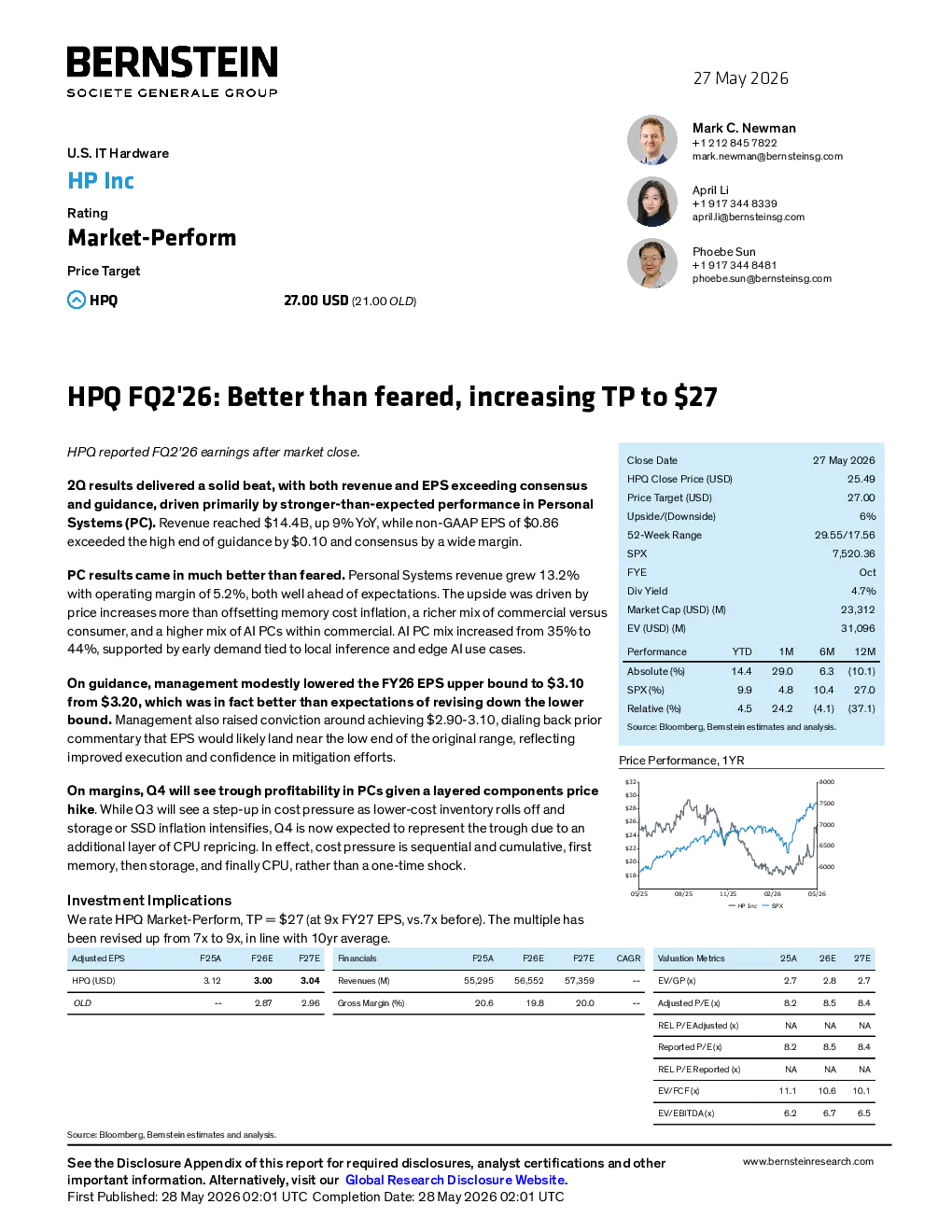
Mark C. Newman+1 212 845 7822mark.newman@bernsteinsg.comApril Li+1 917 344 8339april.li@bernsteinsg.com U.S. IT Hardware Market-Perform Phoebe Sun+1 917 344 8481phoebe.sun@bernsteinsg.com Price Target HPQ 27.00 USD(21.00OLD) HPQ FQ2'26: Better than feared, increasing TP to $27 HPQ reported FQ2’26 earnings after market close. Close Date27 May 2026HPQ Close Price (USD)25.49Price Target (USD)27.00Upside/(Downside)6%52-Week Range29.55/17.56SPX7,520.36FYEOctDiv Yield4.7%Market Cap (USD) (M)23,312EV (USD) (M)31,096 2Q results delivered a solid beat, with both revenue and EPS exceeding consensusand guidance, driven primarily by stronger-than-expected performance in PersonalSystems (PC).Revenue reached $14.4B, up 9% YoY, while non-GAAP EPS of $0.86 PC results came in much better than feared.Personal Systems revenue grew 13.2%with operating margin of 5.2%, both well ahead of expectations. The upside was driven byprice increases more than offsetting memory cost inflation, a richer mix of commercial versusconsumer, and a higher mix of AI PCs within commercial. AI PC mix increased from 35% to On guidance, management modestly lowered the FY26 EPS upper bound to $3.10from $3.20, which was in fact better than expectations of revising down the lowerbound.Management also raised conviction around achieving $2.90-3.10, dialing back priorcommentary that EPS would likely land near the low end of the original range, reflecting On margins, Q4 will see trough profitability in PCs given a layered components pricehike. While Q3 will see a step-up in cost pressure as lower-cost inventory rolls off andstorage or SSD inflation intensifies, Q4 is now expected to represent the trough due to anadditional layer of CPU repricing. In effect, cost pressure is sequential and cumulative, first Investment Implications We rate HPQ Market-Perform, TP = $27 (at 9x FY27 EPS, vs.7x before). The multiple hasbeen revised up from 7x to 9x, in line with 10yr average. DETAILS 2Q delivered a clear beat, with both revenue and EPS exceeding consensus and guidance.The beat was driven bybetter-than-expected performance from Personal Systems (PC). Non-GAAP EPS of $0.86 was $0.10 above the high end ofguidance ($0.70-0.76) and well ahead of the $0.71 consensus. Revenue of $14.4B grew 9% YoY, surpassing the roughly $14B For FY26, management lowered the upper bound of EPS guidance from $3.20 to $3.10, which was in fact better thanmany had expected that the lower bound might be revised down.At the same time, the company increased its convictionin achieving non-GAAP EPS of $2.90-3.10, and stronger execution has improved confidence in delivering higher EPS for the full PC came in much better than feared.Personal Systems revenue grew 13.2% with operating margin at 5.2%, both top-line and profitability well ahead of expectations. The upside was driven by 1) price increases more than offsetting memorycomponents price hikes, 2) a higher mix of commercial versus consumer, and 3) a richer mix of AI PCs within the commercialsegment. Commercial mix is richer than consumer, and within commercial, AI PCs/workstations skew to higher ASPs. AI PC mixrises from 35% to 44%, with customers preloading systems ahead of AI agentic workloads. Next-gen AI PCs relevant spec is We spent time understanding why management expects PC margins to trough in Q4 rather than Q3, as we initially assumedmost of the memory cost pressure would emerge in Q3 given Q2’s partially buffered by lower-cost inventory.The explanationlies in the layered cost pressures, first memory, then storage with CPU repricing acting as the final leg. Q2 margins were supported by inventory secured ahead of recent component price increases. As this benefit rolls off, Q3 willsee a meaningful step-up in cost pressure, driven primarily by storage or SSD inflation, while memory costs remain elevated butare increasing at a slower rate. Moving into Q4, margins face an additional headwind from CPU repricing on top of still-elevated Model and TP Update:We have tweaked up FY26 EPS to $3.00, up 4.7% vs before, due to the strong beat this quarter.Furthermore, we increased FY27 EPS by 2.7% to $3.04, due to the higher 2026 base and assuming some gradual recovery in We are raising our TP to $27, which is 9 x our FY27 EPS of $3.04. The multiple has been revised up from 7x to 9x, The multiplehas been revised up from 7x to 9x, in line with 10yr average. APPENDIX - FINANCIAL FORECASTS PRICE TARGET CHANGE / ESTIMATE CHANGE IN BOLD DISCLOSURE APPENDIX I. REQUIRED DISCLOSURES References to "Bernstein" or the “Firm” in these disclosures relate to the following entities: Bernstein Institutional Services LLC(April 1, 2024 onwards), Sanford C. Bernstein & Co., LLC (pre April 1, 2024), Bernstein Autonomous LLP, BSG France S.A. (April 1,2024 onwards), Sanford C. Bernstein (Hong Kong) Limited盛博香港有限公司,Sanford C. Bernstein (Canada) Limited, SanfordC. Bernstein (India) Private Limited (SEBI registration no. INH000006378), Sanford