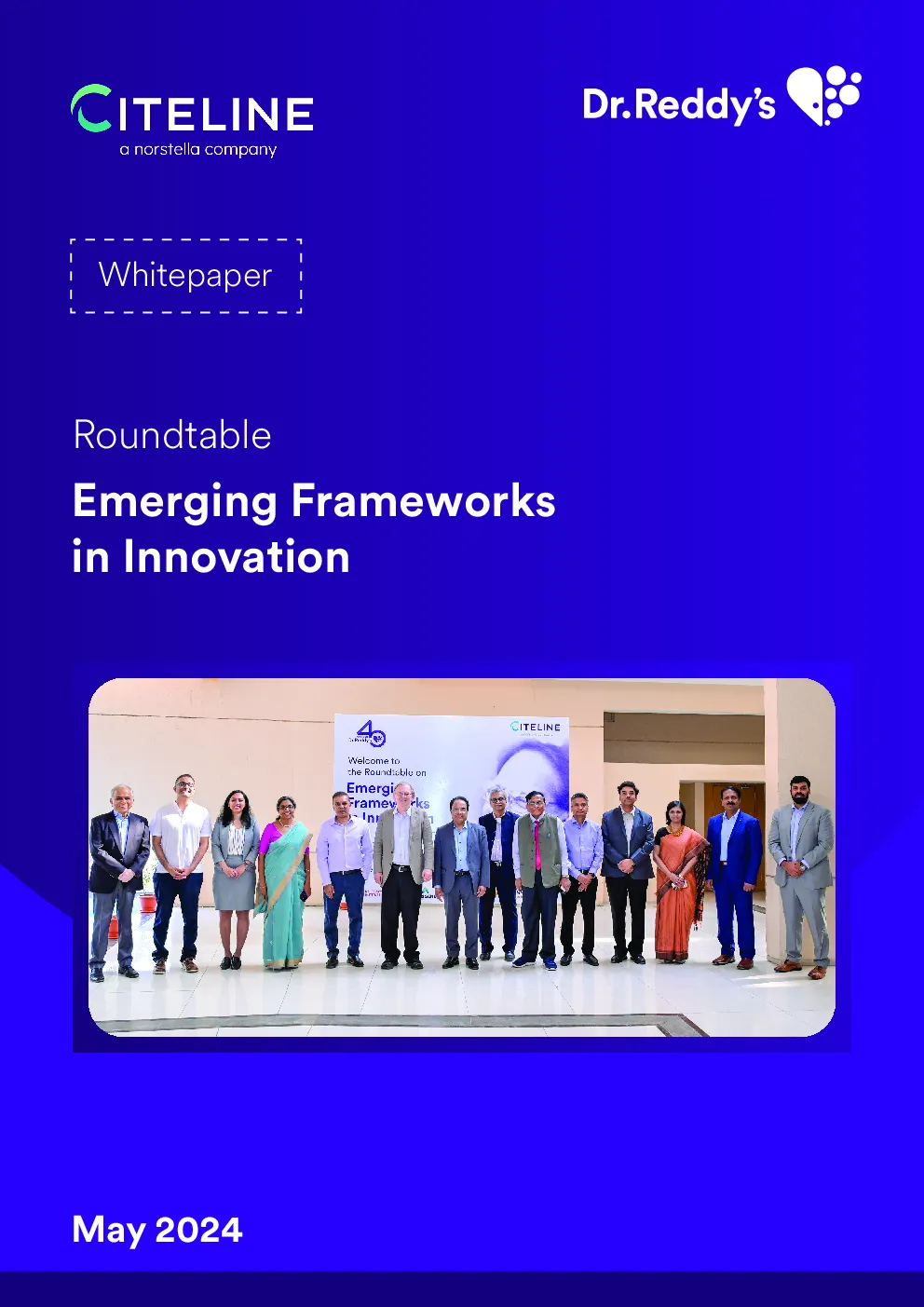
Emerging Frameworksin Innovation Emerging Frameworks in Innovation Chair: Satish Reddy,Chairman, Dr. Reddy’s Laboratories Ltd. Moderator: Ms. Anju Ghangurde,Executive Editor (Asia Pacific), Scrip/Pink Sheet, Citeline Panelists Professor Jack W. Szostak,Nobel LaureateDr. Harish Iyer,Deputy Director, Digital and Health Innovation – India Office, Bill &Melinda Gates FoundationDr. Yamuna Krishnan,Professor, Department of Chemistry, University of ChicagoDr. Shridhar Narayanan,Indian Pharmaceutical AllianceDr. Srinivas Oruganti,Director, Dr. Reddy’s Institute of Life SciencesDr. Murali Ramachandra,CEO, Aurigene OncologyDr. Radha Rangarajan,Director, CSIR-CDRIDr. Ajit Rangnekar,Director General, Research and Innovation Circle of Hyderabad(RICH), TelanganaDr. Ravindranathan,Continental HospitalsDr. Guru N. Reddy,Founder & Chief of Gastroenterology & Liver Diseases,Continental HospitalsDr. Trajko Spasenovski,Vice President, Custom Solutions, Citeline Overview New technologies are revolutionizing drug discovery worldwide. However, efficiently exploitingthese technological advances to develop new drugs and get them to patients can be extremelychallenging. Many stakeholders play significant roles in this complex process, includingacademic researchers, industry, government agencies, industry, and more. “Mainstreaming some of the new age therapies and emerging technologies will require thewhole ecosystem to go along – integrated data platforms, the funding environment,streamlining regulatory pathways, the patents system, addressing payer dynamics, etc.”– Anju Ghangurde, Citeline As India strives to become a larger player in the biopharma sector moving from cost-based tovalue and innovation-based growth, experts are focusing on addressing a variety of issues likecollaborative research, funding mechanisms, the regulatory environment, and the clinical trialinfrastructure. To focus greater attention and resources, and to generate increased momentumin support of the sector, industry and government leaders have developed long-term targets topromote and accelerate biopharma innovation. Emerging Frameworks in Innovation Context The second Dr. Anji Reddy Memorial Lecture, delivered by Nobel Laureate Professor JackSzostak, brought together distinguished leaders representing science, industry, academia, andgovernment. This lecture series was instituted in 2023 to honor the memory of scientist,entrepreneur, and philanthropist Dr. K. Anji Reddy, who founded Dr. Reddy’s Laboratories in1984. In conjunction with this lecture, a roundtable of leading biopharma experts discussed India’spotential to grow the country’s pharmaceutical industry from its current level of $50 billion peryear to $130 billion annually by 2030. The panelists shared their perspectives on achieving thisvision, which will require overcoming various innovation and regulatory challenges with boldthinking and radical steps. They examined the need for greater focus on innovation, transformingthe country’s biopharma ecosystem, rethinking regulatory frameworks, and creating newincentives for investment. “The Indian Pharmaceutical Alliance has set out a vision and said that by 2030, the industryshould reach $130 billion. It’s currently at $50 billion. We have said clearly that onlyinnovation can get us there…. Look at China. They started this innovation game in 2008 or2010. Look where they are today. It requires a different kind of thinking and bold, radicalsteps.”– Satish Reddy, Dr. Reddy’s Laboratories Ltd. Key Takeaways The global biopharma R&D pipeline is growing and will yield many near-term assets. To set the stage for the roundtable discussion, Trajko Spasenovski from Citeline reviewed thecurrent state of biopharma innovation worldwide. Highlights include: •Between 2001 and 2023, the size of the global biopharma R&D pipeline had a compoundannual growth rate of 5.9%. Currently, there are 21,292 drugs under development byapproximately 5,500 companies. Of these new drugs under development, 41% areanti-cancer, 20% are for rare diseases, and 14% are neurologicals. •R&D and innovation are highly diffused, as big pharma increasingly sources its portfolio fromexternal partners. Big pharma’s share of innovation continues to decline as mid-sizecompanies contribute to overall R&D growth. The Top 10 pharma companies’ share of theglobal biopharma pipeline decreased from 13.4% in 2011 to just 4.1% in 2023. It is platformbiotech companies that are now producing new drugs at scale. •Major themes of key drug launches in 2024 include oncology and novel modalities. Thepipeline is set to deliver 69 key launches across 65 discrete drugs in 2024. Of these keylaunches, 42% are expected to be practice changing. Oncology is leading the way with 29expected launches. •Nearly one-quarter of global biopharma R&D activity is occurring in China. China is the #2location for active R&D, behind the US, with 24% of the industry pipeline and 5,033 assetsunder development. Emergi