您的浏览器禁用了JavaScript(一种计算机语言,用以实现您与网页的交互),请解除该禁用,或者联系我们。 [世界卫生组织]:世界卫生组织在不丹的贡献评估(2020-2024年):执行摘要 - 发现报告

世界卫生组织在不丹的贡献评估(2020-2024年):执行摘要

2026-02-16 世界卫生组织 🌱
报告封面

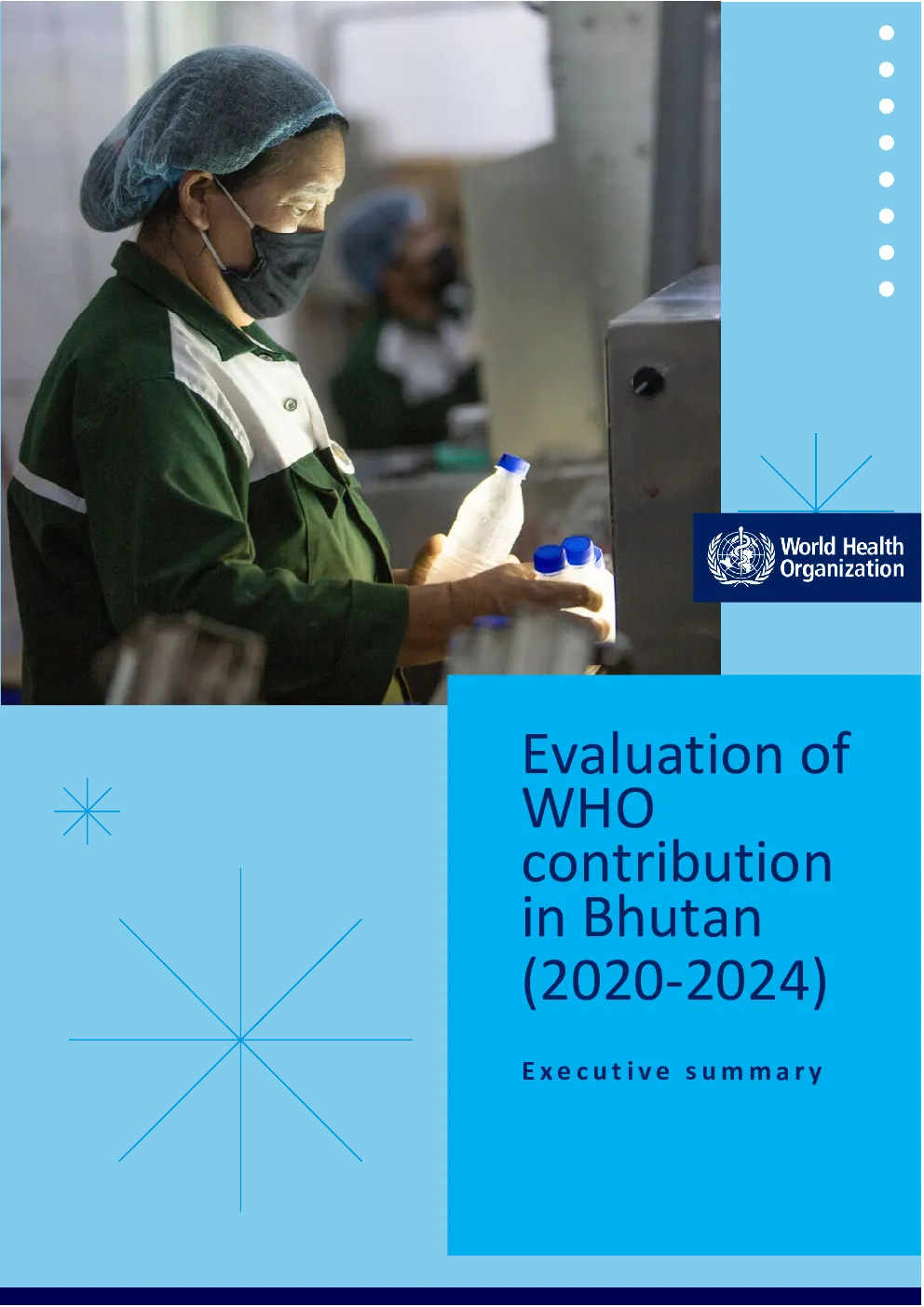
Ex e c u t i v e s u m m a r y © World Health Organization 2025 Some rights reserved. This work is available under the Creative Commons Attribution-NonCommercial-ShareAlike 3.0 IGO licence (CC BY-NC-SA 3.0 IGO;https://creativecommons.org/licenses/by-nc-sa/3.0/igo). Under the terms of this licence, you may copy, redistribute and adapt the work for non-commercial purposes,provided the work is appropriately cited, as indicated below. In any use of this work, there should be nosuggestion that WHO endorses any specific organization, products or services. The use of the WHO logo is notpermitted. If you adapt the work, then you must license your work under the same or equivalent CreativeCommons licence. If you create a translation of this work, you should add the following disclaimer along with thesuggested citation:“This translation was not created by the World Health Organization (WHO). WHO is notresponsible for the content or accuracy of this translation. The original English edition shall be the binding andauthentic edition”. Any mediation relating to disputes arising under the licence shall be conducted in accordance with the mediationrules of the World Intellectual Property Organization (http://www.wipo.int/amc/en/mediation/rules/). Suggested citation. Evaluation of WHO contribution in Bhutan 2020-2024: executive summary. Geneva: WorldHealth Organization; 2025.https://doi.org/10.2471/B09676. Licence:CC BY-NC-SA 3.0 IGO. Cataloguing-in-Publication (CIP) data.CIP data are available athttps://iris.who.int/. Sales, rights and licensing.To purchase WHO publications, seehttps://www.who.int/publications/book-orders.To submit requests for commercial use and queries on rights and licensing, seehttps://www.who.int/copyright. Third-party materials.If you wish to reuse material from this work that is attributed to a third party, such astables, figures or images, it is your responsibility to determine whether permission is needed for that reuse and toobtain permission from the copyright holder. The risk of claims resulting from infringement of any third-party-owned component in the work rests solely with the user. General disclaimers.The designations employed and the presentation of the material in this publication do notimply the expression of any opinion whatsoever on the part of WHO concerning the legal status of any country,territory, city or area or of its authorities, or concerning the delimitation of its frontiers or boundaries. Dotted anddashed lines on maps represent approximate border lines for which there may not yet be full agreement. The mention of specific companies or of certain manufacturers’ products does not imply that they are endorsed orrecommended by WHO in preference to others of a similar nature that are not mentioned. Errors and omissionsexcepted, the names of proprietary products are distinguished by initial capital letters. All reasonable precautions have been taken by WHO to verify the information contained in this publication.However, the published material is being distributed without warranty of any kind, either expressed or implied.The responsibility for the interpretation and use of the material lies with the reader. In no event shall WHO beliable for damages arising from its use. In line with theWHO Evaluation Policy 2018(EB143(9)), this publication contains an independent evaluationreport by the WHO Evaluation Office. It does not reflect the views or policies of WHO. Cover photo description: A woman inspects bottled water for physical contamination in Bhutan, part of the CodexTrust Fund food-safety project involving Bhutan, India and Nepal (11 August 2023). © WHO / Sue Price Executive summary I n t r o d u c t i o n Independent evaluations of the World Health Organization (WHO) contribution at the country level areconducted in line with the WHO Evaluation Policy (2018) and the implementation framework of WHOEvaluation Policy. The World Health Organization (WHO) commissioned this evaluation to assess thecontribution of WHO to Bhutan over the period 2020 to 2024 in pursuit of the planned outcomes of theWHO Country Cooperation Strategy (CCS), Bhutan, 2020–2025. The evaluation provides accountabilityfor WHO's contributions to national health outcomes and learning to inform the development of thenew CCS for 2026–2030, which was conducted in parallel with this assessment. The evaluation wascarried out between January 2025 and April 2025 by independent consultants. E v a l u a t i o n o b j e c t The object of this evaluation was WHO's contribution to progress towards the planned outcomes of theCCS 2020–2025 and related biennial work plans achieved, using input from all three levels of theOrganization – country office, South-East Asia Regional Office and headquarters. The strategic prioritiespursued, the intended outcomes and the financial expenditures during the evaluation period were partof the object of the evaluation. For the biennia 2020–2021, 2022–2023 and for 2024–2025