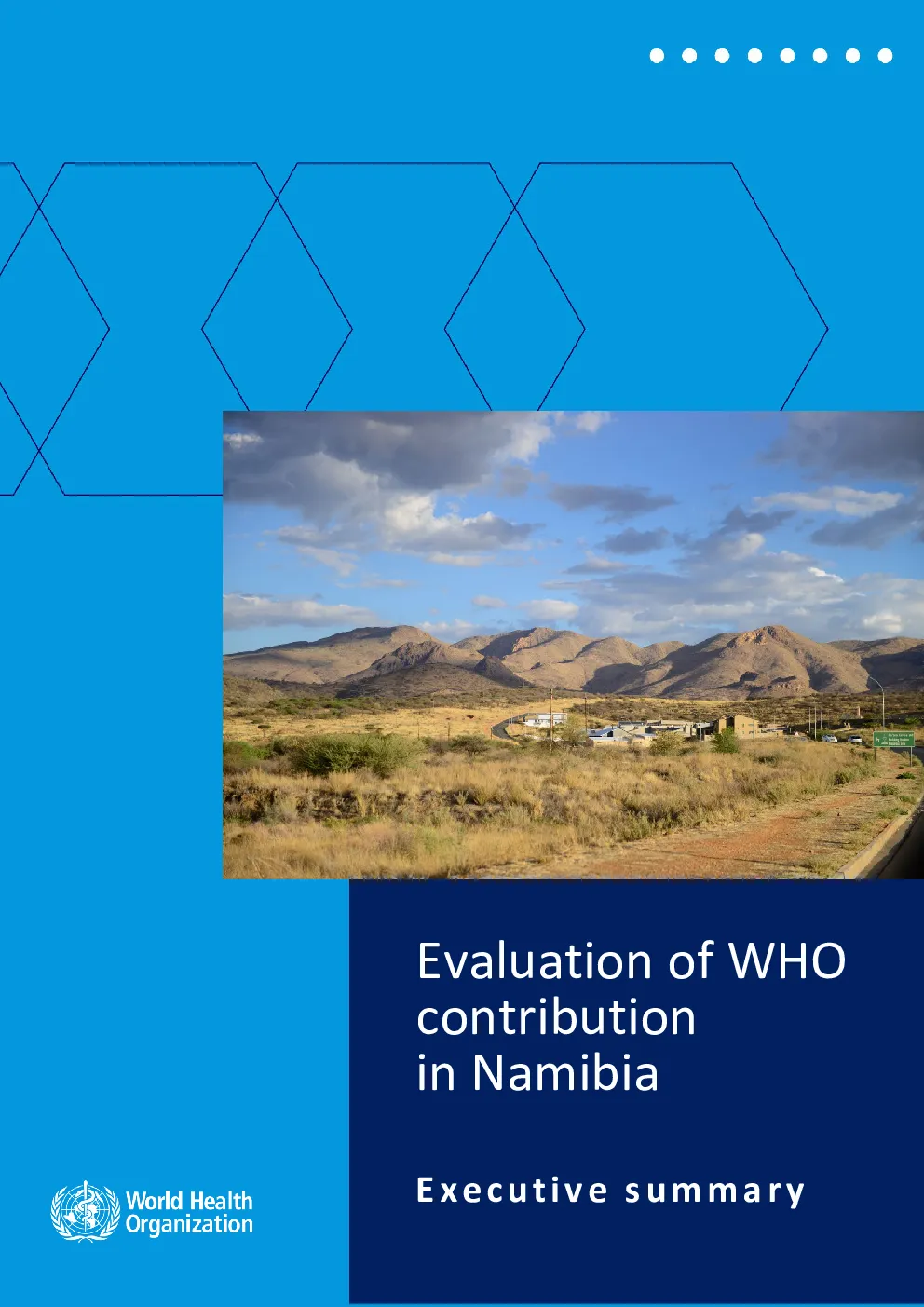
E x e c u t i v e s u m m a r y © World Health Organization 2026 Some rights reserved. This work is available under the Creative Commons Attribution-NonCommercial-ShareAlike 3.0 IGO licence (CC BY-NC-SA 3.0 IGO;https://creativecommons.org/licenses/by-nc-sa/3.0/igo). Under the terms of this licence, you may copy, redistribute and adapt the work for non-commercialpurposes, provided the work is appropriately cited, as indicated below. In any use of this work, thereshould be no suggestion that WHO endorses any specific organization, products or services. The useof the WHO logo is not permitted. If you adapt the work, then you must license your work under thesame or equivalent Creative Commons licence. If you create a translation of this work, you shouldadd the following disclaimer along with the suggested citation:“This translation was not created by Any mediation relating to disputes arising under the licence shall be conducted in accordance with themediation rules of the World Intellectual Property Organization Suggested citation. Evaluation of WHO contribution in Namibia: executive summary. Geneva:World Health Organization; 2026.https://doi.org/10.2471/B09734. Licence:CC BY-NC-SA 3.0 IGO. Cataloguing-in-Publication (CIP) data.CIP data are available athttps://iris.who.int/. Sales, rights and licensing.To purchase WHO publications, seehttps://www.who.int/publications/book-orders. To submit requests for commercial use and queries onrights and licensing, seehttps://www.who.int/copyright. Third-party materials.If you wish to reuse material from this work that is attributed to a third party,such as tables, figures or images, it is your responsibility to determine whether permission is neededfor that reuse and to obtain permission from the copyright holder. The risk of claims resulting from General disclaimers.The designations employed and the presentation of the material in thispublication do not imply the expression of any opinion whatsoever on the part of WHO concerningthe legal status of any country, territory, city or area or of its authorities, or concerning the The mention of specific companies or of certain manufacturers’ products does not imply that they areendorsed or recommended by WHO in preference to others of a similar nature that are not mentioned. All reasonable precautions have been taken by WHO to verify the information contained in thispublication. However, the published material is being distributed without warranty of any kind, eitherexpressed or implied. The responsibility for the interpretation and use of the material lies with the In line with theWHO Evaluation Policy 2018(EB143(9)), this publication contains an independentevaluation report by the WHO Evaluation Office. It does not reflect the views or policies of WHO. Cover page: A picture of a main road in Namibia taken for the Global Road Safety Campaign. © WHO Executive summary I n t r o d u c t i o n Independent evaluations of the World Health Organization (WHO) contribution at the country level areconducted in line with the WHO Evaluation Policy (2018 and 2025) and implementation framework. Inaccordance with this, an independent evaluation of WHO’s contribution in Namibia was commissioned by The evaluation focused on assessing WHO’s contributions to Namibia’s health sector under the CountryCooperation Strategy (CCS) III 2018–2024. It aimed to evaluate the added value of its support, and to WHO has been present in Namibia since the country's independence in 1990. Over the past three decades,WHO has played a significant role in supporting Namibia's health sector, contributing to major public E v a l u a t i o n o b j e c t The object of this evaluation is to assess WHO’s contribution in Namibia, both in terms of results achievedin the CCS III period and its role in implementation of CCS III, and the expected results set out in thebiennial work plans. It reflects the coordinated efforts of all three levels of WHO. CCS III targeted fourstrategic priorities: (1) advancing universal health coverage (UHC), (2) addressing health emergencies, (3)promoting healthier populations, and (4) strengthening leadership and governance. Implementation E v a l u a t i o n p u r p o s e , o b j e c t i v e sa n d i n t e n d e da u d i e n c e The evaluation aimed to strengthen WHO’s accountability to the national government and donors, as wellas to enhance organizational learning across its three levels. To do so, it assessed the CCS alignment withnational health priorities, analysing its achievements and challenges, evaluated its impact and resourceadequacy between 2018 to 2024, and identified lessons and recommendations to inform the design and Evaluation of WHO contribution in Namibia: executive summary headquarters levels, and emphasized cross-cutting issues such as gender equality, health equity, andhuman rights. The primary audience includes the WHO Country Office in Namibia, which will use thefindings to guide strategic and o