您的浏览器禁用了JavaScript(一种计算机语言,用以实现您与网页的交互),请解除该禁用,或者联系我们。[世界卫生组织]:评价世界卫生组织在约旦的贡献:执行摘要 - 发现报告

评价世界卫生组织在约旦的贡献:执行摘要

AI智能总结
查看更多
评价世界卫生组织在约旦的贡献:执行摘要

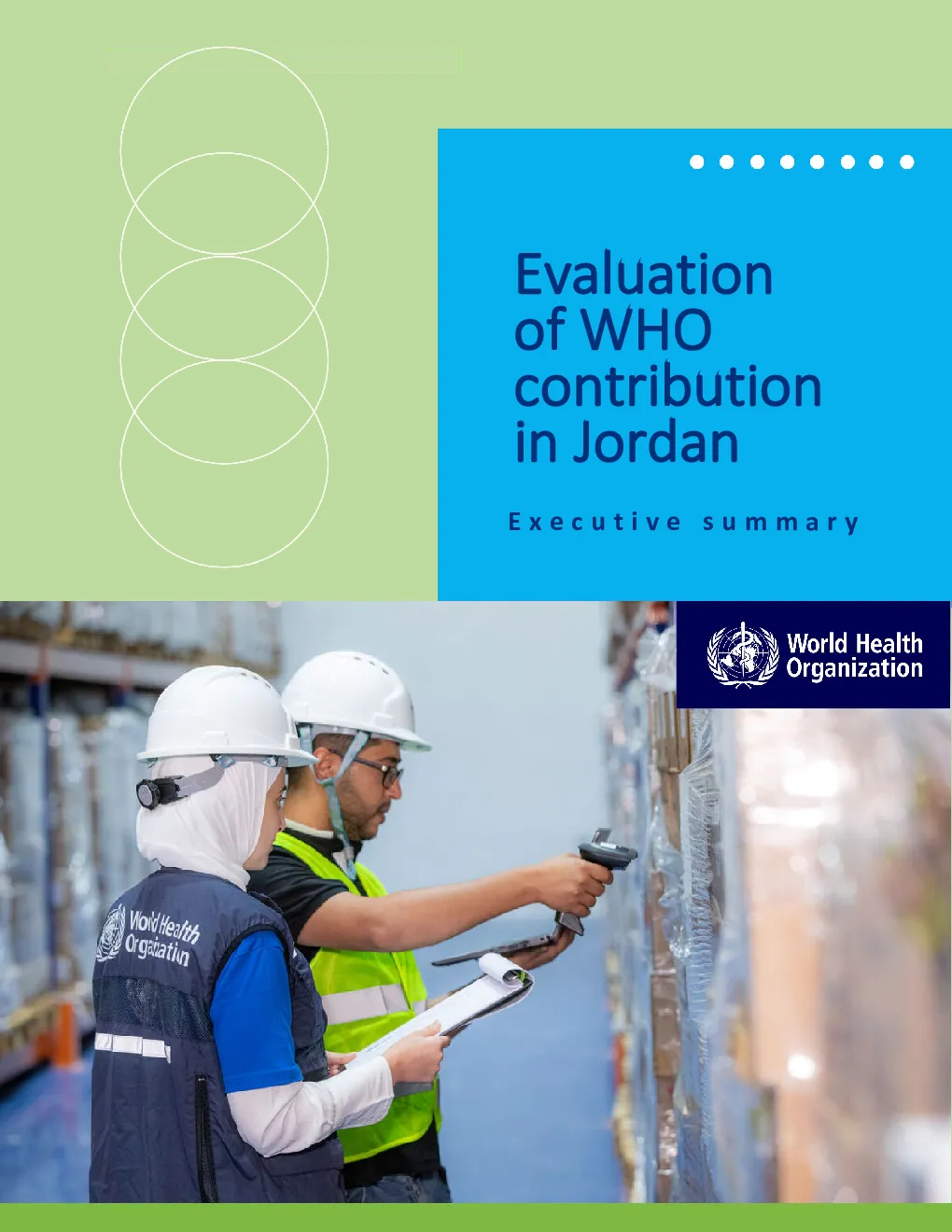
E x e c u t i v es u m m a r y The content of this document is not final and the text may be subject to editorial revisions beforepublication. The content of this draft, however, will not undergo substantive changes. The document maynot be reviewed, abstracted, quoted, reproduced, transmitted, distributed, translated or adapted, in partor in whole, in any form or by any means without the permission of the World Health Organization WHO/DGO/EVL/2025.117 Cover page photo description: Jordan's Ministry of Health opens the first advanced central warehouse formedicines in the public sector - September 2024 Credit: WHO / EMRO Executive summary I n t r o d u c t i o n The independent evaluation of WHO contribution in Jordan focuses on the results achieved at the country level usingthe inputs from all three levels of the World Health Organization (WHO). It documents the key contributions,achievements, success factors, gaps, lessons learnt and the strategic directions WHO employed to improve healthoutcomes in Jordan. This evaluation took place as the WHO Country Office for Jordan is nearing the end of theimplementation of its current Country Cooperation Strategy (CCS) 2021‒2025 and embarking on a process of re-aligning its strategies with the recently approved WHO Fourteenth General Programme of Work (GPW14)(1). Thus,the evaluation aims to inform the strategic direction of the WHO Country Office, moving forward, including thedevelopment and implementation of the next CCS cycle. C o n t e x t As host to nearly 3.3 million refugees from Iraq, Syrian Arab Republic andoccupied Palestinian territory, includingeast Jerusalem‒within the total population of 11 million‒Jordan’s health-care system has faced intense pressureover the past few decades to serve an increasingly diverse and displaced population. The Jordanian context is alsocharacterized by important demographic shifts, leading to an ageing population and an increase in the prevalenceof noncommunicable diseases (NCDs). As a lower-middle-income country, there has been a continued underinvestment in public health and primary healthcare (PHC): 32% of the total health expenditure (THE) is dedicated to PHC in Jordan, compared with the regionalaverage of 70%.1Inrecent years, however, PHC has been more prominently positioned as a government priority,resulting in the allocation of significant funds to enhance primary health care. However,the currentshift in thepriorities of donors and development partners towards non-health areas threatens to undermine those gains. O b j e c t The object of this evaluation is to assess WHO’s contribution in Jordan during the 2021‒2024 strategic period,focusing on the achievement of planned results and WHO’s strategic role, moving forward. Guided by the CCS, WHOprioritized strengthening the health system towards universal health coverage (UHC), promoting health and well-being, enhancing resilience to health emergencies, and building data and innovation capacity. Implementation wasoperationalized through biannual country support plans, developed in collaboration with the Ministry of Health andother stakeholders. WHO invested approximately US$ 62 million during this period, supporting a wide range of technical and strategicinitiatives, including the development of a UHC roadmap, strengthening digital health and enhancing emergency Evaluation of WHO Contribution in Jordan: Executive summary preparedness. With strong support from both regional and global levels, the WHO Country Office also contributedto reinforcing the Ministry of Health leadership and governance, facilitating high-level missions and promotingJordan’s engagement in global health forums. Budget allocations evolved from a focus on COVID-19 response in2020‒2021 to broader investments across health systems and enabling functions in subsequent years. P u r p o s e , o b j e c t i v e sa n d s c o p e The purpose of this evaluation is to support organizational learning and accountability for results amongexternal and internal WHO stakeholders. The specific objectives of the evaluation are to: (i) synthesize insights gained from what worked well andwhat could have been carried out differently; and (ii) offer evidence-informed insights to support thedevelopment of new strategic directions, including the new CCS 2026‒2030. The evaluation covered all interventions across all outcome and output areas undertaken by WHO at thecountry level in Jordan during 2021‒2024. M e t h o d This evaluation followed atheory-based approach, combined with both participatory and utilization-focusedelements, to foster ownership and engagement of Country Office stakeholders and key partners. A theory of change(ToC), developed collaboratively during the inception phase of the evaluation, was used to guide data collection andanalysis. The evaluation framework was structured around five key evaluation questions that aligned with theOrganization for Economic Co-operation and Development‒Devel