评价世界卫生组织在约旦的贡献:执行摘要
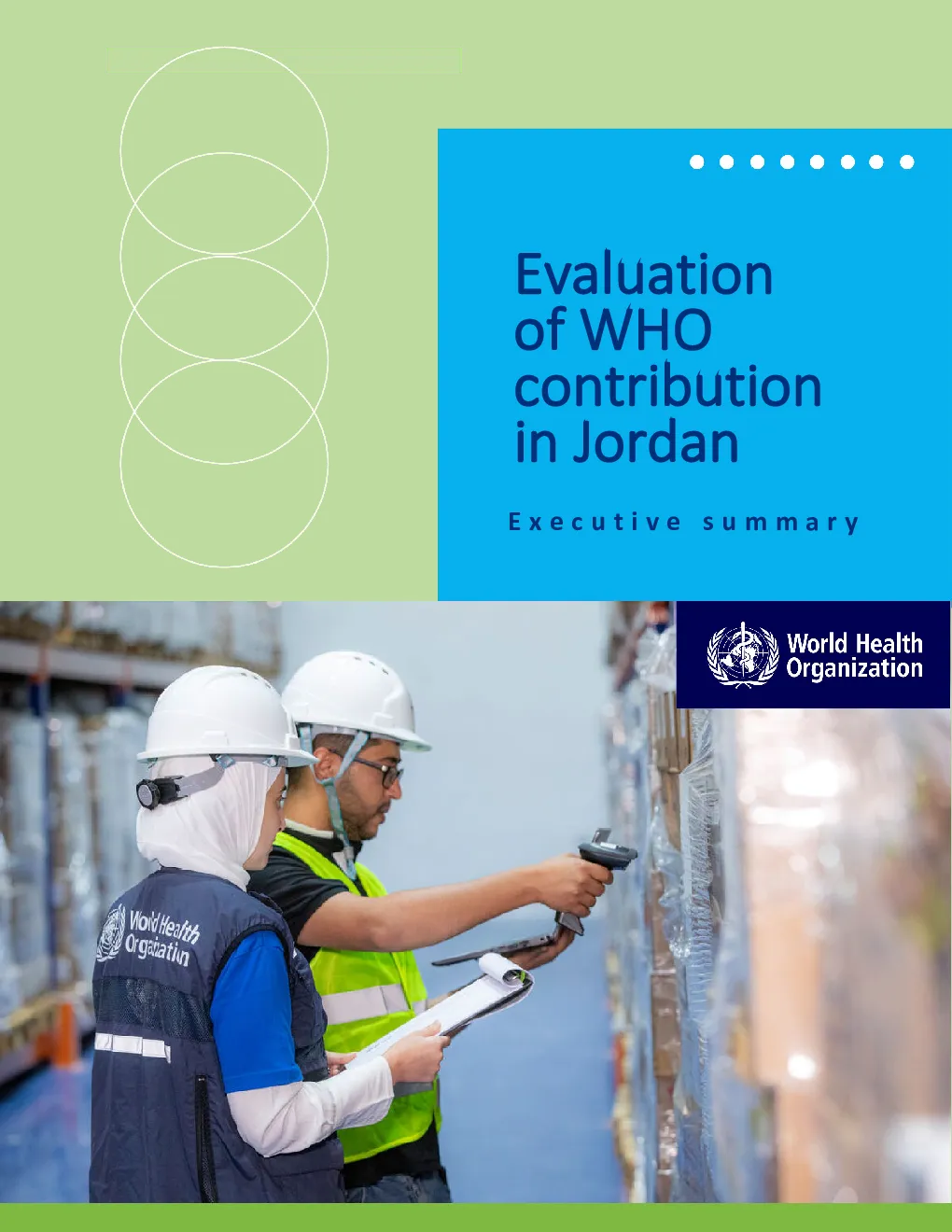
E x e c u t i v es u m m a r y © World Health Organization 2025 Some rights reserved. This work is available under the Creative Commons Attribution-NonCommercial-ShareAlike3.0 IGO licence (CC BY-NC-SA 3.0 IGO;https://creativecommons.org/licenses/by-nc-sa/3.0/igo). Under the terms of this licence, you may copy, redistribute and adapt the work for non-commercial purposes,provided the work is appropriately cited, as indicated below. In any use of this work, there should be no suggestionthat WHO endorses any specific organization, products or services. The use of the WHO logo is not permitted. Ifyou adapt the work, then you must license your work under the same or equivalent Creative Commons licence. If you create a translation of this work, you should add the following disclaimer along with the suggested citation:“This translation was not created by the World Health Organization (WHO). WHO is not responsible for the content Any mediation relating to disputes arising under the licence shall be conducted in accordance with the mediationrules of the World Intellectual Property Organization (http://www.wipo.int/amc/en/mediation/rules/). Suggested citation. Evaluation of WHO contribution in Jordan: executive summary. Geneva: World HealthOrganization; 2025.https://doi.org/10.2471/B09601. Licence:CC BY-NC-SA 3.0 IGO. Cataloguing-in-Publication (CIP) data.CIP data are available athttps://iris.who.int/. Sales, rights and licensing.To purchase WHO publications, seehttps://www.who.int/publications/book-orders. Tosubmit requests for commercial use and queries on rights and licensing, seehttps://www.who.int/copyright. Third-party materials.If you wish to reuse material from this work that is attributed to a third party, such as tables,figures or images, it is your responsibility to determine whether permission is needed for that reuse and to obtainpermission from the copyright holder. The risk of claims resulting from infringement of any third-party-owned General disclaimers.The designations employed and the presentation of the material in this publication do notimply the expression of any opinion whatsoever on the part of WHO concerning the legal status of any country,territory, city or area or of its authorities, or concerning the delimitation of its frontiers or boundaries. Dotted and The mention of specific companies or of certain manufacturers’ products does not imply that they are endorsed orrecommended by WHO in preference to others of a similar nature that are not mentioned. Errors and omissionsexcepted, the names of proprietary products are distinguished by initial capital letters. All reasonable precautions have been taken by WHO to verify the information contained in this publication.However, the published material is being distributed without warranty of any kind, either expressed or implied. Theresponsibility for the interpretation and use of the material lies with the reader. In no event shall WHO be liable for In line with theWHO Evaluation Policy 2018(EB143(9)), this publication contains an independent evaluationreport by the WHO Evaluation Office. It does not reflect the views or policies of WHO. WHO/DGO/EVL/2025.117 Cover page photo description: Jordan's Ministry of Health opens the first advanced central warehouse formedicines in the public sector - September 2024 Credit: WHO / EMRO Executive summary I n t r o d u c t i o n The independent evaluation of WHO contribution in Jordan focuses on the results achieved at the country level usingthe inputs from all three levels of the World Health Organization (WHO). It documents the key contributions,achievements, success factors, gaps, lessons learnt and the strategic directions WHO employed to improve health outcomes in Jordan. This evaluation took place as the WHO Country Office for Jordan is nearing the end of theimplementation of its current Country Cooperation Strategy (CCS) 2021‒2025 and embarking on a process of re- C o n t e x t As host to nearly 3.3 million refugees from Iraq, Syrian Arab Republic andoccupied Palestinian territory, includingeast Jerusalem‒within the total population of 11 million‒Jordan’s health-care system has faced intense pressureover the past few decades to serve an increasingly diverse and displaced population. The Jordanian context is also As a lower-middle-income country, there has been a continued underinvestment in public health and primary healthcare (PHC): 32% of the total health expenditure (THE) is dedicated to PHC in Jordan, compared with the regionalaverage of 70%.1Inrecent years, however, PHC has been more prominently positioned as a government priority, O b j e c t The object of this evaluation is to assess WHO’s contribution in Jordan during the 2021‒2024 strategic period,focusing on the achievement of planned results and WHO’s strategic role, moving forward. Guided by the CCS, WHOprioritized strengthening the health system towards universal health coverage (UHC), promoting health and well- W