评价世界卫生组织对水、环境卫生、个人卫生和健康的贡献:执行摘要
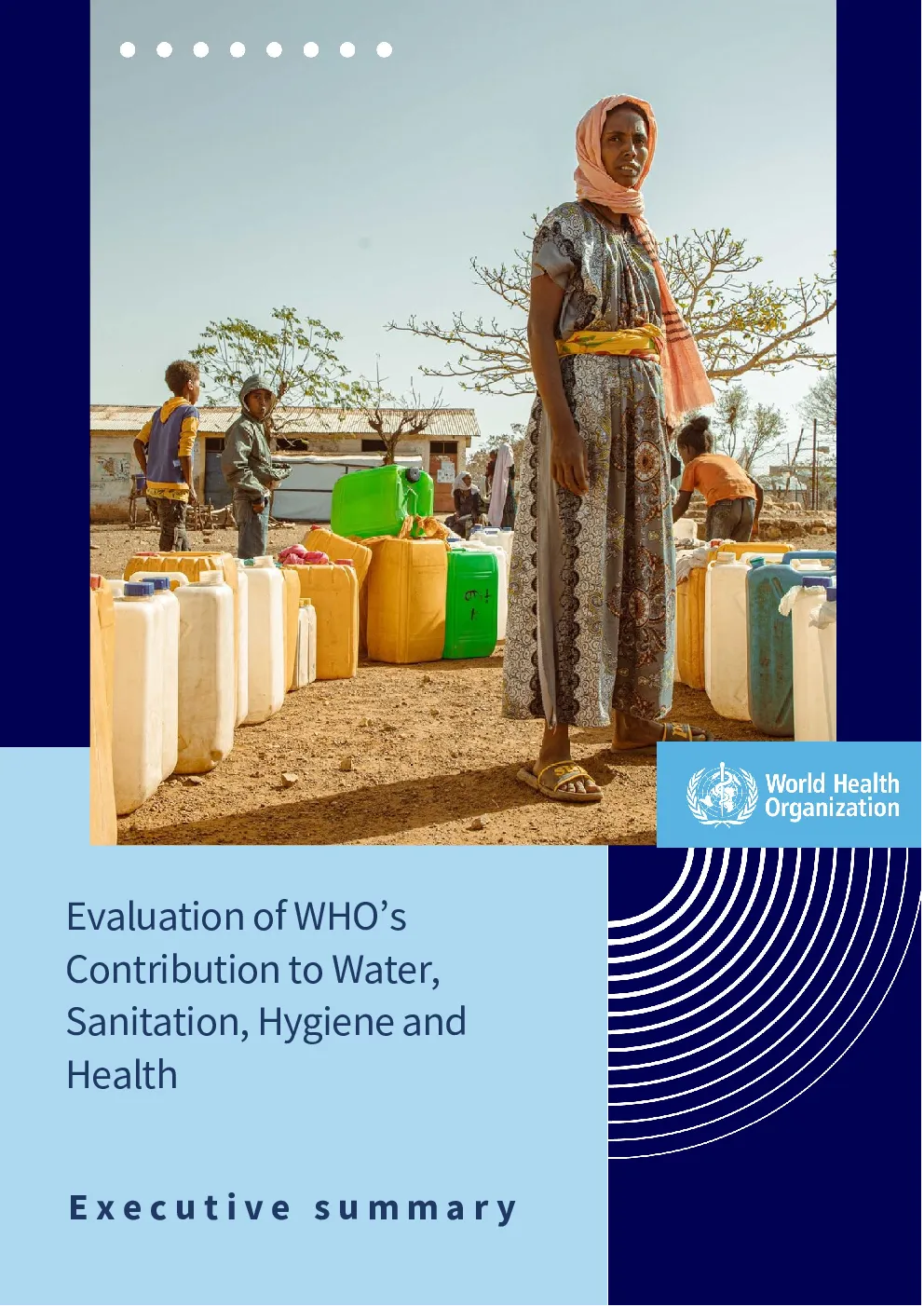
© World Health Organization 2025Some rights reserved. This work is available under the Creative Commons Attribution-NonCommercial-ShareAlike 3.0 IGO licence (CC BY-NC-SA 3.0 IGO;https://creativecommons.org/licenses/by-nc-sa/3.0/igo).Under the terms of this licence, you may copy, redistribute and adapt the work for non-commercial purposes,provided the work is appropriately cited, as indicated below. In any use of this work, there should be nosuggestion that WHO endorses any specific organization, products or services. The use of the WHO logo is notpermitted. If you adapt the work, then you must license your work under the same or equivalent CreativeCommons licence. If you create a translation of this work, you should add the following disclaimer along withthe suggested citation:“This translation was not created by the World Health Organization (WHO). WHO is notresponsible for the content or accuracy of this translation. The original English edition shall be the binding andAny mediation relating to disputes arising under the licence shall be conducted in accordance with the mediationrules of the World Intellectual Property Organization (http://www.wipo.int/amc/en/mediation/rules/).Suggested citation. Evaluation of WHO’s contribution to Water, Sanitation, Hygiene and Health: executivesummary. Geneva: World Health Organization; 2025.https://doi.org/10.2471/B09445. Licence:CC BY-NC-Cataloguing-in-Publication (CIP) data.CIP data are available athttps://iris.who.int/.Sales, rights and licensing.To purchase WHO publications, seehttps://www.who.int/publications/book-orders.To submit requests for commercial use and queries on rights and licensing, seehttps://www.who.int/copyright.Third-party materials.If you wish to reuse material from this work that is attributed to a third party, such astables, figures or images, it is your responsibility to determine whether permission is needed for that reuse andto obtain permission from the copyright holder. The risk of claims resulting from infringement of any third-party-owned component in the work rests solely with the user.General disclaimers.The designations employed and the presentation of the material in this publication do notimply the expression of any opinion whatsoever on the part of WHO concerning the legal status of any country,territory, city or area or of its authorities, or concerning the delimitation of its frontiers or boundaries. Dottedand dashed lines on maps represent approximate border lines for which there may not yet be full agreement.The mention of specific companies or of certain manufacturers’ products does not imply that they are endorsedor recommended by WHO in preference to others of a similar nature that are not mentioned. Errors andomissions excepted, the names of proprietary products are distinguished by initial capital letters.All reasonable precautions have been taken by WHO to verify the information contained in this publication.However, the published material is being distributed without warranty of any kind, either expressed or implied.The responsibility for the interpretation and use of the material lies with the reader. In no event shall WHO beliable for damages arising from its use.In line with theWHO Evaluation Policy 2018(EB143(9)), this publication contains an independent evaluationreport by the WHO Evaluation Office. It does not reflect the views or policies of WHO.Cover Photo: Residents of the Adi Dahro Internally Displaced Persons (IDP) Camp in Tigray, Ethiopia line up to get water.The camp is a repurposed former school and accommodates over 9000 people. April, 2024 authentic edition”.SA 3.0 IGO.WHO/DGO/EVL/2025.7Credit: WHO / Nitsebiho Asrat AcknowledgementsThis report is issued by the WHO Evalua�on Office. It is based on the independent evalua�onconducted by the evalua�on team from Euro Health Group (please see below). The WHO Evalua�on Officewould like to express its apprecia�on to the team members for their dedica�on and excellent work. Thisevalua�on was managed and quality controlled by the WHO Evalua�on Office.The WHO Evalua�on Office would like to thank all par�cipa�ng representa�ves from Member Statesfor their generous �me, insights and candid feedback and contribu�ons; the WHO Secretariat, notably theWater, Sanita�on, Hygiene and Health (WSH) Unit and partners for their dedicated support to the evalua�onand for providing the evalua�on team witha wealth of background documenta�on.In addi�on, the WHO Evalua�on Office would like to thank all members of the WSH Evalua�on ReferenceGroup (ERG), and in par�cular UNICEF, for their par�cipa�on in frui�ul discussions and input and for sharingtheir valuable insights and honest perspec�ves to inform the evalua�on.A special thanks to organizers and facilitators of the two country case studies for this evalua�on inthe Philippines and Ethiopia, and the WHO country offices in each country, for their invaluable advice, supportand input.Independent evalua�on team (Euro Health Group)Jeremy