AI智能总结
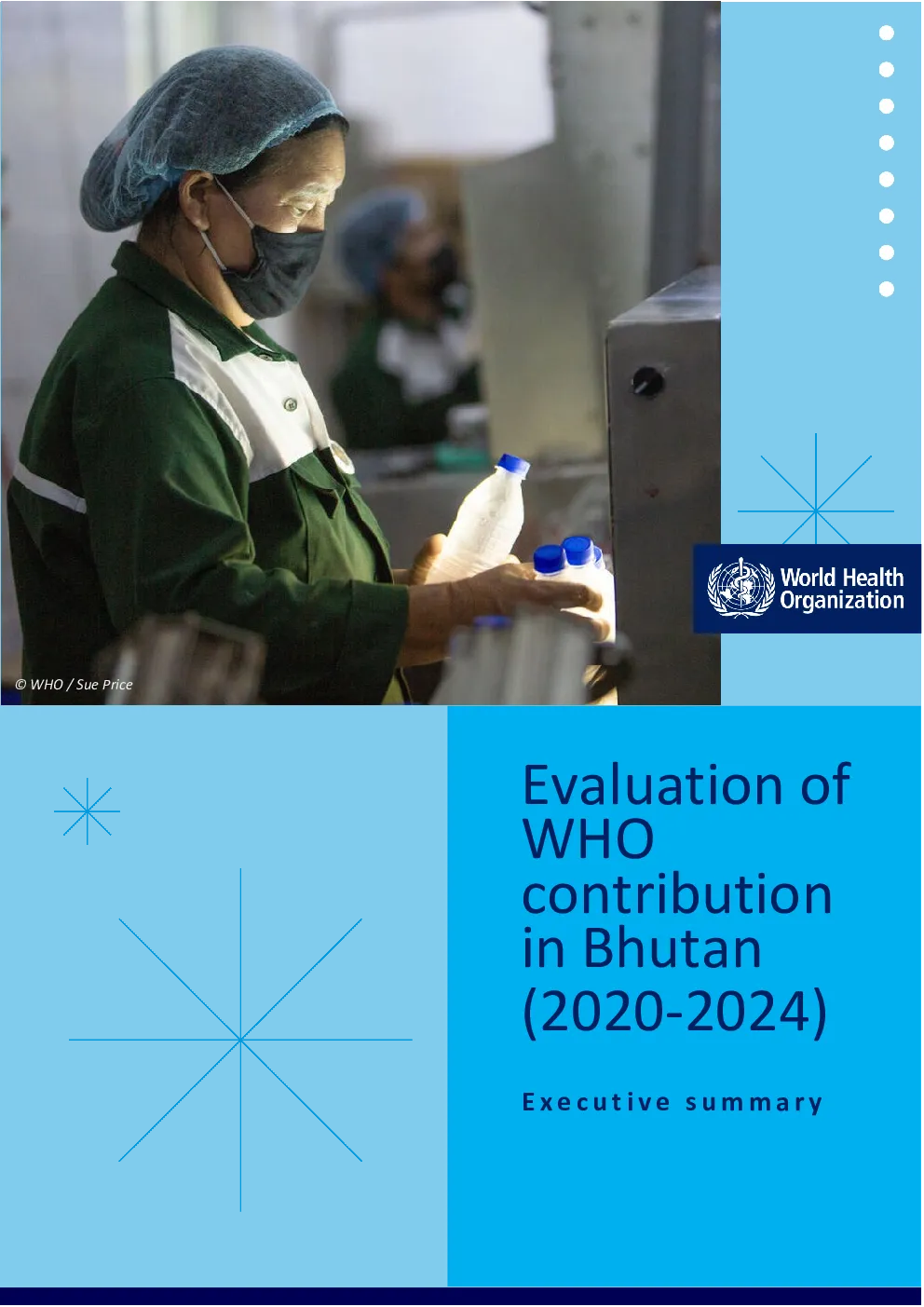
Ex e c u t i v e s u m m a r y © World Health Organization 2025. All rights reserved. The content of this document is not final and the text may be subject to editorial revisions before publication. Thecontent of this draft, however, will not undergo substantive changes. The document may not be reviewed,abstracted, quoted, reproduced, transmitted, distributed, translated or adapted, in part or in whole, in any form WHO/DGO/EVL/2025.132 Cover photo description: A woman inspects bottled water for physical contamination in Bhutan, part ofthe Codex Trust Fund food-safety project involving Bhutan, India and Nepal (11 August 2023). © WHO / Executive summary I n t r o d u c t i o n Independent evaluations of the World Health Organization (WHO) contribution at the country level areconducted in line with the WHO Evaluation Policy (2018) and the implementation framework of WHOEvaluation Policy. The World Health Organization (WHO) commissioned this evaluation to assess thecontribution of WHO to Bhutan over the period 2020 to 2024 in pursuit of the planned outcomes of the E v a l u a t i o n o b j e c t The object of this evaluation was WHO's contribution to progress towards the planned outcomes of theCCS 2020–2025 and related biennial work plans achieved, using input from all three levels of theOrganization – country office, South-East Asia Regional Office and headquarters. The strategic prioritiespursued, the intended outcomes and the financial expenditures during the evaluation period were part E v a l u a t i o n o b j e c t i v e sa n d i n t e n d e d a u d i e n c e The objectives of the evaluation were to assess WHO's contributions to Bhutan's health goals againstthe CCS 2020–2025 and biennial work plans; analyse the coherence of WHO’s strategy and plans withnational priorities; review WHO’s technical assistance and partnerships; and propose strategic shifts toalign with Bhutan's 13thFive-Year Plan (2024–2029) (FYP13). The evaluation findings are intended toinform the development of the new CCS for 2026–2030 in consultation with key stakeholders and to The evaluation is both summative in assessing WHO’s accomplishments since 2020 and formative inidentifying lessons learned to improve WHO's ongoing and future initiatives in Bhutan. The intendedusers of the evaluation are the Who country and regional offices and headquarters as well as the Royal E v a l u a t i o n m e t h o d o l o g y The evaluation employed a participatory, learning-oriented approach that was used focusing onutilization of findings. A theory of change was reconstructed to test assumptions and pathways to •a desk review examining over 100 documents, including the CCS 2020–2025, WHO workplans,national health policies, regional evaluation reports, strategic frameworks from WHO, UN andBhutan's government, third party reports and research papers on health in Bhutan; •quantitative analysis reviewing financial data from the WHO Bhutan Country Office andheadquarters alongside health outcome data from national sources; and •key informant interviews (KIIs) conducted with 50 participants (61% male and 39% female)acrossWHO's three levels and various Bhutanese stakeholders,including governmentministries, academia, development banks, UN agencies and CSOs. Theevaluation employed WHO’s standard evaluation criteria (in line with the revised OECDDevelopment Assistance Committee (DAC) criteria) of relevance, coherence, effectiveness, efficiencyand sustainability, with an additional consolidation of evaluation questions for equity into an equity Constraints faced by the evaluation included: a planned CCS mid-term review, which would haveprovided valuable insights for 2020–2021, could not be conducted due to COVID-19 disruptions; andavailable documentation was largely descriptive and self-assessed, requiring reliance on secondarysources andqualitative interviews for triangulation.Mitigation measures included third party K e yf i n d i n g s A summary of key findings corresponding to each evaluation criterion is presented below: Relevance WHO is strongly aligned with Bhutan's national health priorities, including FYPs 12 and 13. WHO plays aleading role in developing national action plans and strategies across infectious disease control,noncommunicable diseases (NCDs), emergency response, health financing and human resourcesdevelopment. The Organization has kept pace well with changing circumstances and has been a leaderin the collection and analysis of health data, demonstrating a good understanding of the threats facing work through a Media & Communication strategy mainly focusing on social media and holds an annual Coherence There is a high degree of coherence between the Bhutan CCS 2020–2025 and key strategic plans andpolicy documents, namely GPW13 at the international level and Bhutan's FYP12 at national level, withWHO South-East Asia Regional Office Regional Flagship programmes strengthening the coherence ofhealth systems development