您的浏览器禁用了JavaScript(一种计算机语言,用以实现您与网页的交互),请解除该禁用,或者联系我们。 [万宝盛华]:2025年IT工作世界展望 - 发现报告

2025年IT工作世界展望

信息技术 2025-06-25 - 万宝盛华 李辰
报告封面

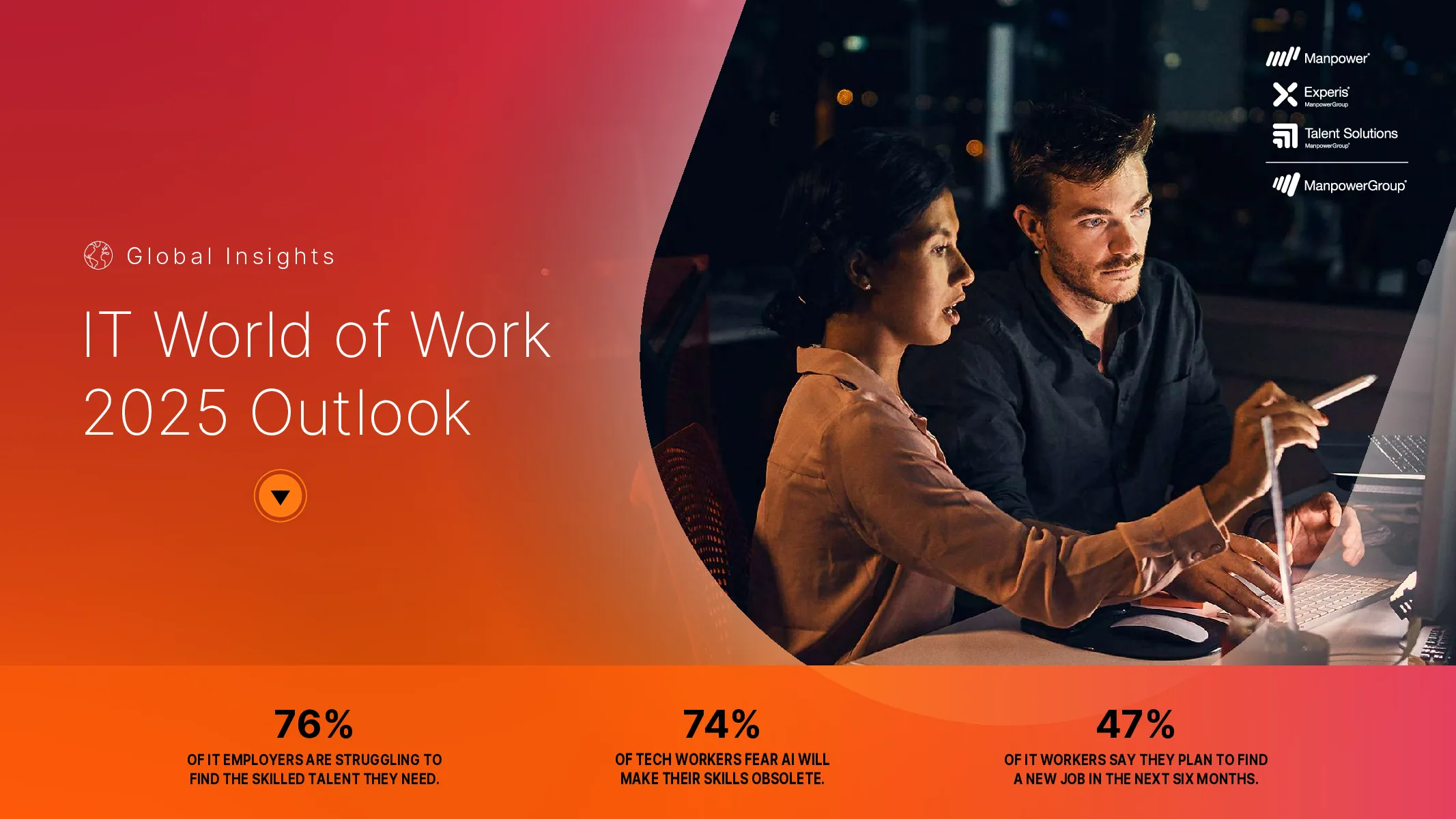
74%OF TECH WORKERS FEAR AI WILLMAKE THEIR SKILLS OBSOLETE. OF IT WORKERS SAY THEY PLAN TO FINDA NEW JOB IN THE NEXT SIX MONTHS. The global IT world of work is undergoing rapid changes characterized by advancements inartificial intelligence (AI), machine learning (ML), blockchain, cloud computing, and cybersecurity.Businesses, governments, and individuals are adapting to new paradigms of hybrid work, diverse This Global Insights report explores how this will change the future of work for both employees •What are the top tech trends in 2025? •Which trends make it to the top of the CIO agenda? •What can employers and workers do to keep up with the pace of rapid innovation? The frequency and sophistication of cyberattacks have escalated, driven by geopolitical tensions andthe proliferation of AI-enabled tools. Daily headlines about data breaches and cyberattacks remind usthat these incidents are no longer anomalies but have become the norm. As businesses grapple with •A Global CIO Priority:There are many important ITchallenges in 2025, but CIOs and tech leaders aroundthe world are most likely to say cybersecurity (41%) is Workforce Implications: •Cybersecurity talent will becomeincreasingly in-demand and difficultto find in the coming years. In fact, •The Impact is Growing:Global cybercrime damage isprojected to reach $10.5 trillion by 2025. The global •Growing Cyber Skills Gaps:Since 2024, the cyberskills gap has increased by 8%, with 66% organizationsreporting moderate to critical skills gaps, including a •Efforts to upskill and reskill incybersecurity must be scaled to address •The risks of failing to invest in the rightcybersecurity expertise amid growingthreats to intellectual property, client AI Change Agents Workforce Implications: •Organizations must evaluate whichtasks are best suited to agentic AI AI is revolutionizing the IT industry by transformingbusiness operations and work execution. Agentic AI,which encompasses autonomous systems capable ofdecision-making and task execution without humanintervention, is rapidly growing. This technology will •Skilled tech talent with an understandingof AI innovation and business needs will •The growth of agentic AI could createthe need for AI talent markets similar to •Demystifying Agentic AI:Agentic AI takes autonomous capabilities to the next level by using adigital ecosystem of large language models (LLMs), machine learning (ML), and natural languageprocessing (NLP) to perform autonomous tasks on behalf of the user or another system. Early-stage “GENERATIVE AI IS NOT ABOUTTHE HYPE. IT’S ABOUTBEING REAL IN THE USE •More Agency Ahead:By 2028, 33% of enterprise software applications will includeagentic AI, up from less than 1% in 2024, enabling 15% of day-to-day work decisions to •Tech Leader Realism:In a recent global Experis study of CIO and tech leadersentiment, they were the most likely to say AI is a valuable solution for specific Adoption Challenges NEARLYONE THIRDOF IT SECTOREMPLOYERS (29%) SAY AI adoption presents a multifaceted array of challenges for IT workers. Significant skills gaps are emerging,requiring IT professionals to upskill in areas such as AI development, machine learning, data science, andprompt engineering. Integrating AI into existing IT infrastructure can be complex, demanding expertise in •Data Integrity:As AI adoption accelerates, data concerns are growing. Across industries, dataaccuracy (45%) and insufficient proprietary data availability (42%) are emerging as top challenges Workforce Implications: •As organizational AI adoptionmatures, finding skilled AI, MLand data scientist expertise will •Implementation Costs and Compliance:Global IT sector employers say high costs (36%) •Skills gaps are growing acrossindustries and functions as the •Skills Gaps:Nearly one third of IT sectoremployers (29%) say their workers don’t •Upskilling and training programsmust scale to meet the growing Insatiable DataCenter Demand •Since data centers are typicallylocated in rural areas, employers The global demand for data centers is growing rapidly,driven by increased data production, cloud computingadoption, and Internet of Things (IoT) devices. Asdigital transformation progresses, robust and securedata storage and processing facilities are essential. •Workforce costs must be effectivelymanaged to offset growing •The ancillary jobs impacts providean opportunity to build goodwill in •Insatiable Demand:Global data center capacity projected to grow at 15% per EACH DATACENTER JOB CREATESUP TOSEVEN •Growing Energy Needs:Global power demand from data centers will increase •Jobs Impact:In the U.S. alone, data center growth helped create 4.7 million jobsbetween 2017 and 2023. This is primarily due to the impact on related industries, Workforce Implications: Low-Code, No-Code •Employers and tech training partnersmust continue to evolve trainingcurriculums to account for the The rise of low or no-code technology has