您的浏览器禁用了JavaScript(一种计算机语言,用以实现您与网页的交互),请解除该禁用,或者联系我们。 [万宝盛华]:消费品和服务2025年工作世界展望 - 发现报告

消费品和服务2025年工作世界展望

商贸零售 2025-04-11 - 万宝盛华 健康🧧
报告封面

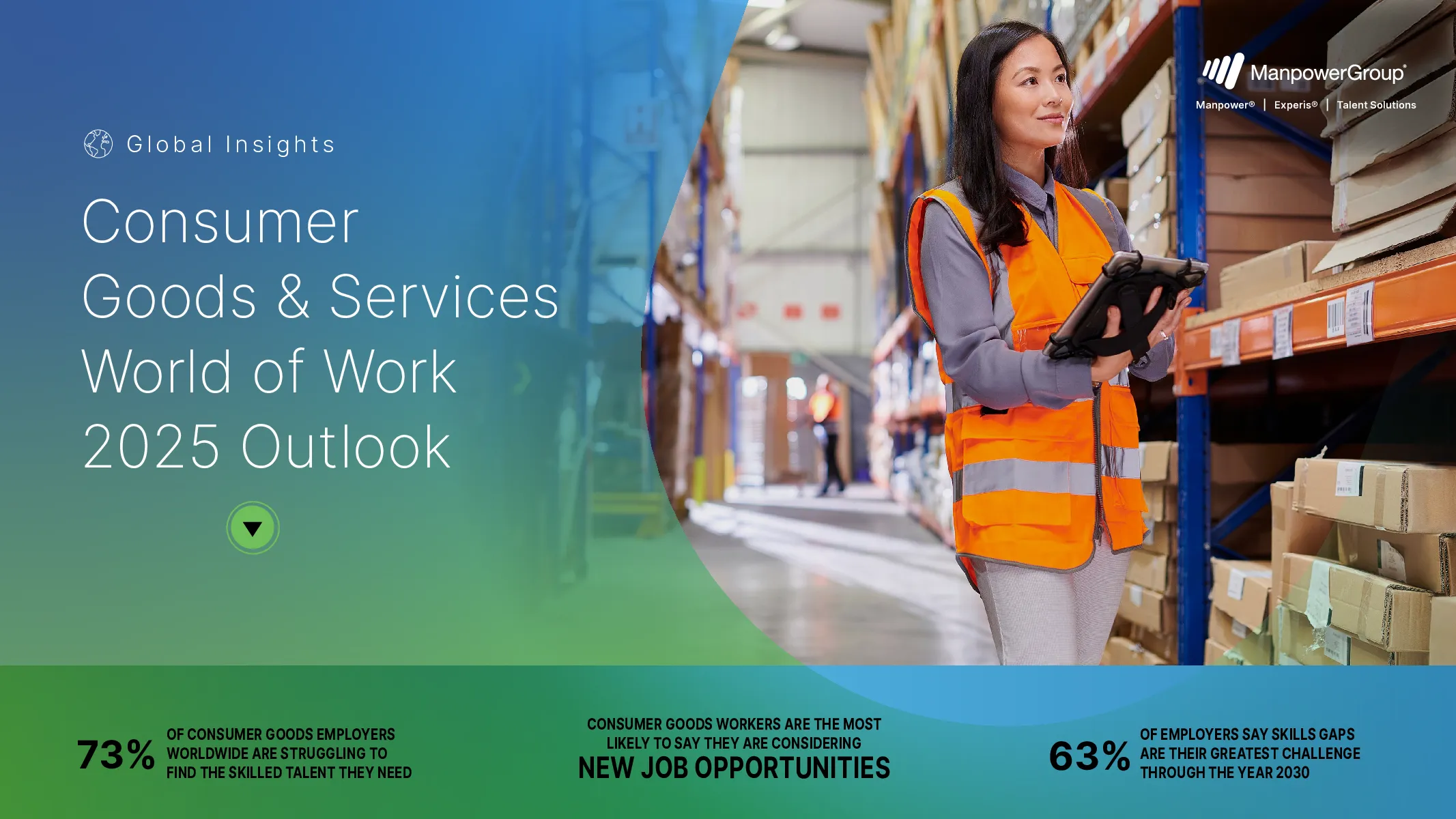
73% 63%THROUGH THE YEAR 2030 FIND THE SKILLED TALENT THEY NEED The outlook for the global consumer goods sector in 2025 is uncertain. At the macro level, we are in the midst of afundamental reordering of the global economic status quo. Meanwhile, consumer goods leaders will need to navigateday-to-day challenges such as supply chain disruptions, inflationary pressures, and shifting consumer preferences •How are global brands reimagining their digital transformation strategies to accelerate innovation? •How are global trends such as geopolitical uncertainty and AI adoption changing the future of retail? •What can business leaders do to future-proof their strategic workforce planning as the pace of change accelerates? Workforce Implications: Ramping Up •Hiring and retaining an innovativeworkforce will be critical with years •Scaling efforts to maintain a skilledand innovative workforce will remaina challenge in the coming year. The global consumer goods industry is at a pivotaljuncture where business transformation is not just rapid technological advancements and evolving consumer expectations, companies must embracedigital innovation to remain competitive. This transformation encompasses the adoption of cutting-edge technologies such as Artificial Intelligence (AI), big data analytics, and the Internet of Things •Despite the growing needs, lessthan half (39%) of consumer goodsand services workers say theyhave received additional training •High Stakes:Recent research estimates generative AI could increase the value of traditional AItools by 15-40%. For the global consumer goods sector, the opportunity is estimated at $160 •A Change Imperative:Nearly half (42%) of CEOs believe their company will not be viablebeyond the next 10 years without reinvention.2 •Bringing Workers Along:Workers in the consumer goods sector are less certain thanothers about the future. They are the most likely (36%) to say their current employer offers BELIEVE THEIRBUSINESS WILLNOT BE VIABLEIN TEN YEARS Workforce Implications: CX Transformation •As AI and automation reshapeconsumer experiences, it will require To stay competitive, consumer goods companies must evolve the customer experience (CX). Thisrequires attracting and retaining talent with expertise in AI, data analytics, and omnichannel commerce.Additionally, fostering a culture of continuous innovation and agile workforce strategies is vital. •Stronger alignment betweenIT, marketing, and supply chainteams is crucial. Employers must •Hyper Personalization:Most consumers (71%) expectcompanies to deliver personalized content. Of thosecustomers, 67% say that they are frustrated when their •Mixing it Up:As global consumer frustration is growing,brands are revisiting their product mix to respond tochanging consumer preferences, and in some cases, offermore premium offerings. Most executives in this sector •As companies collect and utilizevast amounts of consumer data forpersonalized interactions, the risk ofdata breaches and regulatory non- •Sellers Wanted:As consumer goods brands around the world try to improve customerexperience, they say Sales & Marketing (29%), Frontline Customer Service (22%), and IT/Data ASCX INNOVATIONEMPLOYERS SAY THESESKILLSTHE MOSTDIFFICULT TO FIND Buying Resilience in Bulk OFCEOSPLANTO SHIFTSUPPLYCHAINS CLOSERTHEIRCUSTOMERS Supply chain resilience is paramount for employers in the consumer goods industry, where theability to efficiently manage and adapt to disruptions can spell the difference between successand failure. In an era marked by unpredictable global events, from natural disasters to geopolitical •Coming Home:The proportion of CEOsand COOs reporting plans to bringsupply chains closer to home or main •Business leaders will need tofind untapped sources of humancapital as manufacturing returns •Doubling Up:Nearly three quarters ofglobal supply chain managers (73%)now say they are dual sourcing to •Scaling upskilling and reskillingefforts in markets with new •Geopolitical Tremors:A growingnumber of CEOs (40%) say increasingglobal political instability is a potential •With geopolitical uncertaintyexpected to continue, long-term Workforce Implications: •Trade tensions and overalleconomic uncertainty is Consumers Sending •To overcome persistent volatility,a focus on “controlling what youcan control” through strategic Mixed and declining global consumer sentiment has emerged as a critical concern for businessesworldwide. Amidst increasing geopolitical tensions and economic uncertainties, consumerconfidence has taken a hit, leading to reduced spending and a cautious approach towards major •Onsite support or global talentsourcing through trusted thirdparties can help business •Consumer Sentiment is Mixed:Overall global consumer sentiment was down year-over-year inJanuary 2025. While the consumer mood improved in Latin America and Europe, it declined in •Inflation Fatigue:Most industry executives (64%) say consumers