您的浏览器禁用了JavaScript(一种计算机语言,用以实现您与网页的交互),请解除该禁用,或者联系我们。 [PitchBook]:2026年美国风险投资公司IPO前景(英) - 发现报告

2026年美国风险投资公司IPO前景(英)

金融 2026-01-01 PitchBook HEE
报告封面

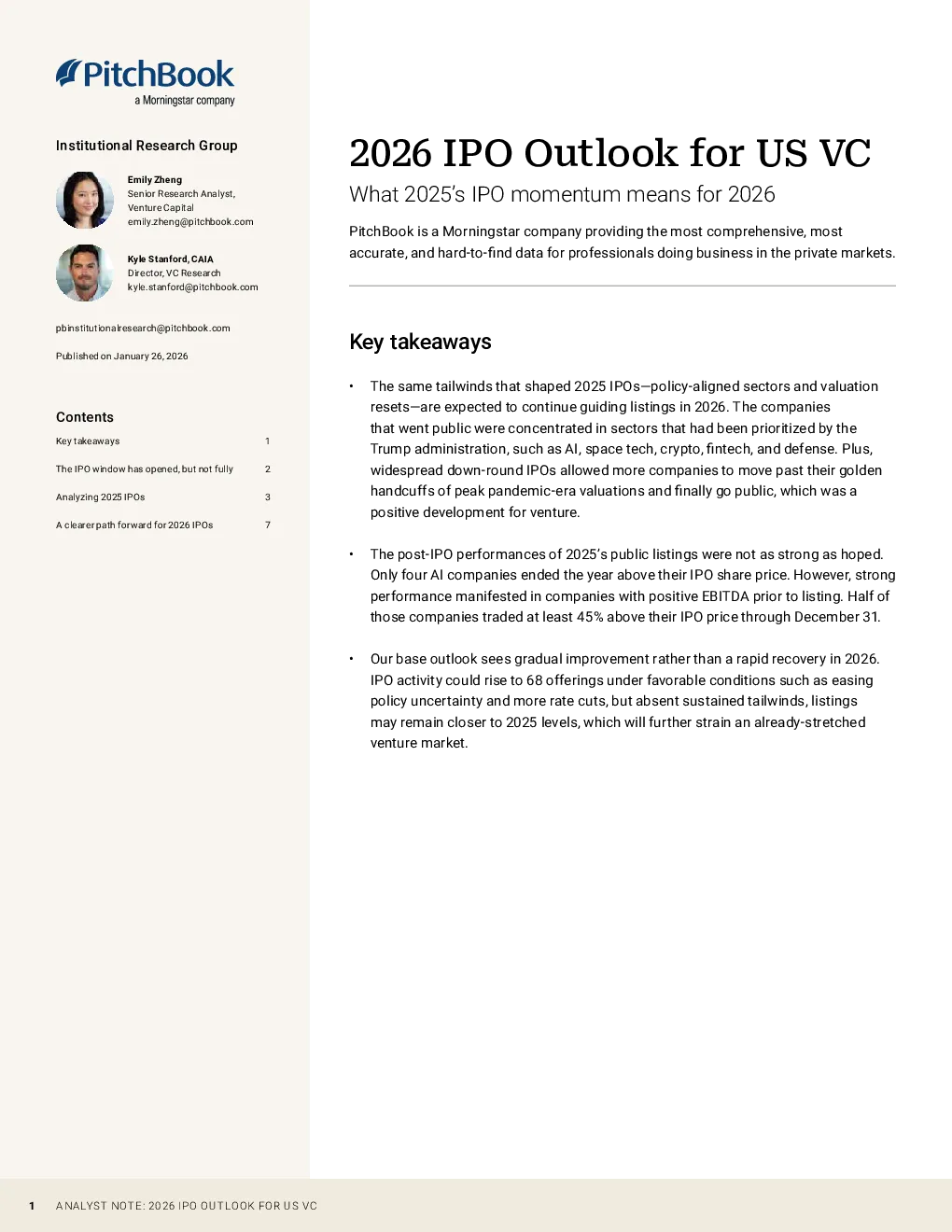
2026 IPO Outlook for US VC Institutional Research Group Emily ZhengSenior Research Analyst,Venture Capitalemily.zheng@pitchbook.com What 2025’s IPO momentum means for 2026 PitchBook is a Morningstar company providing the most comprehensive, mostaccurate, and hard-to-find data for professionals doing business in the private markets. Kyle Stanford, CAIADirector, VC Researchkyle.stanford@pitchbook.com pbinstitutionalresearch@pitchbook.com Key takeaways Published on January 26, 2026 •The same tailwinds that shaped 2025 IPOs—policy-aligned sectors and valuationresets—are expected to continue guiding listings in 2026. The companiesthat went public were concentrated in sectors that had been prioritized by theTrump administration, such as AI, space tech, crypto, fintech, and defense. Plus,widespread down-round IPOs allowed more companies to move past their goldenhandcuffs of peak pandemic-era valuations and finally go public, which was apositive development for venture. Contents Key takeaways1The IPO window has opened, but not fully2Analyzing 2025 IPOs3A clearer path forward for 2026 IPOs7 •The post-IPO performances of 2025’s public listings were not as strong as hoped.Only four AI companies ended the year above their IPO share price. However, strongperformance manifested in companies with positive EBITDA prior to listing. Half ofthose companies traded at least 45% above their IPO price through December 31. •Our base outlook sees gradual improvement rather than a rapid recovery in 2026.IPO activity could rise to 68 offerings under favorable conditions such as easingpolicy uncertainty and more rate cuts, but absent sustained tailwinds, listingsmay remain closer to 2025 levels, which will further strain an already-stretchedventure market. The IPO window has opened, but not fully Liquidity conditions in US VC improved meaningfully in 2025 as a handful of high-profile IPOs delivered much-needed exit value and renewed confidence in publicmarkets. However, this exit value was highly concentrated: Just 48 companies wentpublic, consistent with other post-pandemic years, and only 17 were unicorns. Thislevel of activity falls short of what the venture ecosystem needs to fully recover,leaving more than $4.3 trillion of value locked in private unicorns alone. After fourconsecutive years of negative net cash flows to LPs, the pressure on exits is mounting,particularly as the total value of the US venture market has more than tripled since2020 to $7.4 trillion. Without a broader slate of large IPOs, the venture market willcontinue to struggle to raise new funds, pressuring dealmaking in the future. Macroeconomic uncertainty hindered 2025’s exit momentum as tariff negotiations,a prolonged government shutdown, and episodes of public market volatilitycomplicated IPO timing and pricing. As a result, the reopening of the IPO market washighly selective.The largest listings of 2025 shared certain characteristics: Thesecompanies demonstrated clear paths to profitability or strategic alignment with theTrump administration’s policy priorities, particularly in the AI, space tech, crypto,fintech, and defense sectors. Excluding healthcare and life sciences, 73.1% of 2025IPOs occurred in these sectors. Valuation compression was a defining feature of 2025 IPOs. Most unicorns enteredthe public markets at substantial discounts to their peak private valuations, signaling abroad reset from pandemic-era pricing to current fundamentals. For example, fintechcompany Chime went public at a 63.4% markdown from its private market high. Whilethese down-round IPOs may be painful in the short term, their normalization is apositive development for venture, lowering the bar to an IPO and clearing the runwayfor a lasting recovery of exits. These key themes of standout sectors and resetting valuations are expected tostrongly influence 2026 IPOs as well. However, the market uncertainty that shouldhave eased as the Trump administration entered its second year has given way to aregime change in Venezuela, potential military involvement with Iran, as well as theadministration’s continued provocation of Greenland. A possible narrative shift atthe Federal Reserve (the Fed) could also influence the year’s outlook, depending onhow drastic the change is. The expectation of further cuts from the Fed has lowereda bit, but the potential for a more dovish chair to replace Jerome Powell makes themarket’s reaction harder to predict. Despite these considerations, our outlook remainscautiously optimistic. With few companies in the registration pipeline, the pace of IPOlistings will take time to accelerate, but momentum, even in sentiment, has been built. The defining challenge for the year ahead will be widening the IPO window. While 2026is anticipated to deliver a handful of marquee listings, such as SpaceX’s potential IPOat a reported $1.5 trillion valuation, the broader market is expected to remain selective,benefiting from similar tailwinds to those seen