您的浏览器禁用了JavaScript(一种计算机语言,用以实现您与网页的交互),请解除该禁用,或者联系我们。 [世界银行]:弹性基础,绿色未来:印度尼西亚低收入住房路线图(英)2025 - 发现报告

弹性基础,绿色未来:印度尼西亚低收入住房路线图(英)2025

房地产 2025-11-03 世界银行 米软绵gogo
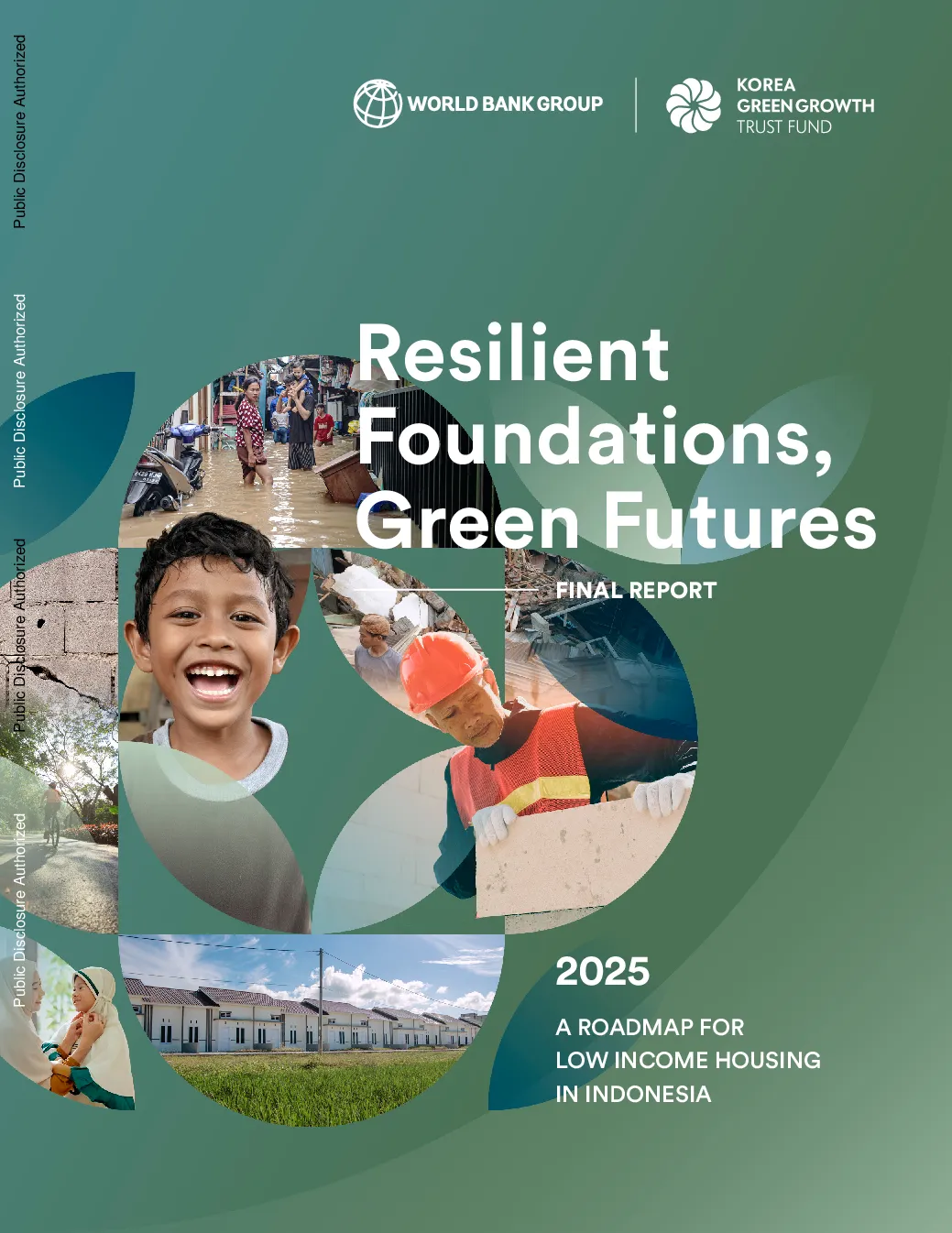
报告封面

A ROADMAP FORLOW INCOME HOUSINGIN INDONESIA DISCLAIMER This work is a product of the staff of The World Bank with external contributions. The findings,interpretations, and conclusions expressed in this work do not necessarily reflect the views of TheWorld Bank, its Board of Executive Directors, or the governments they represent. The World Bank does not guarantee the accuracy of the data included in this work. The boundaries,colors, denominations, and other information shown on any map in this work do not imply any judgmenton the part of The World Bank concerning the legal status of any territory or the endorsement oracceptance of such boundaries. The World Bank does not necessarily own each component of the content contained within the workand does not warrant that the use of any third-party owned individual component or part contained inthe work will not infringe on the rights of those third parties. Rights and Permissions The material in this work is subject to copyright. Because The World Bank encourages disseminationof its knowledge, this work may be reproduced, in whole or in part, for non-commercial purposes if fullattribution to this work is given. Any queries on rights and licenses, including subsidiary rights, shouldbe addressed to World Bank Publications,The World Bank Group,1818 H Street NW, Washington, DC 20433, USA;fax: 202-522-2625;e-mail: PUBRIGHTS@WORLDBANK.ORG. Citation Please cite the report as follows: World Bank. 2025. “Resilient Foundations, Green Futures: GreenRoadmap for Low-Income Housing in Indonesia”. Washington, DC: World Bank. ACKNOWLEDGMENTS This report reflects five years of World Bank engagement in Indonesia's affordable housing sector,grounded in extensive field research and implementation experience under the National AffordableHousing Program. The report benefits from the close collaboration and partnership of the Ministryof Housing and Settlements (MoHS), previously Ministry of Public Works and Housing (MPWH),especially Mr. Haryo Bekti Martoyoedo, Director of Financing System Development for Housing andSettlement Areas and Ms. Fitri Ami Handayani, Head of Sub-directorate for Utilization of FundingSources and Regional Financing System, Directorate General of Governance and Risk Management. This report was made possible through funding from The Korea Green Growth Trust Fund (KGGTF),which supports analytical work on carbon credit baseline, thermal resilience for low-income housing,and other green housing initiatives. Additional work referenced in this report was supported byvarious trust funds, as listed below: •Australia-World Bank Indonesia Partnership (ABIP): Advancing rooftop solar photovoltaic(RSPV) integration strategies (2023-2024)•Energy Sector Management Assistance Program (ESMAP): Piloting a climate-auction modeland analyzing incremental green construction costs (2020-2021); supporting green certificationsystems (2023-2024)•City Climate Finance Gap Fund (Gap): Conducting the Palembang study on green homeimprovement and retrofit approaches (2021-2022) The report was prepared by a team led by Dao H. Harrison (Sr. Housing Specialist, IEAU2) and wasco-authored by Daniel Caesar Pratama, Alfana Ayu Zahrafa, and Nida An Khofiyya (Consultants,IEAU1) with inputs from Harish Surendra Khare (Consultant, IEAU1). The work was carried outunder the overall guidance of Bjorn Philipp (Practice Manager, IEAU1). Chapter 2.1 on combattingextreme heat and passive cooling design solutions benefitted from the team's collaboration withFathina Izmi Nugrahanti from ITB and Habitat for Humanity- Indonesia. Chapter 3.2 on exploringrooftop solar panel was largely based on research of Castalia Consulting, working closely withBipul Singh (Sr. Energy Specialist, IEAI1). Chapter 4.2, especially on carbon credit assessment, wassupported by Keisuke Iyadomi (Senior Climate Change Specialist, SCCSK) and Sandeep Kanda(Consultant, SCCFE). The report received editorial support from Olivia Nielsen from MiyamotoInternational. Administrative support was provided by Nola Safitri (Program Assistant, EAITL). The team was fortunate to receive inputs from the following peer reviewers: Ana Campos Garcia (LeadDRM Specialist, IDURM), Keiko Sakoda (Sr. DRM Specialist, IDURM), Catherine Lynch (SeniorUrban Specialist, IAWU4), and Griya Rufianne (Urban Specialist, IEAU1). Additional commentswere received from Nicholas Jones (Data Scientist, IDURM), Vasudevan Rajasekharan Kadalayil(Consultant, IDURM), Daniel Zepeda (Consultant, IDURM), and Ian Taylor (Consultant, IDURM). ACRONYMS CONTENTS Summary of Actions & Key Recommendations13 1.1Introduction171.2Overview of the Affordable Housing Sector in Indonesia19 2.1Action A: Combating Extreme Heat with Passive Cooling Design Solutions252.2Action B. Promote Resilient Housing Design and Construction to Withstand Floods and Earthquakes322.3Action C: Risk-Informed Site Planning and Urban Design Strategies in Integrated Housing and SettlementUpgrading Project37