2025年东南亚地区溺水状况报告
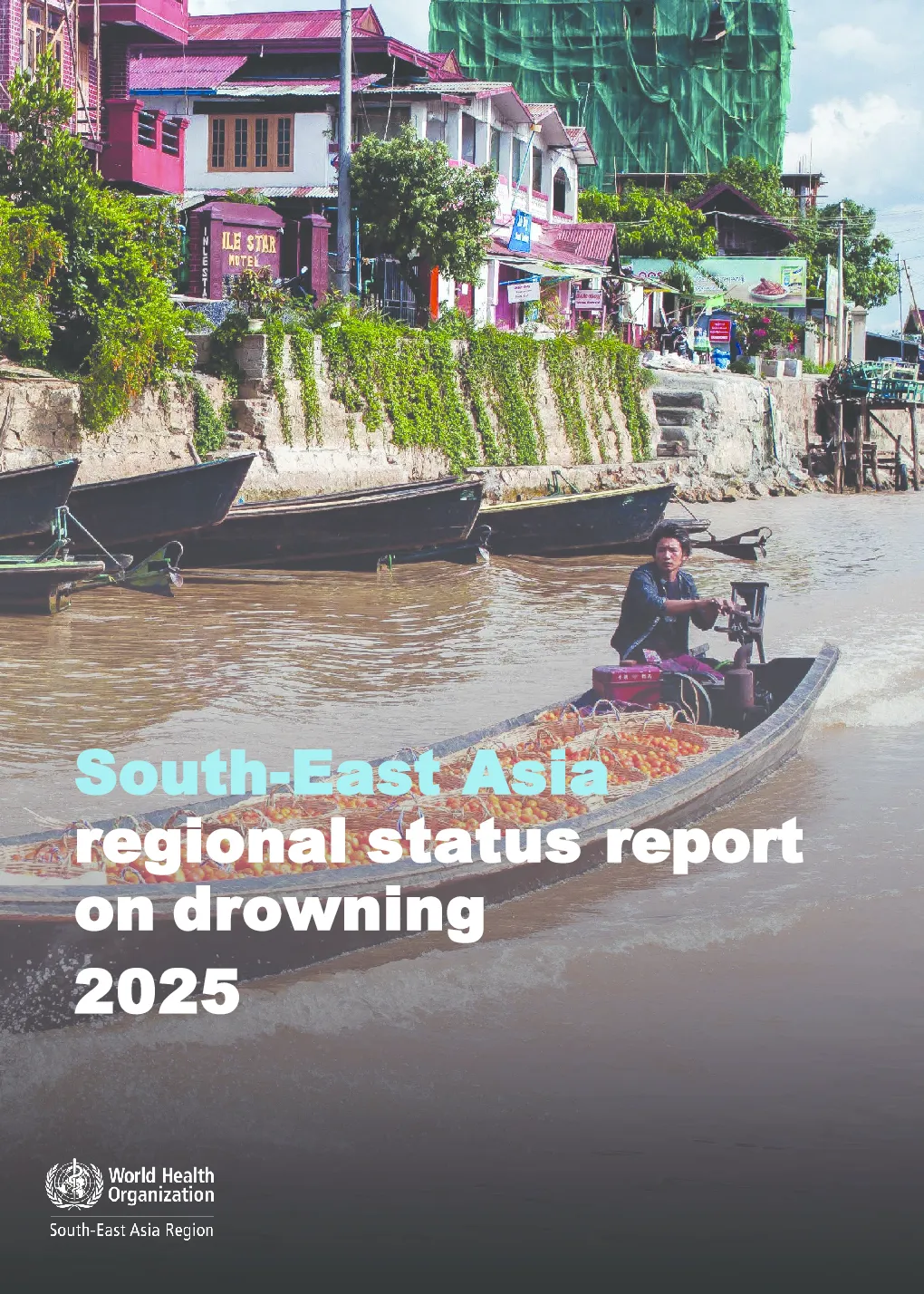
South-East Asia regional status report on drowning 2025 ISBN978-92-9022-109-8 © World Health Organization2025 Some rights reserved.This work is available under the Creative Commons Attribution-NonCommercial-ShareAlike3.0 IGO licence (CC BY-NC-SA 3.0 IGO;https://creativecommons.org/licenses/by-nc-sa/3.0/igo). Under the terms of this licence, you may copy, redistribute and adapt the work for non-commercial purposes, providedthe work is appropriately cited, as indicated below. In any use of this work, there should be no suggestion that WHOendorses any specific organization, products or services. The use of the WHO logo is not permitted. If you adapt the work,then you must license your work under the same or equivalent Creative Commons licence.If you create a translation of this work, you should add the following disclaimer along with the suggested citation: “Thistranslation was not created by the World Health Organization (WHO). WHO is not responsible for the content or accuracyof this translation. The original English edition shall be the binding and authentic edition”. Any mediation relating to disputes arising under the licence shall be conducted in accordance with the mediation rulesof the World Intellectual Property Organization(http://www.wipo.int/amc/en/mediation/rules/). Suggested citation.South-East Asia regional status report on drowning 2025. New Delhi: World Health Organization,Regional Office for South-East Asia; 2025. Licence: CC BY-NC-SA 3.0 IGO. Cataloguing-in-Publication (CIP) data.CIP data are available athttp://apps.who.int/iris. Sales, rights and licensing.To purchase WHO publications, seehttp://apps.who.int/bookorders.To submit requests forcommercial use and queries on rights and licensing, seehttp://www.who.int/about/licensing. Third-party materials.If you wish to reuse material from this work that is attributed to a third party, such as tables,figures or images, it is your responsibility to determine whether permission is needed for that reuse and toobtain permission from the copyright holder. The risk of claims resulting from infringement of any third-party-ownedcomponent in the work rests solely with the user. Generaldisclaimers.ThedesignationsemployedandthepresentationofthematerialinthispublicationdonotimplytheexpressionofanyopinionwhatsoeveronthepartofWHOconcerningthelegalstatusofanycountry,territory,cityorareaorofitsauthorities,orconcerningthedelimitationofitsfrontiersorboundaries.Dottedanddashedlinesonmapsrepresentapproximateborderlinesforwhichtheremaynotyetbefullagreement. The mention of specific companies or of certain manufacturers’ products does not imply that they are endorsed orrecommended by WHO in preference to others of a similar nature that are not mentioned. Errors and omissionsexcepted, the names of proprietary products are distinguished by initial capital letters. All reasonable precautions have been taken by WHO to verify the information contained in this publication. However,the published material is being distributed without warranty of any kind, either expressed or implied. The responsibilityfor the interpretation and use of the material lies with the reader. In no event shall WHO be liable for damages arisingfrom its use. PrintedinIndia. CoverPhoto: Man maneuvering a boat in Myanmar. © WHO / Diego Rodriguez ForewordvAcknowledgementsviAbbreviationsviiExecutive summaryviii1.Introduction11.1Global and regional drowning burden11.2About this report51.3Methodology of the report62.Epidemiology of drowning in the South-East Asia Region102.1Global and regional scenario: focusing on the South-East Asia Region102.2Beneath the surface: a closer look at country data152.3Trends over time192.4Risk factors212.4.1 Sociodemographic andbehaviouralfactors232.4.2 Environmental risk factors242.4.3 High-risk groups253.Current drowning prevention efforts in the South-EastAsia Region283.1Community-based interventions283.2National and regional policies413.2.1 National drowning prevention strategies across the SE Asia Region413.2.2 Legislative coverage423.2.3 Subnational and regional efforts443.2.4 Opportunities for regional alignment443.3WHO and international contributions453.3.1 WHO’stechnical leadership453.3.2 Global advocacy and UN engagement463.3.3 Support from international partners464.Gaps and challenges484.1Data limitations484.2Policy and programmatic gaps504.3Regional disparities525.Conclusion and recommendations535.1Conclusion535.2Recommendations545.3The way forward55References57Annex 1.Regional profile59Annex 2.Country policy briefs62 List of boxes Box 1.UN General Assembly Resolution3Box 2.World Health Assembly Resolution4Box 3.Understanding drowning data: the role of WHO Global Health Estimates8Box 4.Drowning in the WHO South-East Asia Region: at a glance26Box 5.Success stories of different interventions30Box 6.Drowning prevention seminar: strengthening public health diplomacy45 List of case studies Case study 1:Merit Makers for Safer Futures: a community-dri