您的浏览器禁用了JavaScript(一种计算机语言,用以实现您与网页的交互),请解除该禁用,或者联系我们。 [亚开行]:交通领域性别平等工具包:推动亚太地区向性别变革型交通系统迈进 - 发现报告

交通领域性别平等工具包:推动亚太地区向性别变革型交通系统迈进

交通运输 2025-08-17 亚开行 陈宫泽凡
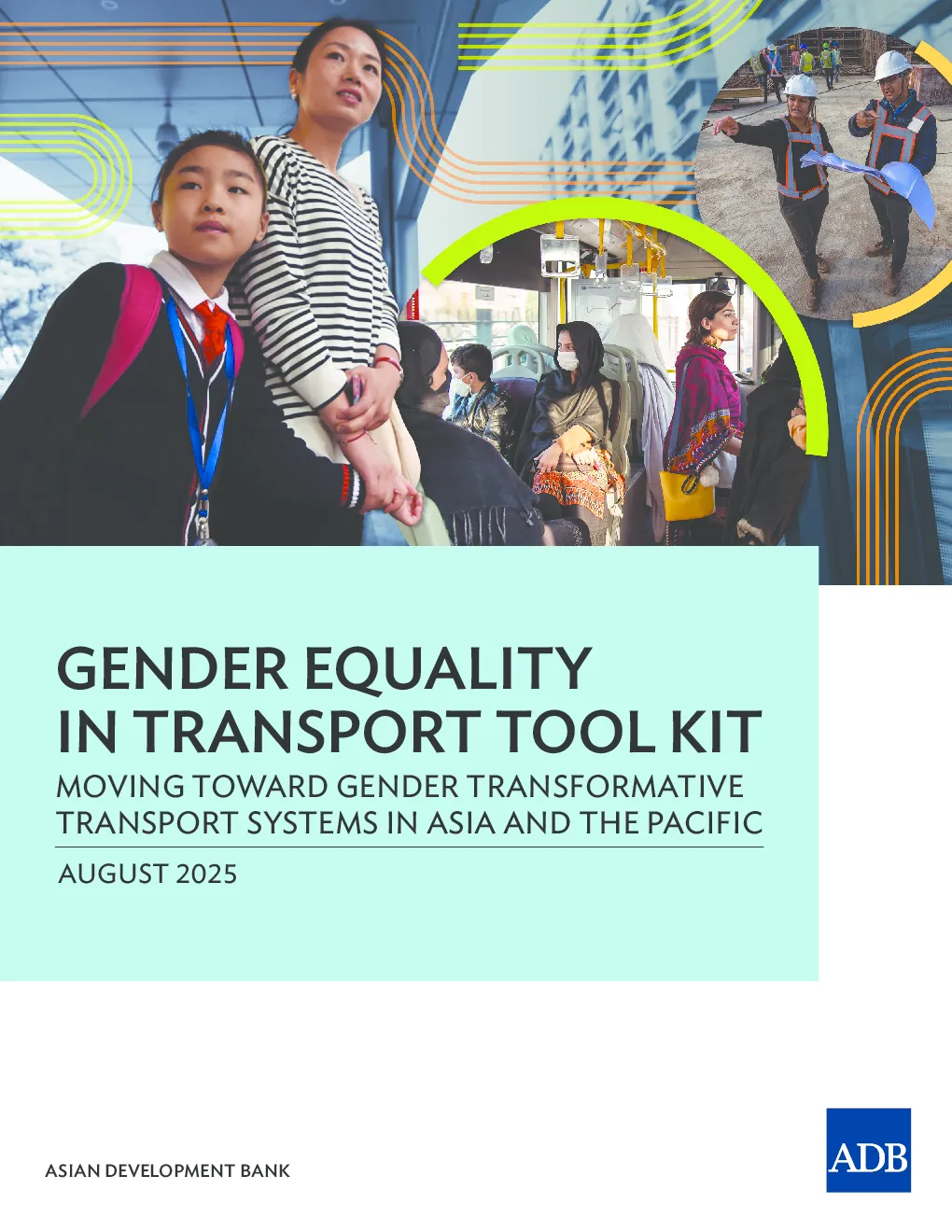
报告封面

MOVING TOWARD GENDER TRANSFORMATIVETRANSPORT SYSTEMS IN ASIA AND THE PACIFIC AUGUST 2025 GENDER EQUALITYIN TRANSPORT TOOL KIT MOVING TOWARD GENDER TRANSFORMATIVETRANSPORT SYSTEMS IN ASIA AND THE PACIFIC AUGUST 2025 Creative Commons Attribution 3.0 IGO license (CC BY 3.0 IGO) © 2025 Asian Development Bank6 ADB Avenue, Mandaluyong City, 1550 Metro Manila, PhilippinesTel +63 2 8632 4444; Fax +63 2 8636 2444www.adb.org Some rights reserved. Published in 2025. ISBN 978-92-9277-366-3 (print); 978-92-9277-367-0 (PDF); 978-92-9277-368-7 (e-book)Publication Stock No. TIM250288-2DOI: http://dx.doi.org/10.22617/TIM250288-2 The views expressed in this publication are those of the authors and do not necessarily reflect the views and policiesof the Asian Development Bank (ADB) or its Board of Governors or the governments they represent. ADB does not guarantee the accuracy of the data included in this publication and accepts no responsibility for anyconsequence of their use. The mention of specific companies or products of manufacturers does not imply that theyare endorsed or recommended by ADB in preference to others of a similar nature that are not mentioned. By making any designation of or reference to a particular territory or geographic area in this document, ADB does notintend to make any judgments as to the legal or other status of any territory or area. This publication is available under the Creative Commons Attribution 3.0 IGO license (CC BY 3.0 IGO)https://creativecommons.org/licenses/by/3.0/igo/. By using the content of this publication, you agree to be boundby the terms of this license. For attribution, translations, adaptations, and permissions, please read the provisionsand terms of use at https://www.adb.org/terms-use#openaccess. This CC license does not apply to non-ADB copyright materials in this publication. If the material is attributedto another source, please contact the copyright owner or publisher of that source for permission to reproduce it.ADB cannot be held liable for any claims that arise as a result of your use of the material. Please contact pubsmarketing@adb.org if you have questions or comments with respect to content, or if you wishto obtain copyright permission for your intended use that does not fall within these terms, or for permission to usethe ADB logo. Corrigenda to ADB publications may be found at http://www.adb.org/publications/corrigenda. Cover design by Josef Ilumin. Tables, Figures, and Boxes Acknowledgments Abbreviations III.What Are Good Practice Gender Performance Indicators and Actions?14Include Outcome-Level Targets Directly Contributing to Closing Gender Gaps14and Inequalities and Promoting Women’s Empowerment in the Program or ProjectInclude Gender Actions That Directly Contribute to Closing Gender Gaps18and Inequalities or Supporting Women’s Empowerment in the Transport Sector IV.What Is the Modality of Implementation?34 V.What Are the Best Practices for Monitoring and Evaluating Gender Impacts35of Transport Projects? VI.What Are the Negative Impacts and Risks and How Can They Be Avoided or Mitigated? 38 Annexes AHow to Mainstream Gender Equality Within ADB’s Upstream Work and Project Life Cycle39BGender-Sensitive Transport Infrastructure41CGender-Inclusive Maintenance Schedule for Streets48 Glossary49 Tables 1Travel Characteristics of Women Compared with Men Across Various Socioeconomic Groups in Asia22Data on Sexual Harassment in Public Transportation Systems Across Some Cities5and Countries in Asia and the Pacific3Women’s Employment in the Transport Sector Across Asia and the Pacific64Parameters, Guiding Questions, and Recommended Actions for a Gendered Analysis105Gender-Focused Transport Outcomes and Indicators14A.1Recommended Actions by Project Stages for Sovereign and Nonsovereign Operations39B.1Gender-Inclusive Walking, Cycling, Public Transport, Highways, and Rural Access Roads42 Figures B.1Gender, Walking, and Cycling: Key Issues and Recommendations41B.2Land Use and Transport Integration47 Boxes 1Gender Equality and Disability Inclusion—Guidelines to Address the Specific Needs4of Women and Girls with Disabilities2Gender Equality and Climate Change Sectors Guide73Women’s Uptake of Electric Two-Wheelers in Delhi and Chennai, India84Case Example of the Gender and Policy Lab in Chennai, India345Case Examples of Transport Project Evaluations356Principles Guiding the Prevention, Mitigation, and Response to Sexual Exploitation,37Abuse, and Harassment Preface The Gender Equality Division in the Climate Change and Sustainable Development Department of theAsian Development Bank (ADB) developed theGender Equality in Transport Tool Kit: Moving Toward GenderTransformative Transport Systems in Asia and the Pacific. The objective of this tool kit is to support transportecosystem stakeholders, such as development finance institutions, developing member countries (DMCs),private sector companies, and transport and gender specialists, to go bey