您的浏览器禁用了JavaScript(一种计算机语言,用以实现您与网页的交互),请解除该禁用,或者联系我们。 [明晟]:你能看到你的整个投资组合吗? - 发现报告

你能看到你的整个投资组合吗?

2026-08-12 - 明晟 黄崇贵-中国医药城15189901173
报告封面

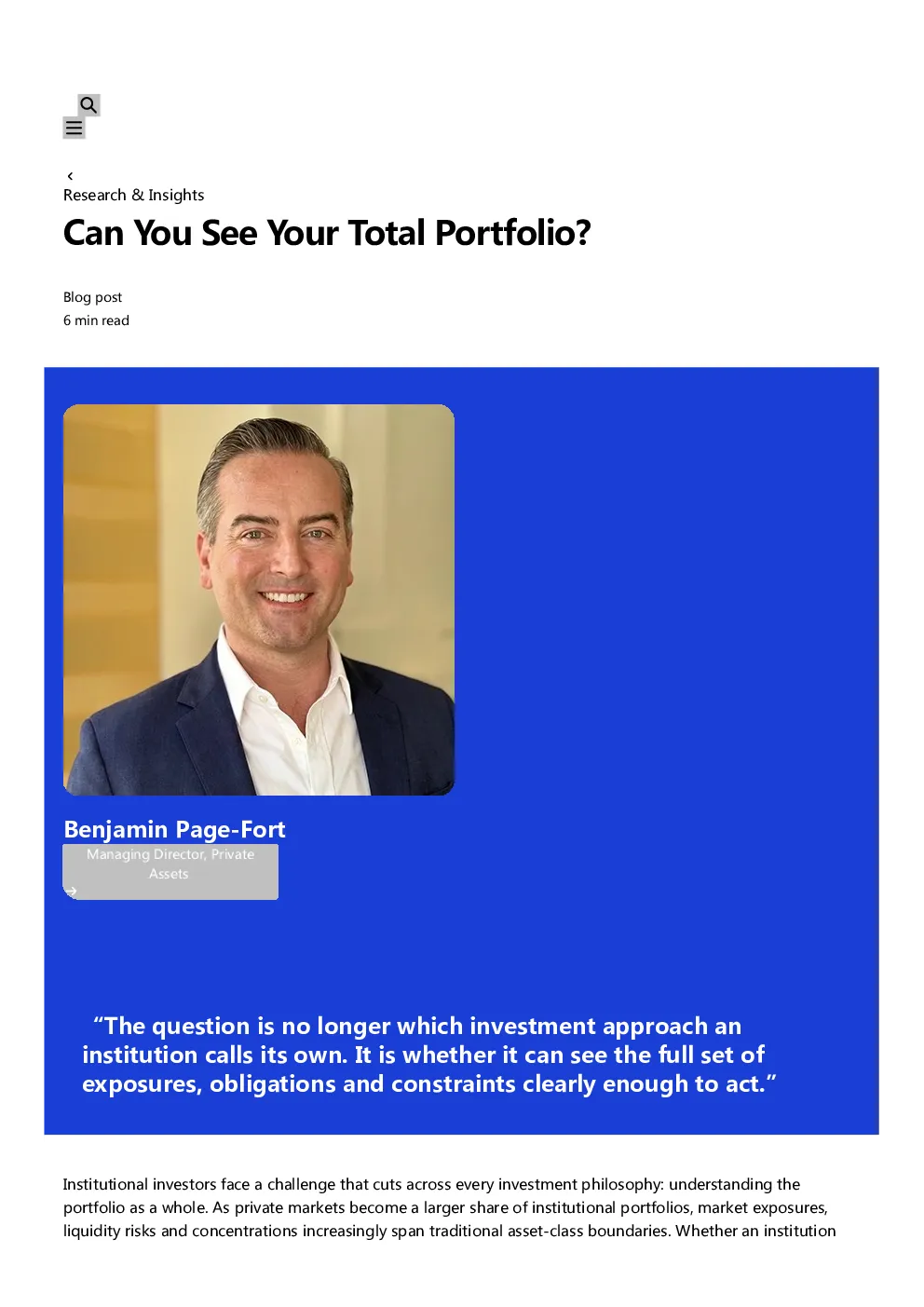
Can You See Your Total Portfolio? Blog post6 minread Benjamin Page-FortManaging Director, PrivateAssets “The question is no longer which investment approach aninstitution calls its own. It is whether it can see the full set ofexposures, obligations and constraints clearly enough to act.” Institutional investors face a challenge that cuts across every investment philosophy: understanding theportfolio as a whole. As private markets become a larger share of institutional portfolios, market exposures,liquidity risks and concentrations increasingly span traditional asset-class boundaries. Whether an institution follows strategic asset allocation (SAA), a total portfolio approach (TPA), a liability-driven framework or someblend of these, total portfolio visibility has become an essential capability. How institutions organize themselves to achieve that visibility is a separate question and one that hasdominated industry discussion. Too often, however, the conversation begins with investment models ratherthan the capability they are intended to support. The debate is usually framed as a choice between SAA andTPA. But these are two points on a wider spectrum of integrated portfolio frameworks, and the real issue iswhether an institution can understand and manage the portfolio as a whole. The structure that got institutional investors here Strategic asset allocation has been the organizing principle of institutional investing for more than 50 years,and for good reason. Divide the portfolio into asset-class groups. Assign specialized teams. Measure each assetclass against its own benchmark. Rebalance toward policy targets. This logic still holds. Specialization drives better decisions within each asset class. Clear mandates create clearaccountability. Governance is simple from the board's perspective: everyone knows who holds what and who isresponsible for it. What has changed is not the logic of SAA, but the portfolio sitting inside it. For many large asset owners,private markets have grown from a marginal allocation to a substantial one. Among the world's 100 largestasset owners, alternatives, led by private equity and including real estate, infrastructure and private credit,account for 28% of total assets as of 2025.1 “At 5% private markets allocation, limited visibility acrosspublic and private exposures may go unnoticed. At 40%,closing that gap becomes a governance imperative.” These are illiquid, long-horizon investments whose interaction with the rest of the portfolio is difficult tocapture through asset-class reporting alone. A private equity portfolio heavily exposed to technology andgrowth stocks may sit alongside a public equity portfolio with strikingly similar characteristics, and no singleinvestment team is responsible for recognizing that concentration, even though the portfolio ultimately bearsthe combined exposure. At 5% private markets allocation, limited visibility across public and private exposuresmay go unnoticed. At 40%, closing that gap becomes a governance imperative. Total portfolio approach is one response among several Some institutions have responded to these pressures by changing the operating model itself. Rather thanevaluating decisions within asset-class silos, TPA judges every investment by its contribution to the totalportfolio. In practice, institutions that adopt TPA often anchor to a simple reference portfolio, such as 80% global equitiesand 20% government bonds, and measure every active investment against this passive alternative. Capital isallocated toward opportunities expected to improve total portfolio performance rather than towardpredetermined asset-class weights. Making this work requires more than analytical capability. The board typically shifts from approving detailedasset-class allocations to defining a risk budget. The CIO gains broader discretion. Investment teams learn tocollaborate across traditional boundaries, and incentive structures evolve to reward total portfolio performancerather than individual mandates. For this reason TPA is not the destination for every institution, and even the most committed are still buildingtoward it. We’ve observed the most mature adoption in Australia, New Zealand, Canada and Singapore, wherelarge sovereign wealth funds and pension plans have invested years in developing governance andorganizational culture alongside their investment processes. Elsewhere, including the United States, Europe, theUnited Kingdom and the Middle East, adoption tends to be selective rather than broad-based. The industry trend, therefore, is more nuanced than a wholesale shift from SAA to TPA. Most institutions will continue to operate some form of strategic asset allocation while building stronger total portfolio capabilitiesalongside it. As arecent MSCI paper on TPAexplores, the hard part of the shift may be cultural and structuralrather than analytical. That is why visibility does not have to wait: the capability to see the whole por