您的浏览器禁用了JavaScript(一种计算机语言,用以实现您与网页的交互),请解除该禁用,或者联系我们。 [未知机构]:东吴宏观转载2026年7月FOMC发布会演讲稿 - 发现报告

东吴宏观转载2026年7月FOMC发布会演讲稿

2026-07-31 未知机构 HEE
报告封面

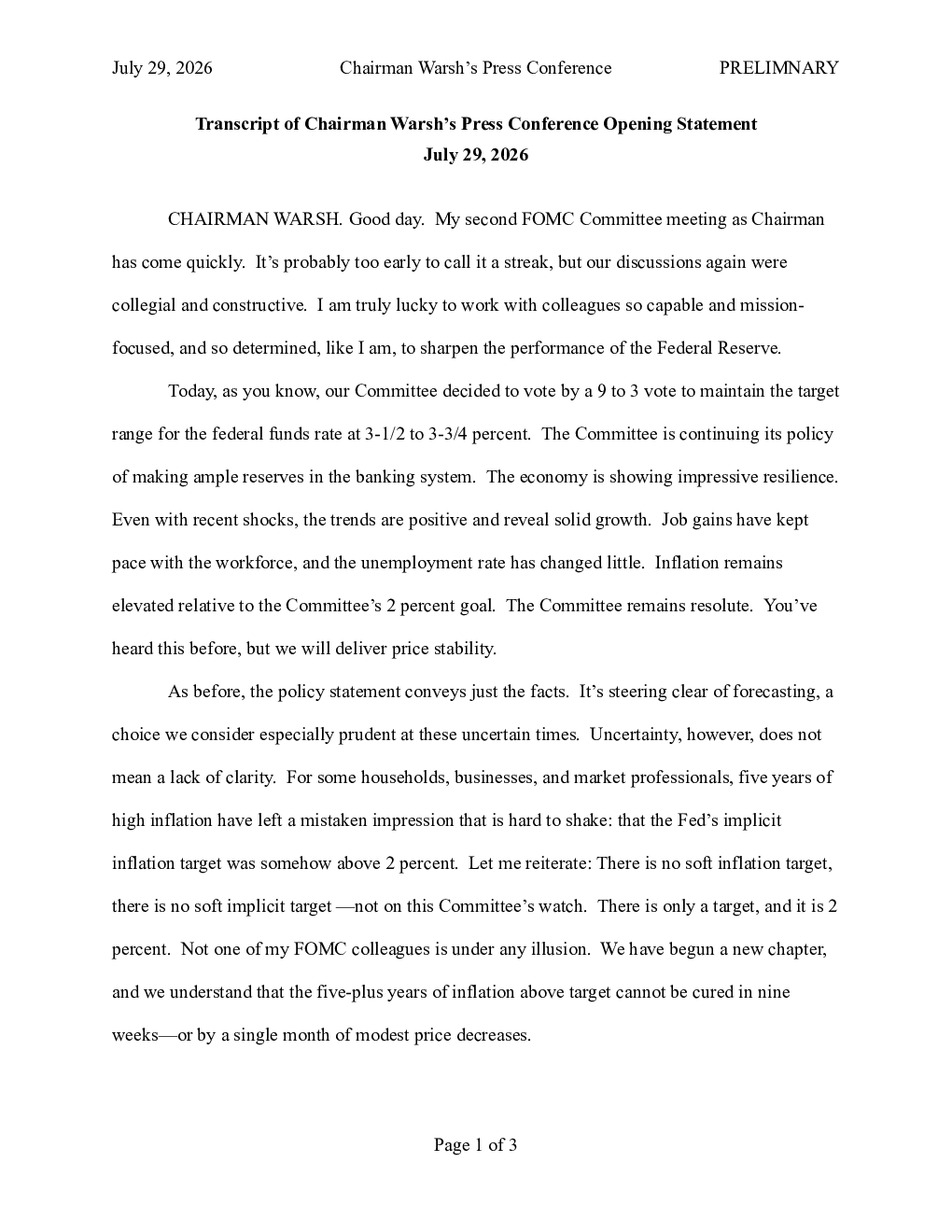
CHAIRMAN WARSH. Good day. My second FOMC Committee meeting as Chairmanhas come quickly. It’s probably too early to call it a streak, but our discussions again werecollegial and constructive. I am truly lucky to work with colleagues so capable and mission-focused, and so determined, like I am, to sharpen the performance of the Federal Reserve. Today, as you know, our Committee decided to vote by a 9 to 3 vote to maintain the targetrange for the federal funds rate at 3-1/2 to 3-3/4 percent. The Committee is continuing its policyof making ample reserves in the banking system. The economy is showing impressive resilience.Even with recent shocks, the trends are positive and reveal solid growth. Job gains have keptpace with the workforce, and the unemployment rate has changed little. Inflation remainselevated relative to the Committee’s 2 percent goal. The Committee remains resolute. You’veheard this before, but we will deliver price stability. As before, the policy statement conveys just the facts. It’s steering clear of forecasting, achoice we consider especially prudent at these uncertain times. Uncertainty, however, does notmean a lack of clarity. For some households, businesses, and market professionals, five years ofhigh inflation have left a mistaken impression that is hard to shake: that the Fed’s implicitinflation target was somehow above 2 percent. Let me reiterate: There is no soft inflation target,there is no soft implicit target —not on this Committee’s watch. There is only a target, and it is 2percent. Not one of my FOMC colleagues is under any illusion. We have begun a new chapter,and we understand that the five-plus years of inflation above target cannot be cured in nineweeks—or by a single month of modest price decreases. This Fed will not waver. Our credibility rests on performing our duties, and delivering onour responsibilities. Americans are right to expect that, because our nation’s prosperity dependson it. To the regulars here in the press room, today’s assessment might sound familiar. Yet therewas nothing inertial about our discussions, our policy, or our strategy. Two economic developments are worth highlighting. The first is a very notable changesince our last meeting 42 days ago: nominal and real yields are materially higher across theTreasury curve. In fact, some of the increases in market interest rates between FOMC meetingsare among the most significant in the last two decades, ranking around the top decile or so. But if the Committee didn’t change its policy rate, what happened? In the inter-meetingperiod, market attention centered on real data and real economic developments. Prices reacted inreal time to incoming information, and the reduction in forward guidance may have been afactor. Market participants are learning to play the ball, not the referee—and market prices willcontinue to respond in the direction and magnitude they see fit. This is, in my view, a change forthe better—and we are just getting started. After all, the central bank need not always andeverywhere be the center of attention. I understand the desire for rolling forecasts andcommentary from this Committee. But for our part, we need to observe market reaction todevelopments, direct and unfiltered. I want to stress, of course, that decisions by this Committeematter a great deal. And where necessary and appropriate, we will not hesitate to act. A second economic development is one that I noted at the congressional oversighthearings this month, but it’s worth repeating. The most striking feature of the economy is thestrong growth of business investment. The surge in high-tech capex has been remarkable. Butthat does not necessarily make the Fed’s role any easier. In the A.I.-related category of high-techequipment and software, the most recent data shows four-quarter growth rates of nearly 20 percent. This is helping to sustain the healthy momentum of manufacturing output. Moregenerally, capex is preparing the ground for future growth. Nonetheless, the precise timing andmagnitude of effects on the supply side remain hard to predict. FOMC meetings produce policy decisions. But just as important is candid discussion ofthe big things that matter most. That too is a priority in this new chapter at the Fed. In ourmeeting, vigorous discussion centered on four questions, which I will enumerate. First, we talked a lot about the implications of the past five years of high inflation on thecurrent policy conjuncture. To echo an old phrase, has the past really passed? Second, my colleagues and I considered the economic shocks of recent years. Strainedsupply chains arising from the pandemic, military conflicts, energy-supply disruptions,substantial increases in tariff rates, and yes, the surge in A.I.-related investment. These differ intheir sources—do they also differ in their effects on output and employment? Third, we took up the related question of price increases arising from shocks. Thebusiness capex boom, for exa