您的浏览器禁用了JavaScript(一种计算机语言,用以实现您与网页的交互),请解除该禁用,或者联系我们。 [未知机构]:SemiAnalysis中国长鑫存储即将挑战DRAM行业巨头---ChinasCXMTI - 发现报告

SemiAnalysis中国长鑫存储即将挑战DRAM行业巨头---ChinasCXMTI

2026-07-21 未知机构 王英文
报告封面

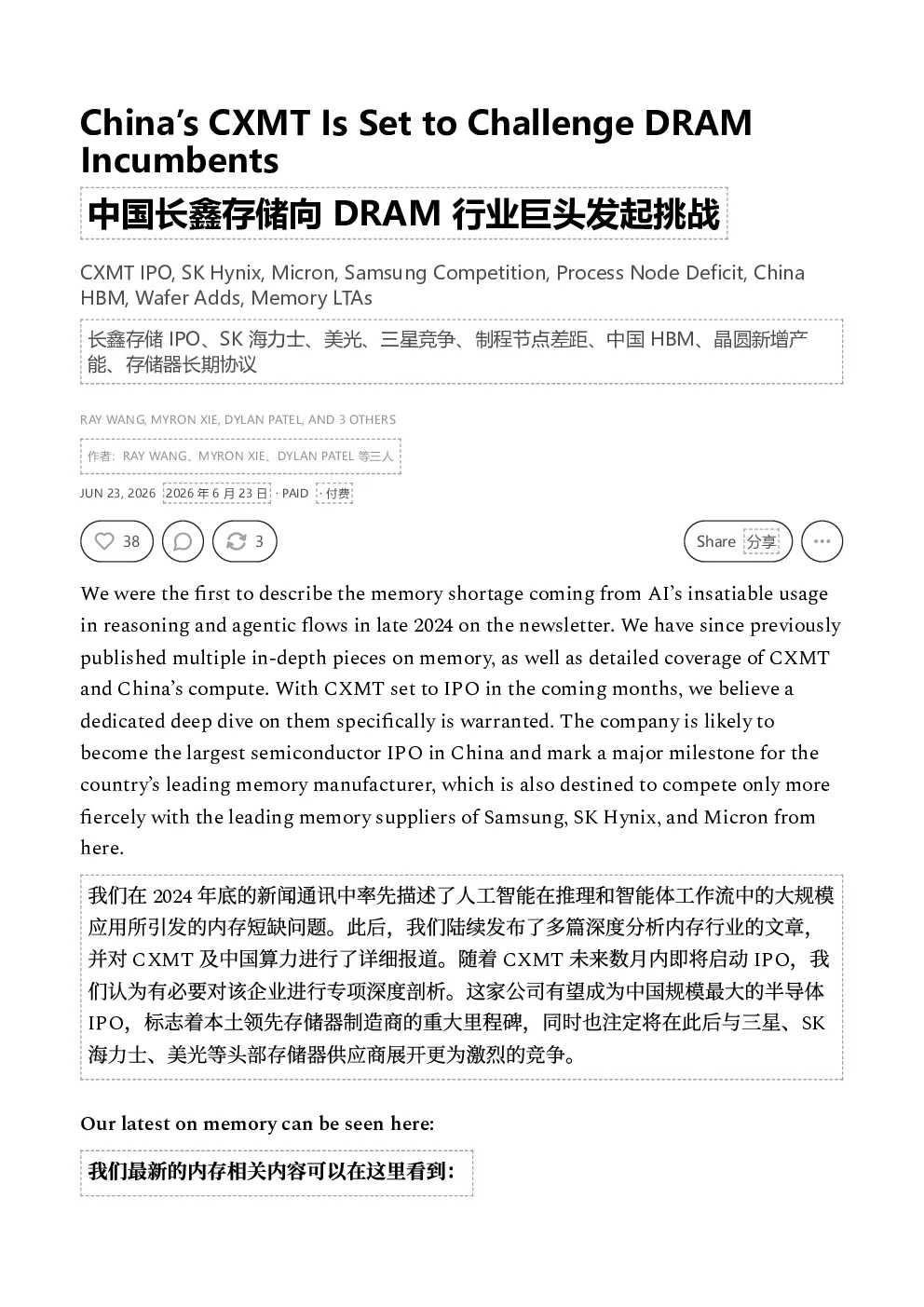
中国长鑫存储向 DRAM 行业巨头发起挑战 CXMT IPO, SK Hynix, Micron, Samsung Competition, Process Node Deficit, ChinaHBM, Wafer Adds, Memory LTAs 长鑫存储 IPO、SK 海力士、美光、三星竞争、制程节点差距、中国 HBM、晶圆新增产能、存储器长期协议 RAY WANG,MYRON XIE,DYLAN PATEL,AND3OTHERS 作者:RAY WANG、MYRON XIE、DYLAN PATEL 等三人 JUN 23, 20262026 年 6 月 23 日·PAID·付费 We were the first to describe the memory shortage coming from AI’s insatiable usagein reasoning and agentic flows in late 2024 on the newsletter. We have since previouslypublished multiple in-depth pieces on memory, as well as detailed coverage of CXMTand China’s compute. With CXMT set to IPO in the coming months, we believe adedicated deep dive on them specifically is warranted. The companyis likely tobecome the largest semiconductor IPO in China and mark a major milestone for thecountry’s leading memory manufacturer, which is alsodestined to compete only morefiercely with the leading memory suppliers of Samsung, SK Hynix, and Micron fromhere. 我们在2024年底的新闻通讯中率先描述了⼈⼯智能在推理和智能体⼯作流中的⼤规模应⽤所引发的内存短缺问题。此后,我们陆续发布了多篇深度分析内存⾏业的⽂章,并对CXMT及中国算⼒进⾏了详细报道。随着CXMT未来数⽉内即将启动IPO,我们认为有必要对该企业进⾏专项深度剖析。这家公司有望成为中国规模最⼤的半导体IPO,标志着本⼟领先存储器制造商的重⼤⾥程碑,同时也注定将在此后与三星、SK海⼒⼠、美光等头部存储器供应商展开更为激烈的竞争。 Our latest on memory can be seen here: 我们最新的内存相关内容可以在这⾥看到: Memory Mania: How a Once-in-Four-Decades Shortage IsFueling a Memory Boom 内存狂潮:四十年一遇的短缺如何催生存储芯片繁荣 Or other older but excellent memory or China compute pieces below: 或以下其他旧款但性能优异的存储芯⽚或中国算⼒芯⽚: 1.Huawei Ascend Production Ramp: Die Banks, TSMC Continued Production,HBM is The Bottleneck 华为昇腾产能爬坡:晶粒库存、台积电持续⽣产,HBM成为瓶颈 2.Huawei AI CloudMatrix 384 – China’s Answer to Nvidia GB200 NVL72华为AI云矩阵384——中国对标英伟达GB200 NVL72的⽅案 3.Scaling the Memory Wall: The Rise and Roadmap of HBM突破存储瓶颈:⾼带宽存储器(HBM)的崛起与发展路线图 存储瓶颈:DRAM的过去、现在与未来 5.Scaling Laws - O1 Pro Architecture, Reasoning Training Infrastructure, Orion andClaude 3.5 Opus “Failures”, Inference Tokenomics of Test Time Compute 规模定律——O1 Pro架构、推理训练基础设施、Orion与Claude 3.5 Opus的“失败”、测试时计算的推理代币经济学 CXMT, established in 2016, is going to be listed on China’s STAR Market. Now theleading DRAM player in China, its history shows an interesting path of technologytransfer, talent flows, and the patience of state-venture capital, together of which are turning the company toward indigenous innovation. 成⽴于2016年的⻓鑫存储(CXMT)即将在中国科创板上市。作为中国⽬前领先的DRAM⼚商,其发展历程展现了技术转移、⼈才流动与国有⻛险资本耐⼼的有趣轨迹,这些因素正共同推动该公司⾛向⾃主创新。 The Silicon Valley Returnee硅谷归国人才 Zhu Yiming, the founder of CXMT, earned his undergraduate degree in physics atTsinghua University in 1994 and came to SUNY Stony Brook for his graduate study inelectrical engineering. He then worked in Silicon Valley and became a project lead atMoSys (Monolithic System Technology) around 2001. In 2005, he went back to Chinawith a set of SRAM patent and US$100,000 in seed money, foundingGigaDevice,which later became well known for its SPI NOR flash and microcontrollers, a fablessdesign house that grew into one of the world’s top NOR flash suppliers. But the globalNOR flash market is much smaller compared to DRAM or NAND flash. Zhu Yimingalways dreams big, and not surprisingly he chose to march into the DRAM business. ⻓鑫存储创始⼈朱⼀明于1994年在清华⼤学获得物理学学⼠学位,随后赴纽约州⽴⼤学⽯溪分校攻读电⼦⼯程研究⽣。此后他曾在硅⾕⼯作,2001年前后成为MoSys(单⽚系统技术公司)的项⽬主管。2005年,他带着⼀组SRAM专利和10万美元种⼦资⾦回国,创⽴了兆易创新。该公司后来凭借SPI NOR闪存和微控制器闻名,是⼀家⽆晶圆⼚设计公司,成⻓为全球顶级NOR闪存供应商之⼀。然⽽全球NOR闪存市场规模远⼩于DRAM或NAND闪存。朱⼀明始终怀揣远⼤抱负,毫不意外地选择了进军DRAM产业。 DRAM, however, is not a design-house game in which one can stay fabless. DRAM iscapital-devouring, IP-fortified, and manufacturing-bound, and by 2016 the wholeindustry was dominated by three survivors, Samsung, SK Hynix, and Micron, fortifiedby four decades of patents and capital that no newcomer had breached. Zhu’s SRAMpatents and GigaDevice’s NOR franchise gave him neither a DRAM cell, nor a DRAMprocess, nor any cover from the incumbents’ patents. Thus, when Zhu and the Hefeimunicipal government launched the DRAM venture in 2016, the “506” project that became CXMT, the core technology had to come from somewhere else entirely. 然⽽,DRAM并⾮那种可以保持⽆晶圆⼚模式的芯⽚设计⾏业。DRAM领域是资本密集型、知识产权壁垒⾼筑且⾼度依赖制造能⼒的产业。到2016年,整个⾏业已被三星、SK海⼒⼠和美光三⼤幸存者垄断,它们凭借四⼗年来积累的专利和资本构筑的防线,令任何新⼊局者都望⽽却步。朱⼀明拥有的SRAM专利和兆易创新的NOR闪存业务,既未赋予他DRAM存储单元技术、DRAM制造⼯艺,也⽆法提供任何规避现有巨头专利保护的⽅案。因此,当朱⼀明与合肥市政府于2016年启动DRAM项⽬——即后来成为⻓鑫存储的"506"⼯程时,核⼼技术必须完全另寻来源。 It came from a dead company in Germany. 这些核⼼技术来⾃⼀家已经倒闭的德国企业。 The DRAM Foundation: Inheriting QimondaDRAM 基石:继承奇梦达遗产 The dead company wasQimonda. Though the company went bankrupt in January 2009due to the 2008 Global Financial Crisis and the following dramatic memorydowncycle, it was then the leading DRAM player in Europe. A subsidiary of Infineon,which originated from Siemens, it offered a rare alternative: a deep DRAM patent baseand a cell architecture, both originating outside the dominant Samsung-SK Hynix-Micron triangle. In June 2015, Polaris Innovations, a subsidiary of WiLAN, a Canadianpatent-monetization firm, bought roughly7,000 Qimonda patentsand applicationsfrom Infineon for about 30 millio