您的浏览器禁用了JavaScript(一种计算机语言,用以实现您与网页的交互),请解除该禁用,或者联系我们。 [Aokah]:全球食品行业全球能力中心影响:包装食品、饮料、宠物食品及分销领域合并分析 - 发现报告

全球食品行业全球能力中心影响:包装食品、饮料、宠物食品及分销领域合并分析

食品饮料 2026-02-01 Aokah 葛大师
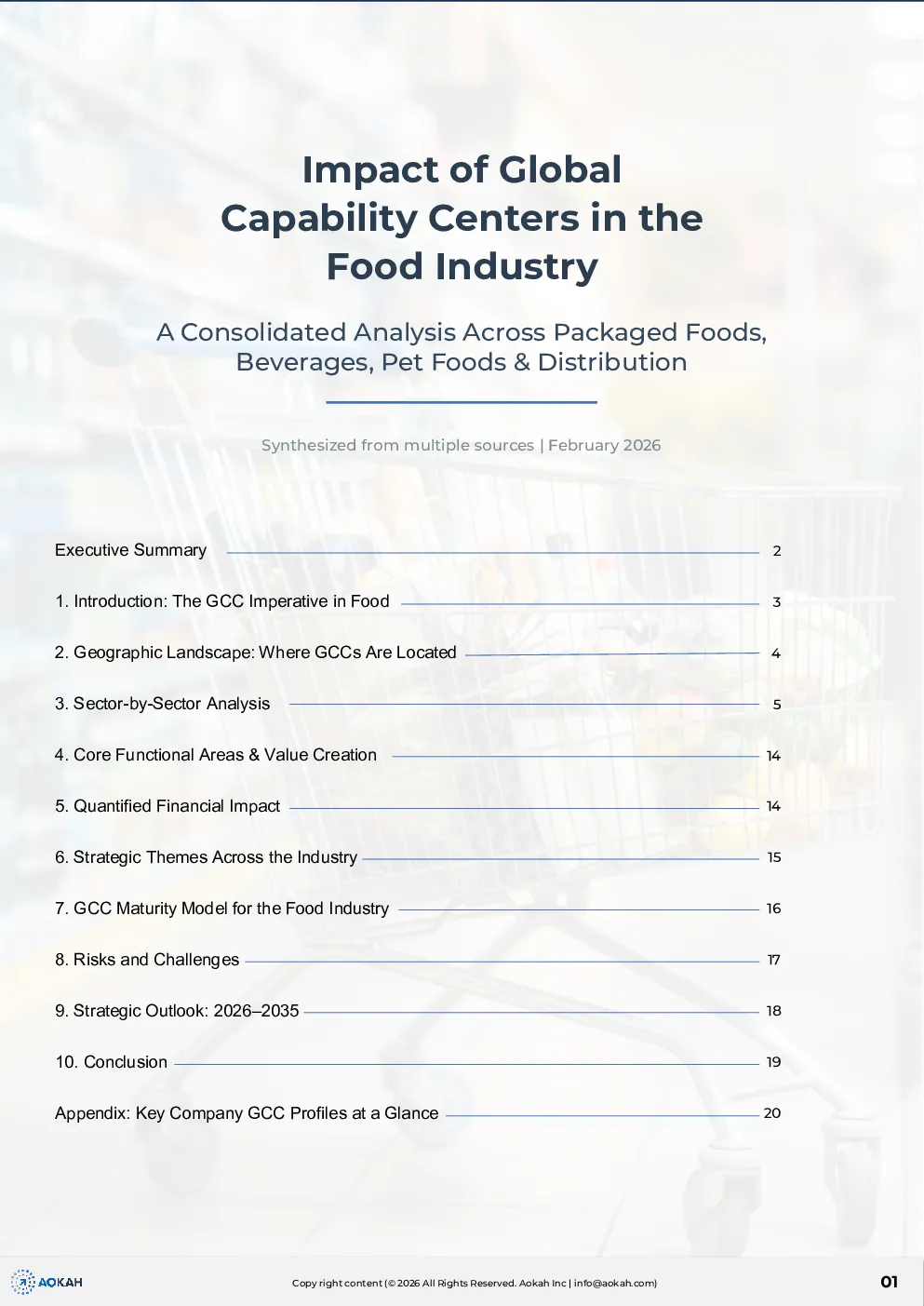
报告封面

A Consolidated Analysis Across Packaged Foods,Beverages, Pet Foods & Distribution Synthesized from multiple sources | February 2026 --23451414151617181920Executive Summary1. Introduction: The GCC Imperative in Food2. Geographic Landscape: Where GCCs Are Located3. Sector-by-Sector Analysis4. Core Functional Areas & Value Creation5. Quantified Financial Impact6. Strategic Themes Across the Industry7. GCC Maturity Model for the Food Industry8. Risks and Challenges9. Strategic Outlook: 2026–203510. ConclusionAppendix: Key Company GCC Profiles at a Glance EXECUTIVESUMMARY Global Capability Centers (GCCs) have undergone a fundamental transformation across the food industry–evolving from transactional cost-arbitrage units intostrategic innovation and transformation engines.This report synthesises findings from multiple independent research sources to present a consolidatedanalysis of how major players in packaged foods, beverages, pet foods, and food distribution areleveraging GCCs to drive competitive advantage. Key findings from the research are as follows: GCCs in the food sector have moved beyondback-office processing tolead digitaltransformation, AI deployment, and supplychain orchestration. India is thedominant GCC destinationfor foodcompanies, housing over1,900 GCCswithnearly2 million professionalsas of 2026. The pet food segment represents agap inpublic GCC disclosure, though parentcompanies like Mars and Nestlé integrate petnutrition into their broader GCC structures. Leading companies includingNestlé, PepsiCo,General Mills, AB InBev, Carlsberg, Mars, andSyscohave established mature GCC operationsdelivering measurable financial and strategicvalue. FinancialImpactHighlights20–40%Cost ReductionReduction in transactional costs 2–4%Margin UpliftMargin uplift from analytics 5–10%Working CapitalWorking capital improvement 1.INTRODUCTION: THE GCC IMPERATIVE IN FOOD The global food industry operates under persistent structural pressures: volatile commodity costs,complex multi-tier supply chains, thinning margins, ESG compliance mandates, SKU proliferation, andrapidly shifting consumer preferences. To meet these challenges at scale, leading multinational foodcorporations have establishedGlobal Capability Centers–wholly owned captive hubs that concentrateexpertise in technology, analytics, finance, procurement, R&D, and supply chain management. GCCs (also referred to as Global Business Services centres, Global In-house Centers, or Shared ServicesCenters) have followed a clear evolutionary arc: Phase 1 Phase 2 Process Excellence Cost Optimisation Finance, HR, procurement transaction processing ERP standardisation, shared analytics Phase 3 Phase 4 Digital Enablement Innovation & Strategy Data science, automation, AI/ML deployment R&D support, product analytics, sustainability modelling Most leading food industry GCCs now operate atPhase 3 or Phase 4 maturity.The strategicrationale has shifted decisively:talent access and capability building have overtaken costsavingsas the primary driver of GCC investment. 2. GEOGRAPHIC LANDSCAPE: WHERE GCCS ARELOCATED India has emerged as the dominant hub for food industry GCCs, driven by deep digital talent pools,English proficiency, cost competitiveness, and a mature GCC ecosystem. As of 2026, India houses over1,900GCCsemploying nearly2 million professionals. Carlsberg's decision to establish its first-ever GCC in India in 2025 illustrates the country'ssustained appeal. According to Esther Wu, Carlsberg's Group CIO, India"stood out as a placewhere we can attract and retain talent,"with the company reaching250 staff within nine monthsof conception using a Build-Operate-Transfer model with partner GSPANN. 3.SECTOR-BY-SECTOR ANALYSIS Packaged food companies represent the most mature GCC segment in the food industry, withseveral organizations having operated capability centers for decades. Nestlé operates GCCs across India (Gurugram, Chennai), the Philippines, Poland, andMexico. Core capabilities include finance and accounting, procurement analytics, digitalmarketing analytics, supply chain planning, data science, and IT transformation. Theorganization uses its GCC network to standardize its global digital backbone, run end-to-end demand forecasting, and automate sustainability reporting. Nestlé also operatesa dedicated Global IT Services Centre in Bengaluru supporting over 45 countries, and aDigital, Data, and Tech Hub established in Bangalore in 2022. 1 General Mills established its India Center (GIC) in Mumbai in 1996, making it one of theearliest food industry entrants into the GCC space. The center now employsapproximately 2,000 people, with technology constituting the largest function at 850employees. GIC operates on four technology pillars: Digital Core (SAP, Microsoft,ServiceNow, cloud infrastructure), Data and Analytics (AI/ML, automation), EnterpriseSolutions (commercial technologies), and Compliance and Global Impact (cybersecurity,sustai