您的浏览器禁用了JavaScript(一种计算机语言,用以实现您与网页的交互),请解除该禁用,或者联系我们。 [花旗]:花旗太空经济与AI未来研讨会十大核心要点 - 发现报告

花旗太空经济与AI未来研讨会十大核心要点

2026-07-09 花旗 Man💗
报告封面

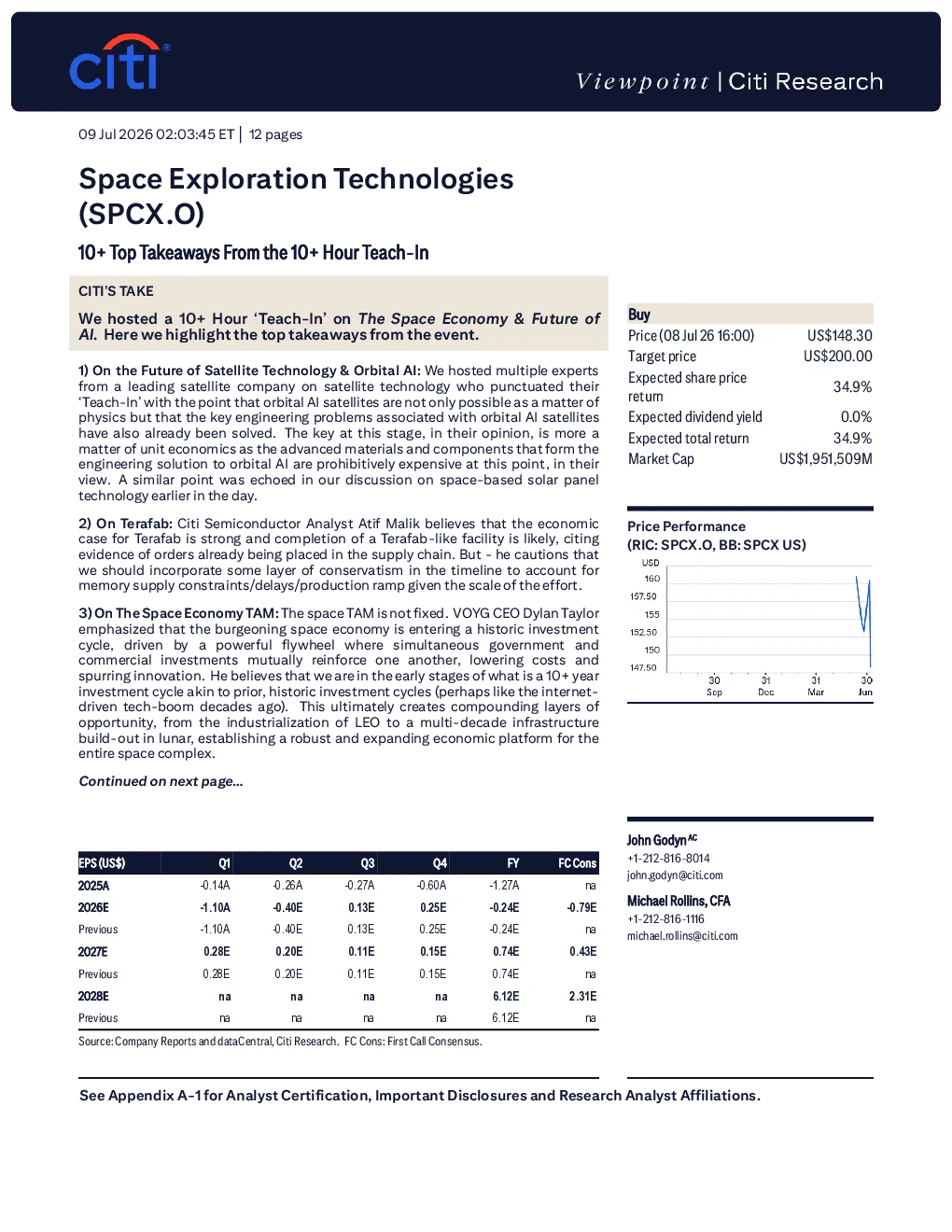
Space Exploration Technologies(SPCX.O) 10+ Top Takeaways From the 10+ Hour Teach-In CITI'S TAKE We hosted a 10+ Hour ‘Teach-In’ onThe Space Economy & Future ofAI. Here we highlight the top takeaways from the event. 1) On the Future of Satellite Technology & Orbital AI:We hosted multiple expertsfrom a leading satellite company on satellite technology who punctuated their‘Teach-In’ with the point that orbital AI satellites are not only possible as a matter ofphysics but that the key engineering problems associated with orbital AI satelliteshave also already been solved. The key at this stage, in their opinion, is more amatter of unit economics as the advanced materials and components that form theengineering solution to orbital AI are prohibitively expensive at this point, in theirview. A similar point was echoed in our discussion on space-based solar paneltechnology earlier in the day. 2) On Terafab:Citi Semiconductor Analyst Atif Malik believes that the economiccase for Terafab is strong and completion of a Terafab-like facility is likely, citingevidence of orders already being placed in the supply chain. But - he cautions thatwe should incorporate some layer of conservatism in the timeline to account formemory supply constraints/delays/production ramp given the scale of the effort. 3) On The Space Economy TAM:The space TAM is not fixed. VOYG CEO Dylan Tayloremphasized that the burgeoning space economy is entering a historic investmentcycle,driven by a powerful flywheel where simultaneous government andcommercialinvestments mutually reinforce one another,lowering costs andspurring innovation. He believes that we are in the early stages of what is a 10+ yearinvestment cycle akin to prior, historic investment cycles (perhaps like the internet-driven tech-boom decades ago).This ultimately creates compounding layers ofopportunity, from the industrialization of LEO to a multi-decade infrastructurebuild-out in lunar, establishing a robust and expanding economic platform for theentire space complex. Continued on next page… John GodynAC+1-212-816-8014john.godyn@citi.com Michael Rollins, CFA+1-212-816-1116michael.rollins@citi.com 4) On Bipartisan Support:Multiple speakers emphasized the strong historic andcontinued bipartisan support for space that has transcended typical politicalcycles. With that said, speakers could not rule out that a continued progressivelean among Democrats could increasingly raise risks for space weapons & defensespending in particular. Accordingly, the ramifications of the mid-term electionsshould be considered a risk and focal point for investors focused on the spaceweapons & defense economy. 5) On Urgency to Get Back to the Moon:We hosted experts including Meg Vernal,General Counsel (VOYG) on space law and the political/regulatory backdrop forspace who painted a picture of an unusual "grey area" legal framework governingactivities on the moon in conjunction with specific areas of lunar real estate beingmuch more valuable than others. Ultimately, the combination of these two themessuggests that there is a strong argument favoring a 'first mover advantage' and thatnations interested in establishing a lunar presence must act with urgency or riskbeing boxed out by countries who get there sooner. 6) On the FAA's Role in Space/Launch:We hosted Michael O'Donnell, FormerDeputy Associate Administrator, Commercial Space Transportation (AST-2) at TheFederal Aviation Administration, who believed that it was not outlandish to achievethousands of launches annually in the coming years. His optimism surprised evenus. He emphasized that significant investment had to be made in the FAA from aresource and personnel perspective but that there were no structural barriers toachieving thousands of launches annually that a reasonable amount of investmentcould not solve. He also argued that there is directional support for a dramaticexpansion in launch capacity driven in part by a view that if the US doesn't lean intoits momentum in launch, then China will surpass the US, which is viewed as anunacceptable risk to many. 7) On Themes in AI:We hosted Jason Warner, Co-Founder/Co-CEO of Poolside andformer CTO of GitHub, for a wide-ranging discussion on frontier intelligence and AIinfrastructure. Warner argued that current open models exceed the capabilities offrontier systems from roughly 18 months ago, and positioned knowledge work as aroughly $29T category where AI may increasingly substitute for or augment humanlabor. SeeAI Insights from Citi’s Space & AI Virtual Teach In. 8) On Themes in AI Infrastrucure:We hosted Benny Yufei Chein, Co-Founder,Fireworks AI, on the future of AI infrastructure, centering on inference as the nextmajor battleground. The session reinforced that AI infrastructure value is not onlyabout compute capacity, but also inference cost, customer control, modelcustomization, and workload-specific deployment. SeeAI Insights from Citi’sSpace & AI Virtual Teach In. 9) On Starlink Build