百事公司(PEP)2026年Q2业绩回顾:国内压力影响有机增长与市盈率
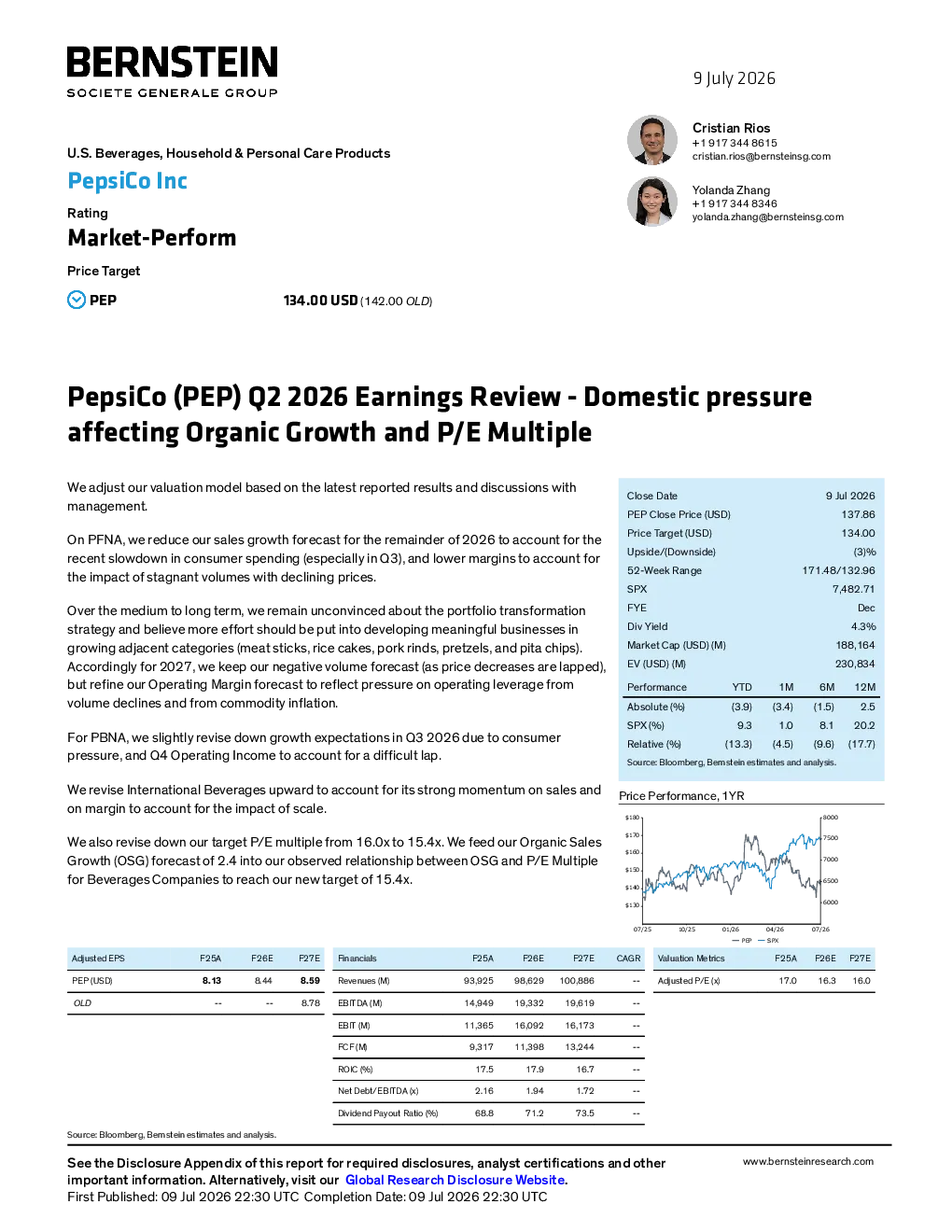
RatingMarket-Perform Price Target 134.00 USD(142.00OLD) PepsiCo (PEP) Q2 2026 Earnings Review - Domestic pressureaffecting Organic Growth and P/E Multiple We adjust our valuation model based on the latest reported results and discussions withmanagement. Close Date9 Jul 2026PEP Close Price (USD)137.86Price Target (USD)134.00Upside/(Downside)(3)%52-Week Range171.48/132.96SPX7,482.71FYEDecDiv Yield4.3%Market Cap (USD) (M)188,164EV (USD) (M)230,834 On PFNA, we reduce our sales growth forecast for the remainder of 2026 to account for therecent slowdown in consumer spending (especially in Q3), and lower margins to account forthe impact of stagnant volumes with declining prices. Over the medium to long term, we remain unconvinced about the portfolio transformationstrategy and believe more effort should be put into developing meaningful businesses ingrowing adjacent categories (meat sticks, rice cakes, pork rinds, pretzels, and pita chips).Accordingly for 2027, we keep our negative volume forecast (as price decreases are lapped),but refine our Operating Margin forecast to reflect pressure on operating leverage fromvolume declines and from commodity inflation. For PBNA, we slightly revise down growth expectations in Q3 2026 due to consumerpressure, and Q4 Operating Income to account for a difficult lap. We revise International Beverages upward to account for its strong momentum on sales andon margin to account for the impact of scale. We also revise down our target P/E multiple from 16.0x to 15.4x. We feed our Organic SalesGrowth (OSG) forecast of 2.4 into our observed relationship between OSG and P/E Multiplefor Beverages Companies to reach our new target of 15.4x. DETAILS PepsiCo reported Q2 2026 earnings today. Core EPS of $2.20 were roughly in line with consensus of $2.19 (VA). But despiteachieving consensus, the stock opened 4%-5% lower vs. the previous day. We believe the move in the stock price was driven bya miss on the North America businesses. On the top line, PFNA declined 1.5% versus consensus estimates of +0.4%, while PBNA slightly exceeded consensus on salesgrowth with 6.6% versus consensus of 6.4%. Operating Income also missed, with PFNA operating margins of 21.5% versusconsensus of 22.9%, and PBNA at 13.7% versus consensus of 14.8%. The gap in earnings from the North America businesses was compensated by International businesses, most notablyInternational Beverages, which exceeded consensus expectations of 4.3% and delivered 9.0% organic sales growth. APACFoods was also a bright spot, growing organically 9.0% versus 5.3% on consensus. We were bearish vs. consensus on PFNA for the quarter (our forecast for YoY sales was -1.7%). We recognize that part of thesequential degrading of performance relative to Q1 was driven by consumer pressure, as indeed we have seen in scannerdata every category in our coverage slow down relative to Q1. That said, while we think performance will sequentially improvethroughout the year as consumer spending rebounds, we remain bearish on the mid to long-term potential of the snacksbusiness. We are unconvinced by the portfolio transformation initiatives, which we believe focus too much on the core (potato chips,tortilla chips) and are missing opportunities to more aggressively penetrate other adjacent categories that are showing healthiergrowth rates. Specifically, we would love to see a consistent, long-term strategy to build sizable businesses in meat sticks, ricecakes, pork rinds, pretzels, and pita, all of which are growing organically year over year and where the portfolio currently under-indexes and/or is losing share. We realize that, given the scale and profitability of the core, this would be a long term project, butwe also think that if the best time to start was yesterday, the second-best time to start is today. In addition, given the pressure on margins that we are seeing this year, we don’t see how the company could sustainablycontinue to invest in affordability in 2027. So, as price decreases are lapped, we believe volumes will turn negative again. We arebearish vs. consensus on this outlook. In addition, our work on category elasticity suggests that Salty Snacks are quite elastic, and we believe PFNA’s inability totake price next year, combined with deleveraging from volume declines, will continue to erode margins despite productivityinitiatives. We believe PBNA will continue to be challenged as share issues on the core (Pepsi, Mountain Dew) continue to be unaddressed.We believe the headwinds here are structural, driven partly by a shift to zero sugar (Pepsi) and Energy Drinks (Mountain Dew),but the impact will persist regardless. Exposure to RTD Cofee and Tea, both of which are declining and where Pepsi is losingshare, will also remain as a persistent headwind. The energy drinks strategy is sound in terms of the chosen portfolio (Celsius), but the limitations of the approach (distribution vs.ownership) have already emerged, as the structure