2Q26流媒体研讨会要点
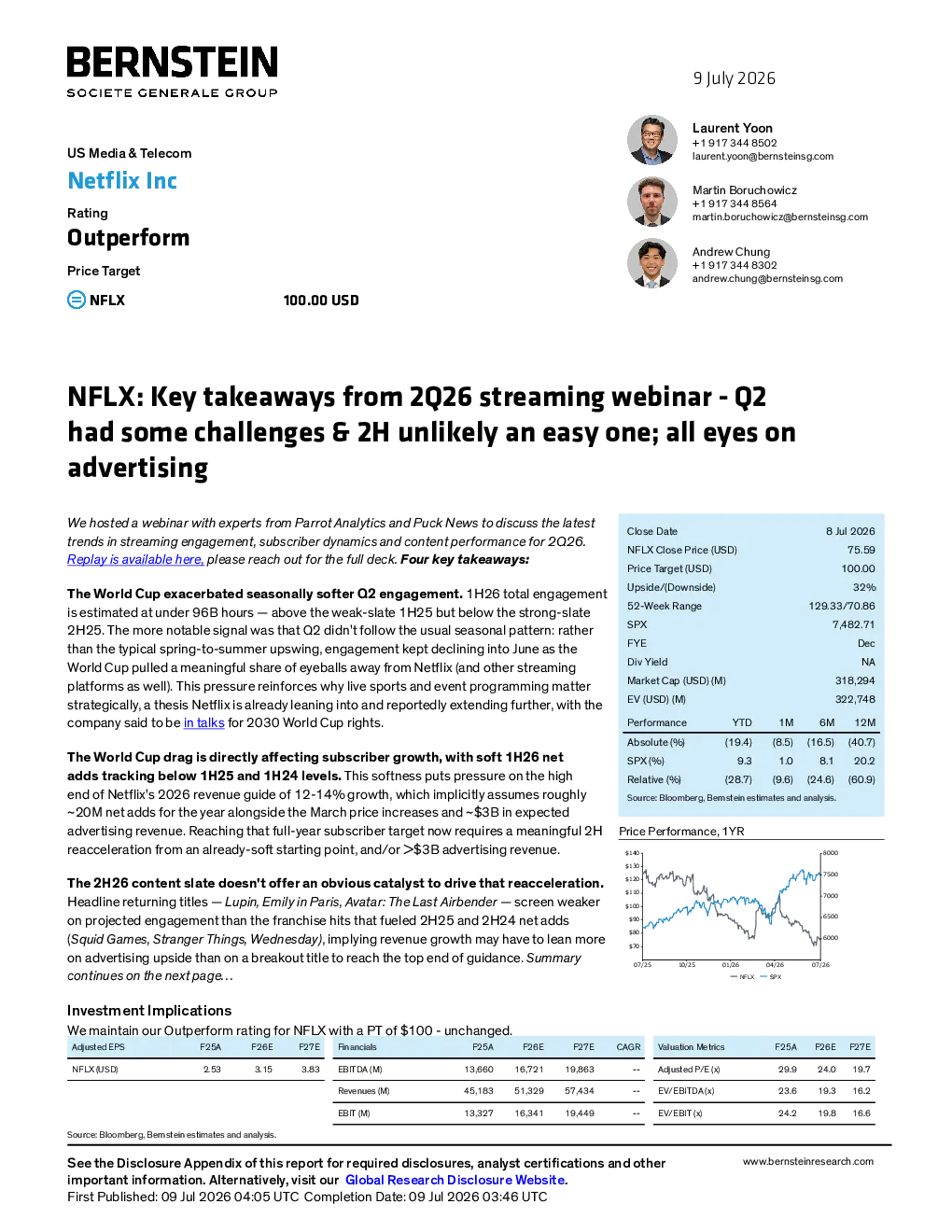
Laurent Yoon+1 917 344 8502laurent.yoon@bernsteinsg.com Martin Boruchowicz+1 917 344 8564martin.boruchowicz@bernsteinsg.com Andrew Chung+1 917 344 8302andrew.chung@bernsteinsg.com Price Target NFLX: Key takeaways from 2Q26 streaming webinar - Q2had some challenges & 2H unlikely an easy one; all eyes onadvertising We hosted a webinar with experts from Parrot Analytics and Puck News to discuss the latesttrends in streaming engagement, subscriber dynamics and content performance for 2Q26.Replay is available here, please reach out for the full deck.Four key takeaways: The World Cup exacerbated seasonally softer Q2 engagement.1H26 total engagementis estimated at under 96B hours — above the weak-slate 1H25 but below the strong-slate2H25. The more notable signal was that Q2 didn't follow the usual seasonal pattern: ratherthan the typical spring-to-summer upswing, engagement kept declining into June as theWorld Cup pulled a meaningful share of eyeballs away from Netflix (and other streamingplatforms as well). This pressure reinforces why live sports and event programming matterstrategically, a thesis Netflix is already leaning into and reportedly extending further, with thecompany said to be in talks for 2030 World Cup rights. The World Cup drag is directly affecting subscriber growth, with soft 1H26 netadds tracking below 1H25 and 1H24 levels.This softness puts pressure on the highend of Netflix's 2026 revenue guide of 12-14% growth, which implicitly assumes roughly~20M net adds for the year alongside the March price increases and ~$3B in expectedadvertising revenue. Reaching that full-year subscriber target now requires a meaningful 2Hreacceleration from an already-soft starting point, and/or >$3B advertising revenue. The 2H26 content slate doesn't offer an obvious catalyst to drive that reacceleration.Headline returning titles —Lupin, Emily in Paris, Avatar: The Last Airbender— screen weakeron projected engagement than the franchise hits that fueled 2H25 and 2H24 net adds(Squid Games, Stranger Things, Wednesday), implying revenue growth may have to lean moreon advertising upside than on a breakout title to reach the top end of guidance.Summarycontinues on the next page… Investment Implications We maintain our Outperform rating for NFLX with a PT of $100 - unchanged. DETAILS Summary continued... Structurally, engagement per subscriber remains under pressure — a trend we've discussed before — and it's drivingNetflix to invest more broadly and diversify across content types.Faster-decaying library content means Netflix needsto continue adding volume to sustain engagement, while returning seasons, though unexpectedly underperforming their priorinstallment, remain a core retention tool that Netflix is leaning on heavily (a large share of the 2026 slate is returning seasons).The trade-off is cost: sequels get progressively more expensive, international content is no longer the cheap lever it once was (atleast not as cheap as before), and Netflix (and others) still needs to keep building new franchises alongside all of these to keepfeeding the content pipeline. RELEVANT RECENT NOTES 8 Jul 2026 - NFLX Q2: More than a quarter - key debates heading into the print 7 Jul 2026 - US Media: The cost of growth - the return of rising content spend 4 Jun 2026 - Netflix: Messy Near-Term Narrative, but a Durable Engine 22 May 2026 - Weekend Media Blast: The Battle of 16:9 vs 9:16 WORLD CUP DISRUPTS SEASONAL ENGAGEMENT PATTERN Total 1H26 engagement is tracking below 96B hours, landing between last year's 1H and 2H.Netflix's global hourswatched are projected to come in just under 96B for 1H26, roughly -0.5% versus 2H25 and +0.5% versus 1H25. This places1H26 between a strong 2H25, which benefited from a robust content slate, and a weaker 1H25, which suffered from a thinnerslate — suggesting total 1H26 engagement hours did not meaningfully grow despite some subscriber growth (Exhibit 1, Exhibit2). Weekly hours watched declined steadily through the first half, with a sharp drop into June due to the FIFA World Cup.Engagement typically eases through the spring months following a strong holiday viewing season, but 2026 saw declinesextend further and steepen heading into June, breaking from the normal seasonal pattern. Summer is usually a seasonal pickupperiod (as children are out of school etc.) but this year's June instead saw engagement decline further rather than recover.This steeper-than-normal June decline can be directly attributed to the start of the FIFA World Cup in North America. Thisyear's tournament expanded to over 45 participating countries (up from 32 in 2022) with significantly more matches than prioreditions (40 more games), creating direct competition for viewing time. Looking at engagement across individual countries, themajority of World Cup participating countries saw Netflix engagement decline versus both May 2026 and June 2025 (Exhibit 3). This engagement pressure reinforces the growing strategi