您的浏览器禁用了JavaScript(一种计算机语言,用以实现您与网页的交互),请解除该禁用,或者联系我们。 [BIS]:加密资产和稳定币全球监管框架的实施——执行摘要 - 发现报告

加密资产和稳定币全球监管框架的实施——执行摘要

2026-06-25 BIS 我不是奥特曼
报告封面

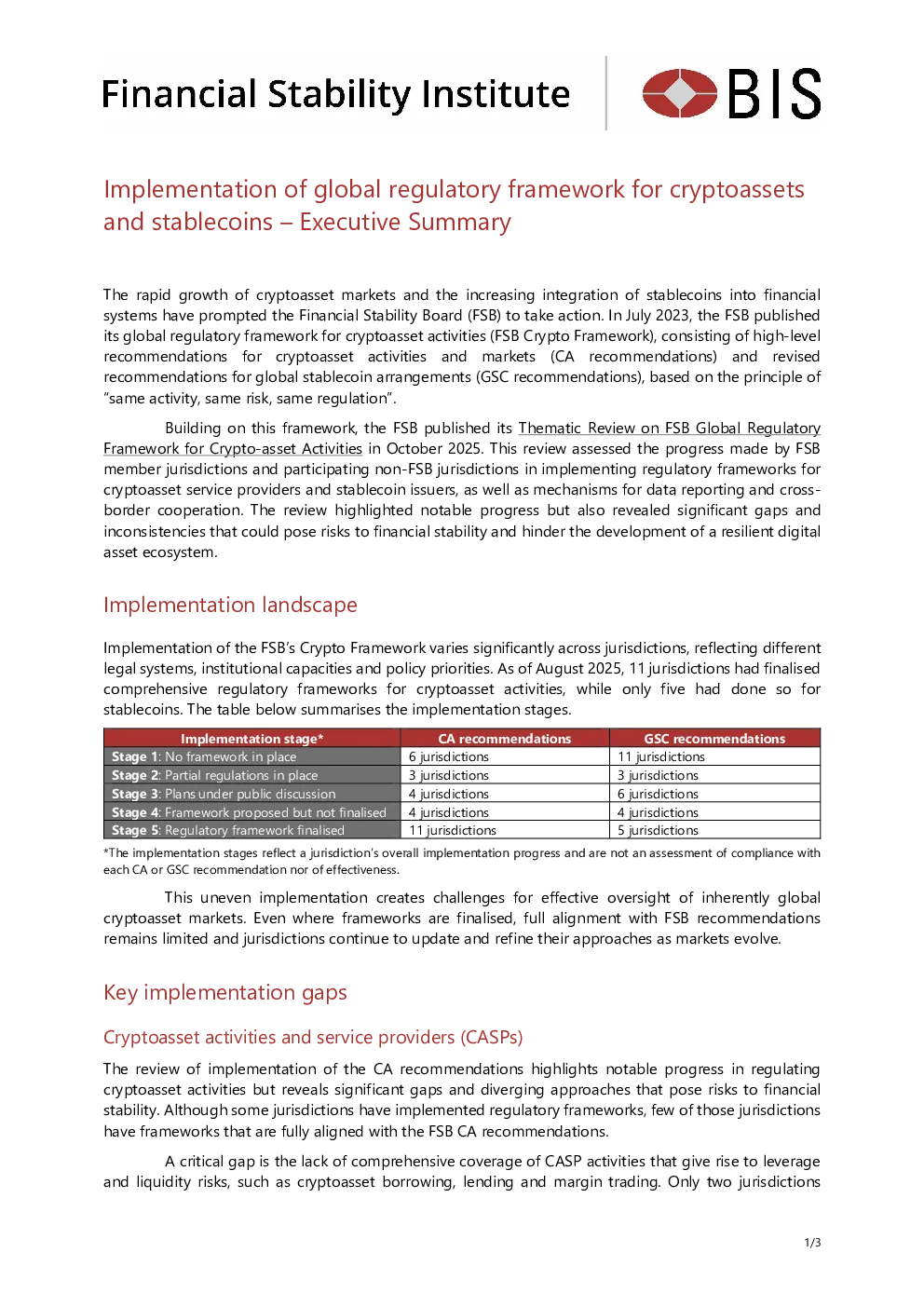
Implementation of global regulatory framework for cryptoassetsand stablecoins – Executive Summary The rapid growth of cryptoasset markets and the increasing integration of stablecoins into financialsystems have prompted the Financial Stability Board (FSB) to take action. In July 2023, the FSB publishedits global regulatory framework for cryptoasset activities (FSB Crypto Framework), consisting of high-levelrecommendationsfor cryptoasset activities and markets(CA recommendations)and revisedrecommendations for global stablecoin arrangements (GSC recommendations), based on the principle of“same activity, same risk, same regulation”. Building on this framework, the FSB published itsThematic Review on FSB Global RegulatoryFramework for Crypto-asset Activitiesin October 2025. This review assessed the progress made by FSBmember jurisdictions and participating non-FSB jurisdictions in implementing regulatory frameworks forcryptoasset service providers and stablecoin issuers, as well as mechanisms for data reporting and cross-border cooperation. The review highlighted notable progress but also revealed significant gaps andinconsistencies that could pose risks to financial stability and hinder the development of a resilient digitalasset ecosystem. Implementation landscape Implementation of the FSB’s Crypto Framework varies significantly across jurisdictions, reflecting differentlegal systems, institutional capacities and policy priorities. As of August 2025, 11 jurisdictions had finalisedcomprehensiveregulatory frameworks for cryptoasset activities,while only five had done so forstablecoins. The table below summarises the implementation stages. This uneven implementation creates challenges for effective oversight of inherently globalcryptoasset markets. Even where frameworks are finalised, full alignment with FSB recommendationsremains limited and jurisdictions continue to update and refine their approaches as markets evolve. Key implementation gaps Cryptoasset activities and service providers (CASPs) The review of implementation of the CA recommendations highlights notable progress in regulatingcryptoasset activities but reveals significant gaps and diverging approaches that pose risks to financialstability. Although some jurisdictions have implemented regulatory frameworks, few of those jurisdictionshave frameworks that are fully aligned with the FSB CA recommendations. A critical gap is the lack of comprehensive coverage of CASP activities that give rise to leverageand liquidity risks, such as cryptoasset borrowing, lending and margin trading. Only two jurisdictions comprehensively cover these activities in their cryptoasset regulatory frameworks, whereas for otherjurisdictions, these activities are beyond the scope of their regulatory frameworks. Supervision andenforcementalso lag behind regulatory development,with many jurisdictions yet to implementsupervisory and enforcement tools to ensure comprehensive oversight and compliance with regulatoryrequirements. This uneven implementation indicates that jurisdictions should undertake further efforts toachieve full and consistent implementation of the CA recommendations. Uneven and fragmentedimplementation can create opportunities for regulatory arbitrage and complicate cross-border oversightof the rapidly evolving, inherently global cryptoasset market. Stablecoin arrangements The regulation of GSCs similarly reflects a fragmented and inconsistent landscape. Implementationprogress has been slow, as relatively few jurisdictions have established comprehensive regulatoryframeworks for GSCs. This is largely because jurisdictions’ existing regulatory mandates and tools areunlikely to comprehensively address the risks of GSCs and align with the GSC recommendations. As a result, jurisdictions are recognising that they should develop tailored regulatory frameworksthat treat stablecoins as distinct payment instruments. However, few of these tailored frameworks are fullyaligned with the GSC recommendations; critical gaps include insufficient requirements for robust riskmanagement practices, capital buffers and recoveryand resolution planning (including insolvencyframeworks). Variations across jurisdictions in redemption and custody requirements, the timing anddetails of disclosures, and reserve collateralisation frameworks pose regulatory and supervisory challengesfor stablecoin arrangements that operate across multiple jurisdictions. Data, disclosure and regulatory reporting Significant challenges persist for authorities in obtaining the data necessary to effectively monitor financialstability risks associated with cryptoasset markets and activities. Regulatory data sources remain limited,prompting authorities to rely heavily on commercial data providers, surveys and other incomplete orfragmented data sources. These approaches often present challenges related to accuracy, consistency andcomprehensiveness, further complicating efforts to assess and address risk