您的浏览器禁用了JavaScript(一种计算机语言,用以实现您与网页的交互),请解除该禁用,或者联系我们。[世界卫生组织]:关于“开发人类细胞和组织以及高级治疗药物监管框架的HO考虑因素”实施研讨会的执行摘要 - 发现报告

关于“开发人类细胞和组织以及高级治疗药物监管框架的HO考虑因素”实施研讨会的执行摘要

AI智能总结
查看更多
关于“开发人类细胞和组织以及高级治疗药物监管框架的HO考虑因素”实施研讨会的执行摘要

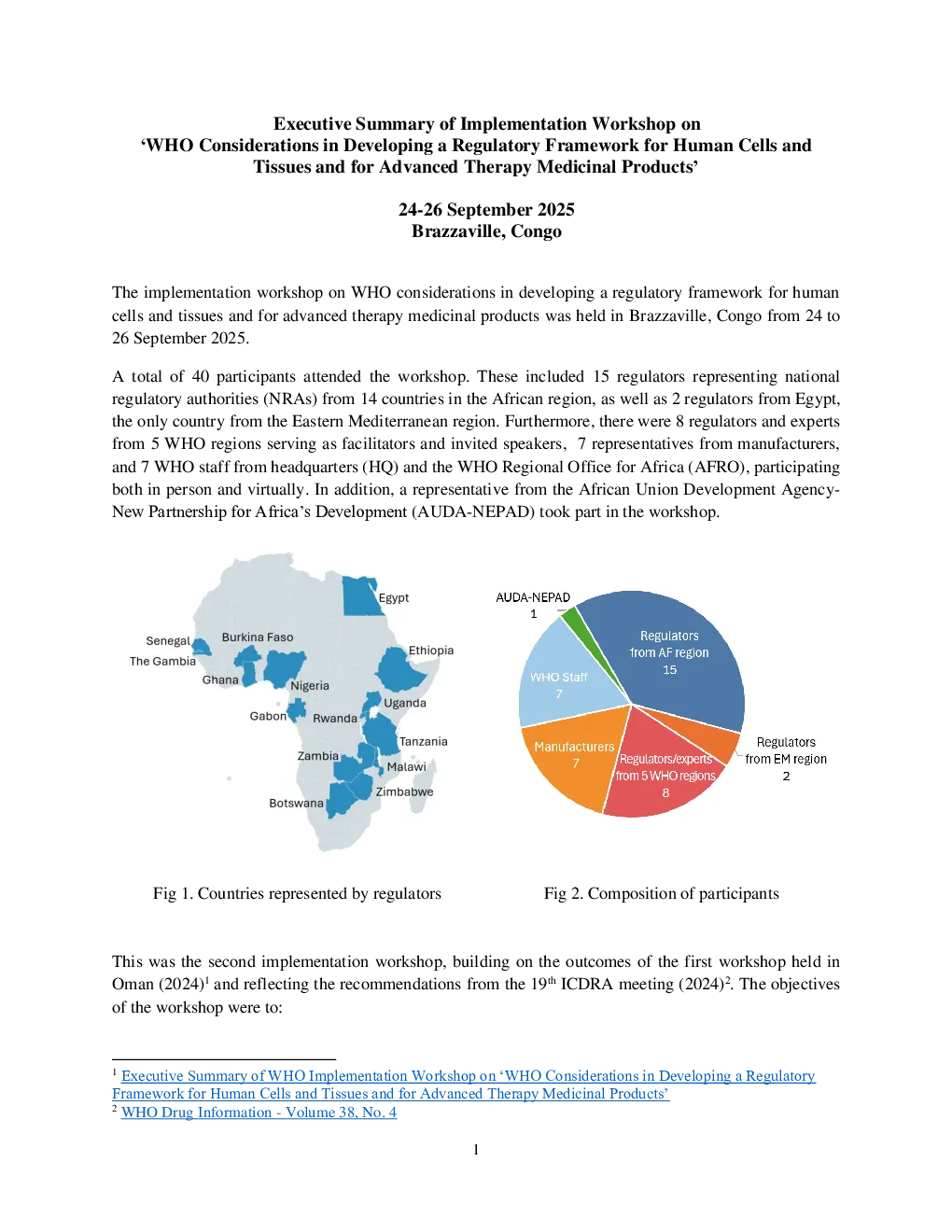
24-26September2025Brazzaville,Congo The implementation workshop on WHO considerations in developing a regulatory framework for humancells and tissues and for advanced therapy medicinal products was held inBrazzaville,Congofrom24to26September2025. A total of 40 participants attended theworkshop. These included15regulatorsrepresenting nationalregulatory authorities(NRAs)from 14 countries intheAfrican region,as well as 2 regulators fromEgypt,theonly countryfrom the EasternMediterraneanregion.Furthermore, there were 8 regulators and expertsfrom5 WHOregions serving as facilitators and invited speakers,7 representatives from manufacturers,and 7 WHO stafffromheadquarters (HQ) and the WHO Regional Office forAfrica (AFRO),participatingboth in person and virtually.In addition,arepresentativefrom theAfrican Union Development Agency-New Partnership for Africa’s Development(AUDA-NEPAD)took part in theworkshop. Thiswas the second implementation workshop, building on theoutcomesofthefirstworkshopheldinOman (2024)1andreflectingtherecommendations from the 19thICDRA meeting (2024)2.The objectivesof the workshop wereto: •ProvideNRAswith key principles oftheWHO considerations to facilitate theirimplementationinto nationalpractices.•Share regulatory and development experiences,as well as country situations and plans forrespectiveframeworks.•Discuss opportunities for collaborationto establish or improve regulatory frameworks and topromote regulatory convergence. Overthe three-day workshop,thekeyprinciplesoutlined inthe WHOdocument “Considerations indeveloping a regulatory framework for human cells and tissues and for advanced therapymedicinalproducts(WHO TRS No. 1048, Annex 3, 2023)3” were discussed intenopen sessions,with particular focusontheAfricancontext.Thedetailedagendaofthe workshopis providedat the end of thisdocument. The sessions began with an overview of WHO activities in biological standardization,followed bydiscussions ontherisk-based approach fortheregulation of CGTPs,includingproductclassificationandterminology.The regulatory status of CGTPs in different countries was shared and discussedbyregulators,together with theirexperiences, challenges,andareas where WHO support is needed.Manufacturersprovidedperspectivesonthe current stateof CGTPdevelopment, anddiscussionswere also held onclinicaltrialsof CGTPs.Furtherdiscussionsfocusedonthe implementation oftheWHO considerations document,includingplanstobe developedby countries toestablishand strengthen regulatory frameworks, the supportneeded from WHO, andapproaches tobuildregulatorycapacity. Group activities on three case studies were conducted, covering products ranging from minimallymanipulated tissues to advanced therapy medicinal products requiring comprehensive regulatory oversight.These exercises provided participants with an opportunity to apply risk-based regulatory approaches inpractice.Through these discussions, participants emphasized the importance of clearly defining safety,manipulation, classification, and terminology. Challenges highlighted included difficulties in classifyingproducts, the regulatory complexity of gene therapy products, and the need for training in regulatoryevaluation, including GMP requirements.The limited number of clinical trials and marketing authorizationapplications for CGTPs in many African countries was noted as a barrier, as it restricts practical exposureand hands-on experience, suggesting that capacity constraints and the absence of guidance maylimitdevelopment. Manufacturerssharedperspectives onpathways to improve access to CGTPs in low-and middle-incomecountries. They recommended measures such as optimizing or establishing GMP facilities, creatingregional hubs, fostering international training partnerships, integrating CGTP-related curricula intouniversities, and developing indigenous supply chains. They also emphasized the importance of regulatoryconvergence across the region, the establishment of fast-track pathways, and the development of country-specific frameworks, including those for rare diseases. Participants expressed strong support for the WHO considerations document and agreed on the need forcapacity building, both at the level of national regulatory systems and among regulatory staff. Specificneeds identified included training on CGTP evaluation, the establishment of dedicated teams for ATMPs,and mechanisms to ensure long-term follow-up of patients, particularly for gene therapy products. Thevalue of reliance mechanisms, joint reviews, and regional cooperation was underlined as essential tosupportcountries with limited resources. Several cross-cutting issues were also raised. Medical tourism was identified as a global concern, withparticipants noting that insufficient regulation in some countries exposes patients to unsafe products whilecreating additional burdens on health systems when adverseeventsoccur. The complexity of regulatingproducts prepared in hospitals was also highlighted, particularly in s