月度预算审查:2026年5月
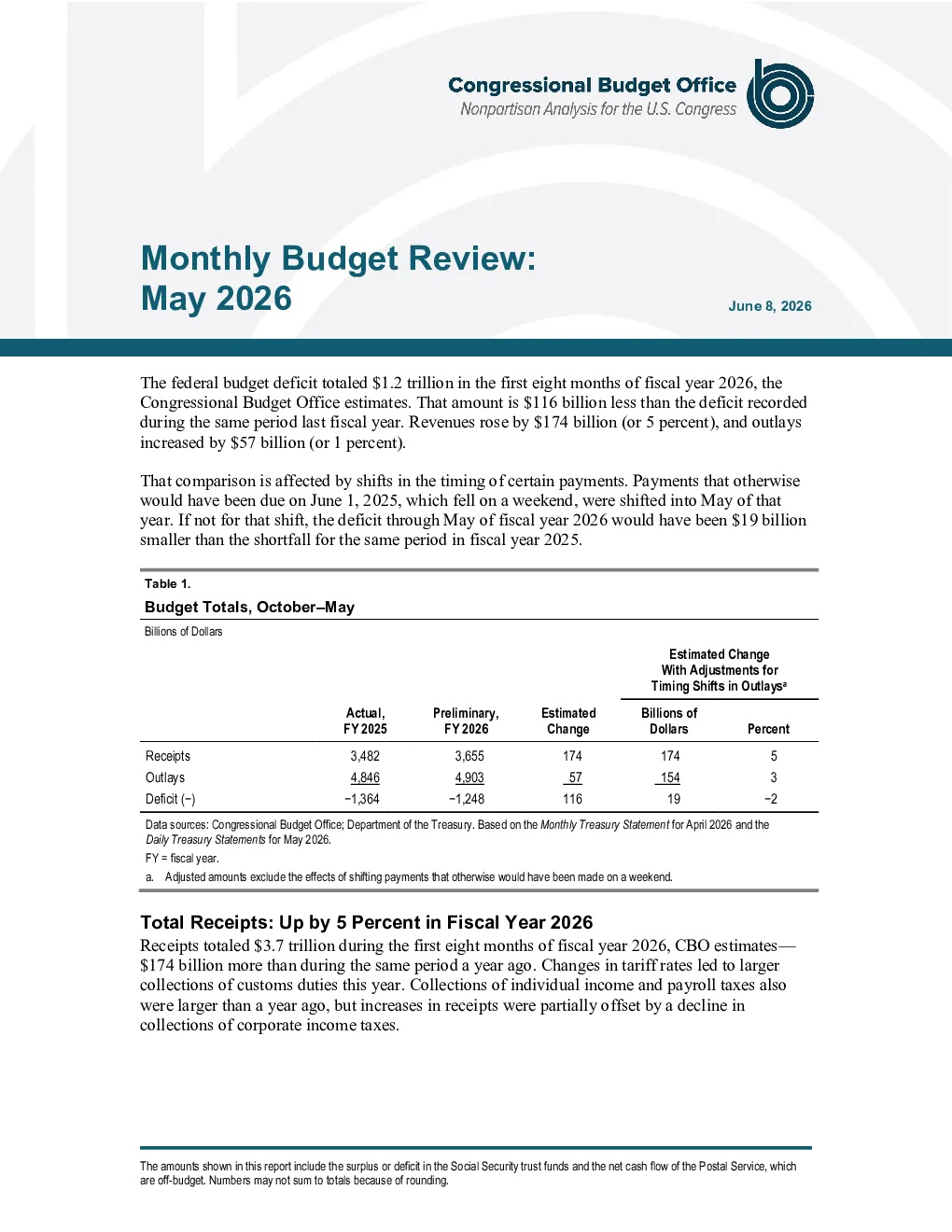
The federal budget deficit totaled $1.2 trillion in the first eight months of fiscal year 2026, theCongressional Budget Office estimates. That amount is $116 billion less than the deficit recordedduring the same period last fiscal year. Revenues rose by $174 billion (or 5 percent), and outlays That comparison is affected by shifts in the timing of certain payments. Payments that otherwisewould have been due on June 1, 2025, which fell on a weekend, were shifted into May of thatyear. If not for that shift, the deficit through May of fiscal year 2026 would have been $19 billion a.Adjusted amounts exclude the effects of shifting payments that otherwise would have been made on a weekend. Total Receipts: Up by 5 Percent in Fiscal Year 2026 Receipts totaled $3.7 trillion during the first eight months of fiscal year 2026, CBO estimates—$174 billion more than during the same period a year ago. Changes in tariff rates led to largercollections of customs duties this year. Collections of individual income and payroll taxes also Actual receipts from taxes collected through mid-May were below the amounts that would havebeen expected at that point on the basis of CBO’s February 2026 baseline projections (which Compared with the February baseline, collections of individual income taxes for the period wereslightly larger than anticipated, and corporate income tax collections were somewhat smaller. Thereasons for those differences will become clearer as additional data become available over thenext two years. Collections of customs duties also were smaller than in CBO’s baseline, which The changes in receipts from last year to this year were as follows: ■Individualincomeandpayroll(social insurance)taxestogether increased by $148 billion(or 5 percent). •Amounts withheld from workers’ paychecks rose by $103 billion (or 4 percent), areflection of rising wages and salaries. ■Medicaidoutlays increased by $35 billion (or 8 percent) largely because of rising costs perenrollee. Other areas with large increases were the following: ■Outlays fornet interest on the public debtrose by $68 billion (or 10 percent) because thedebt was larger than it was in the first eight months of fiscal year 2025 and because of higherlong-term interest rates. Declines in short-term rates partially mitigated the overall rise in ■Outlays from theDepartment of Veterans Affairsincreased by $25 billion (or 10 percent),primarily because more people received veterans’ benefits and spending per person rose. ■Spending by theDepartment of Defensefor military activities was $24 billion (or 4 percent)greater than in the same period in fiscal year 2025; the largest increases were for military The largest decreases were the following: ■Outlays recorded by theEnvironmental Protection Agencydecreased by $20 billion(or 64 percent), primarily because in November and December 2024 that agency spent$20 billion under a clean energy grant program established by the 2022 reconciliation act ■Spending by theDepartment of Homeland Securitydecreased by $16 billion (or20 percent) mainly because the Federal Emergency Management Agency spent more inresponse to disasters during the same period last fiscal year. Higher outlays this year, ■Outlays of theDepartment of Educationdecreased by $9 billion (or 10 percent) largelybecause spending from the Education Stabilization Fund declined. That total decline wouldhave been larger if not for outlays of about $4 billion stemming from the recording of the ■Spending by theDepartment of Commercedecreased by $8 billion (or 48 percent) mostlybecause the department spent less to support semiconductor manufacturing in the first eight Spending for other programs and activities increased or decreased by smaller amounts. Estimated Deficit in May 2026: $294 BillionThe federal government incurred a deficit of $294 billion in May 2026, CBO estimates— $21 billion less than the deficit recorded for the previous May. Revenues and outlays alike weresmaller in May 2026 than they were in May 2025—by $36 billion and $57 billion, respectively. Shifts in the timing of certain federal payments affect that comparison. Because June 1, 2025, fellon a weekend, certain federal payments were shifted into May of that year. If not for that shift,the deficit for May 2026 would have been $76 billionlargerthan the deficit in May 2025. CBO estimates that receipts in May 2026 totaled $335 billion—$36 billion (or 10 percent) lessthan the amount recorded last May. That decrease was driven by collections of corporate income