2025年7月月度预算审查
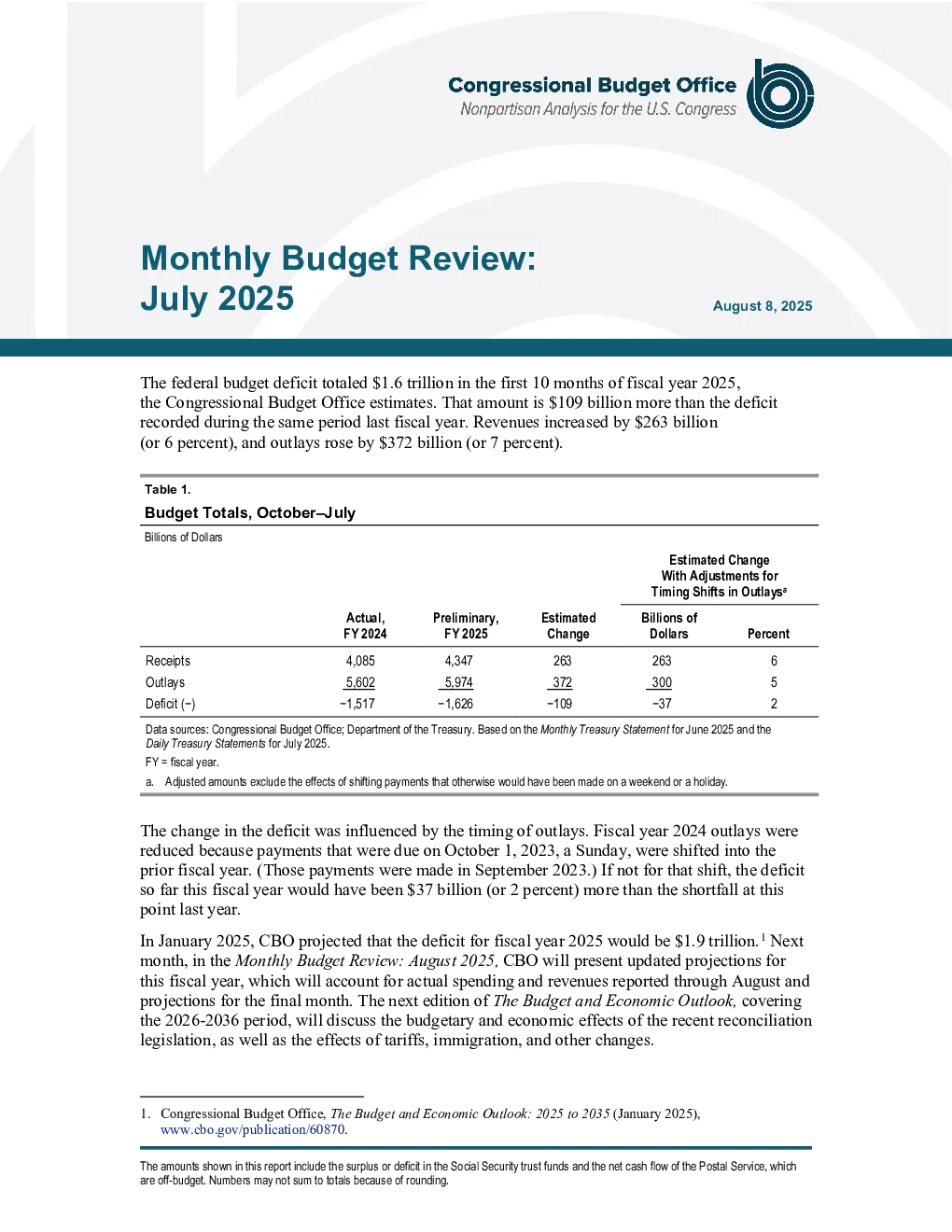
August 8,2025 The federal budget deficit totaled $1.6 trillion in the first 10 months of fiscal year 2025,the Congressional Budget Office estimates. That amount is $109 billion more than the deficitrecorded during the same period last fiscal year. Revenues increased by $263 billion(or 6 percent), and outlays rose by $372 billion (or 7 percent). The change in the deficit was influenced by the timing of outlays. Fiscal year 2024 outlays werereduced because payments that were due on October 1, 2023, a Sunday, were shifted into theprior fiscal year. (Those payments were made in September 2023.) If not for that shift, the deficitso far this fiscal year would have been $37 billion (or 2 percent) more than the shortfall at thispoint last year. In January 2025, CBO projected that the deficit for fiscal year 2025 would be $1.9 trillion.1Nextmonth, in theMonthly Budget Review: August 2025,CBO will present updated projections forthis fiscal year, which will account for actual spending and revenues reported through August andprojections for the final month. The next edition ofThe Budget and EconomicOutlook,coveringthe 2026-2036 period, will discuss the budgetary and economic effects of the recent reconciliationlegislation, as well as the effects of tariffs, immigration, and other changes. Total Receipts: Up by 6 Percent in Fiscal Year 2025 Receipts totaled $4.3 trillion during the first 10 months of fiscal year 2025, CBO estimates—$263 billion (or 6 percent) more than during the same period a year ago. That increase wasmoderated by changes to payment deadlines for certain taxpayers over the past two years.Receipts were boosted by about $70 billion in the first quarter of fiscal year 2024 because theInternal Revenue Service (IRS) postponed certain 2023 tax deadlines until early in fiscal year2024 for some taxpayers in federally declared disaster areas. The IRS also postponed, until earlynext fiscal year, certain 2025 deadlines for a smaller group of similarly affected taxpayers. The changes in receipts from last year to this year were as follows: ■Individual incomeandpayroll (social insurance)taxes together rose by $214 billion(or 6 percent). •Amounts withheld from workers’ paychecks rose by $155 billion (or 6 percent), areflection of rising wages and salaries.•Nonwithheld payments of income and payroll taxes increased by $75 billion (or8 percent) relative to payments in the same period in fiscal year 2024. The estimatedincrease so far this fiscal year has been smaller than it otherwise would have been; CBOestimates that the postponement of deadlines for some taxpayers in 2023 shifted$35 billion in nonwithheld income tax payments into the beginning of fiscal year 2024.Since the beginning of January, those payments have been 15 percent greater thanpayments from the same period last year, mostly reflecting an increase in 2024 taxliabilities.•Individual income tax refunds increased by $22 billion (or 8 percent). (A portion ofrefunds stemming from refundable tax credits are classified as outlays and discussedseparately below.) ■Receipts fromcorporate income taxesdecreased by $27 billion (or 7 percent) relative to thesame period in fiscal year 2024. During fiscal year 2023, for many corporations in areasaffected by natural disasters, particularly in California, the IRS postponed the deadline tomake payments that ordinarily would have been due by the end of that fiscal year. Most ofthose payments were made in the first month of fiscal year 2024.CBO estimates that thepostponement of deadlines for some taxpayers in 2023 shifted $35 billion in corporateincome tax payments into the beginning of fiscal year 2024. ■Receipts fromother sourcesrose by $76 billion (or 39 percent) relative to the same periodlast year. •Customs duties increased by $70 billion (or 112 percent). Since February, theAdministration has increased tariffs on most imported goods.•Excise taxes increased by $4 billion (or 4 percent).•Miscellaneous fees and fines increased by $2 billion (or 7 percent).•Remittances from the Federal Reserve to the Treasury increased by $2 billion(or 79 percent).•Estate and gift taxes decreased by $2 billion (or 7 percent). Total Outlays: Up by 7 Percent in Fiscal Year 2025 Outlays in the first 10 months of fiscal year 2025 were $6 trillion, CBO estimates, $372 billion(or 7 percent) more than during the same period last year. If not for the timing shift discussedabove, outlays so far in fiscal year 2025 would have been $300 billion (or 5 percent) greater thanoutlays during the same period in fiscal year 2024. The discussion below reflects adjustments toexclude the effects of that timing shift. Outlays for the largest mandatory spending programs increased by $207 billion (or 8 percent): ■Spending forSocial Securitybenefits rose by $102 billion (or 8 percent). Such spending wasboosted by increases in the average benefit payment (stemming mostly from cost-of-livingadjustments) and in the number of beneficiaries. In additio