您的浏览器禁用了JavaScript(一种计算机语言,用以实现您与网页的交互),请解除该禁用,或者联系我们。 [PitchBook]:注意差距:消费者人工智能中的买卖价差(英)2026 - 发现报告

注意差距:消费者人工智能中的买卖价差(英)2026

信息技术 2026-06-15 PitchBook 曾阿牛
报告封面

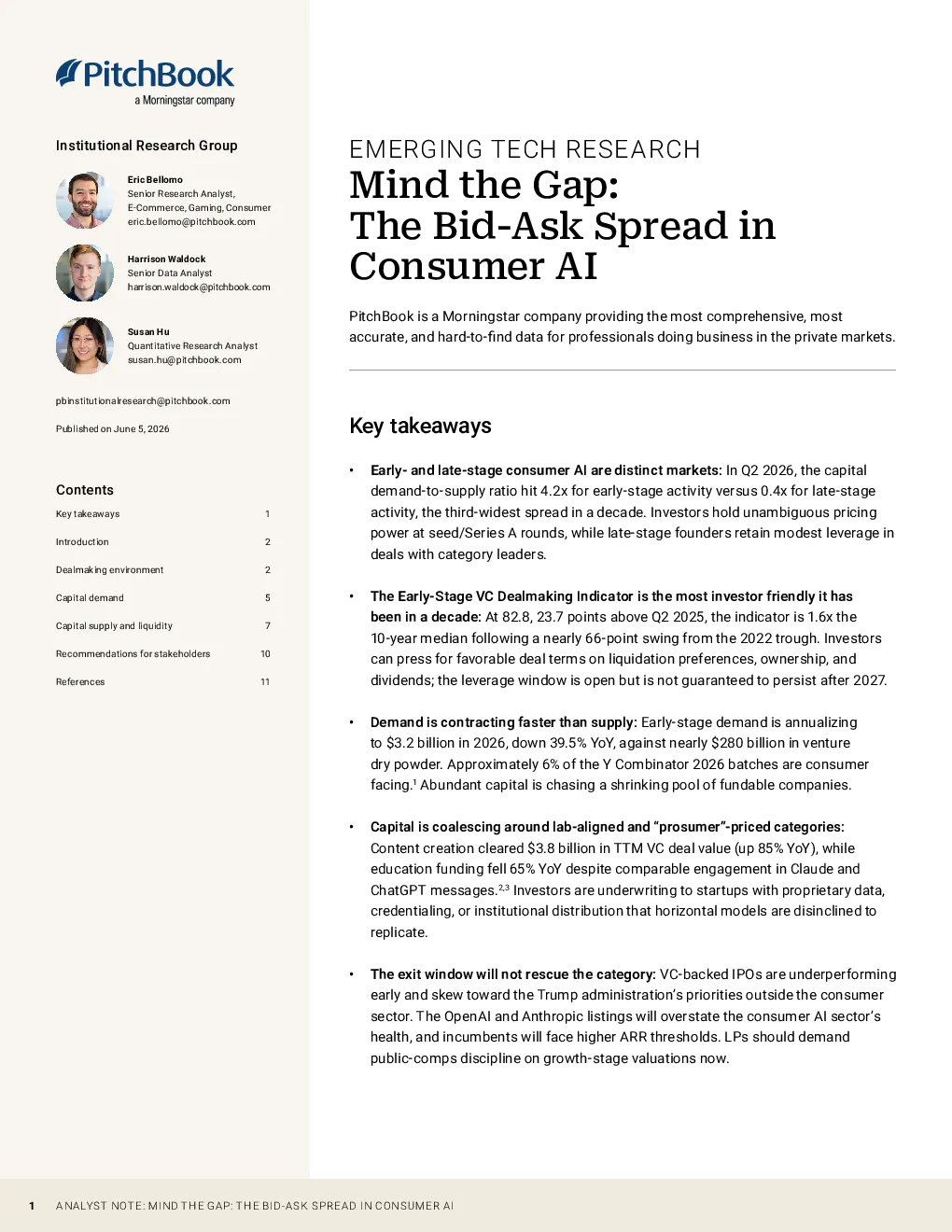
EMERGING TECH RESEARCHMind the Gap: Institutional Research Group The Bid-Ask Spread in Eric BellomoSenior Research Analyst,E-Commerce, Gaming, Consumereric.bellomo@pitchbook.com PitchBook is a Morningstar company providing the most comprehensive, mostaccurate, and hard-to-find data for professionals doing business in the private markets. Susan HuQuantitative Research Analystsusan.hu@pitchbook.com Key takeaways Published on June 5, 2026 •Early- and late-stage consumer AI are distinct markets:In Q2 2026, the capitaldemand-to-supply ratio hit 4.2x for early-stage activity versus 0.4x for late-stageactivity, the third-widest spread in a decade. Investors hold unambiguous pricingpower at seed/Series A rounds, while late-stage founders retain modest leverage in •Demand is contracting faster than supply:Early-stage demand is annualizingto $3.2 billion in 2026, down 39.5% YoY, against nearly $280 billion in venturedry powder. Approximately 6% of the Y Combinator 2026 batches are consumer •Capital is coalescing around lab-aligned and “prosumer”-priced categories: Content creation cleared $3.8 billion in TTM VC deal value (up 85% YoY), whileeducation funding fell 65% YoY despite comparable engagement in Claude and •The exit window will not rescue the category:VC-backed IPOs are underperformingearly and skew toward the Trump administration’s priorities outside the consumersector. The OpenAI and Anthropic listings will overstate the consumer AI sector’shealth, and incumbents will face higher ARR thresholds. LPs should demand Introduction This analysis represents a new application of PitchBook’s proprietary dealmakingframework on a vertical basis. Using the measures below, our first-in-class datasetquantifies the extent of market bifurcation and capital concentration across stages for Key terms and notes •Demand-to-supply ratio:The capital sought by startups raising funding (demand)versus the capital deployed by VC firms and other market participants (supply). •VC Dealmaking Indicator:A composite score indicating if a fundraisingenvironment is favorable to startups or to investors. Inputs include a variety of dealterms, including, but not limited to, cumulative dividends, liquidation participation, •Z-score:How far a quarter’s capital supply or demand sits, expressed in standard •Note:We exclude the venture-growth stage in our analysis due to small samplesizes. Other references to our bid-ask analyses can be found inprior notes, ourQuantitative Perspectives series, and thePitchBook-NVCA VentureMonitor. Dealmaking environment Capital demand-to-supply ratio requires separate early- and late- In Q2 2026, the capital demand-to-supply ratio reached 4.2x for early-stage activityand 0.4x for late-stage activity against 10-year averages of 1.8x and 1.6x, respectively.For every $1 invested, early-stage founders sought $4.18, indicative of an investor- From 2016 to 2021, early- and late-stage ratios largely moved in tandem and withina narrow band, averaging 1x to 1.5x. The ratios decoupled in 2022, and since then,the early and late stages have increasingly behaved as distinct markets. Quarterlyvolatility also rose sharply after 2022, with the ratio landing at 2.6x for the early stage Early-stage investors should press for favorable deal terms now The Early-Stage VC Dealmaking Indicator exceeded 80 in Q1 and Q2 2026, the onlytwo readouts above 80 in our dataset and 1.6x the 10-year median of 50.9. The paceof change should not be understated: Fundraising dynamics were neutral in 2023 and2024 and shifted to being deeply investor friendly in 18 months. The Early-Stage VC The late-stage market has already normalized The Late-Stage VC Dealmaking Indicator peaked at 72.1 in Q2 2024 and fell to 55.3in Q2 2026, largely in line with the 10-year median of 53 and approximately 17 pointsbelow the Q2 2024 peak. The 27.5-point spread between early-stage and late-stage Late-stage dealmaking directly follows the federal funds path with a correlationcoefficient (r) of +0.9 at a one-quarter lag (rof +1 indicates perfect positivecorrelation). Higher interest rates compress valuations and restrict deal terms,thereby favoring investors. Early-stage repricing is much slower (rpeaks at +0.6 LPs •Reweight toward early-stage vintages:The early-stage market offers the strongestentry terms in our data series. Increased commitments to seed/Series A specialists •Stress-test growth-stage allocations:Late-stage capital demand growthdecelerated from over 90% YoY in 2021 to approximately 7% in 2025, with 2026tracking toward flat or negative levels. Require growth-stage GPs to justify their •Demand public-comps discipline on marks:A select batch of 25 publicly tradedB2C software platforms show distress concentration (Altman Z-scores below 3)similar to apparel retailers. A shrinking pool of healthy public comps compresses References 1:“Startup Directory,” Y Combinator, n.d., accessed May27, 2026.2:“How People Use Claude for Support