您的浏览器禁用了JavaScript(一种计算机语言,用以实现您与网页的交互),请解除该禁用,或者联系我们。 [翰宇国际律师事务所]:超级发薪日——变化和意外后果 - 发现报告

超级发薪日——变化和意外后果

2026-06-12 翰宇国际律师事务所 故人
报告封面

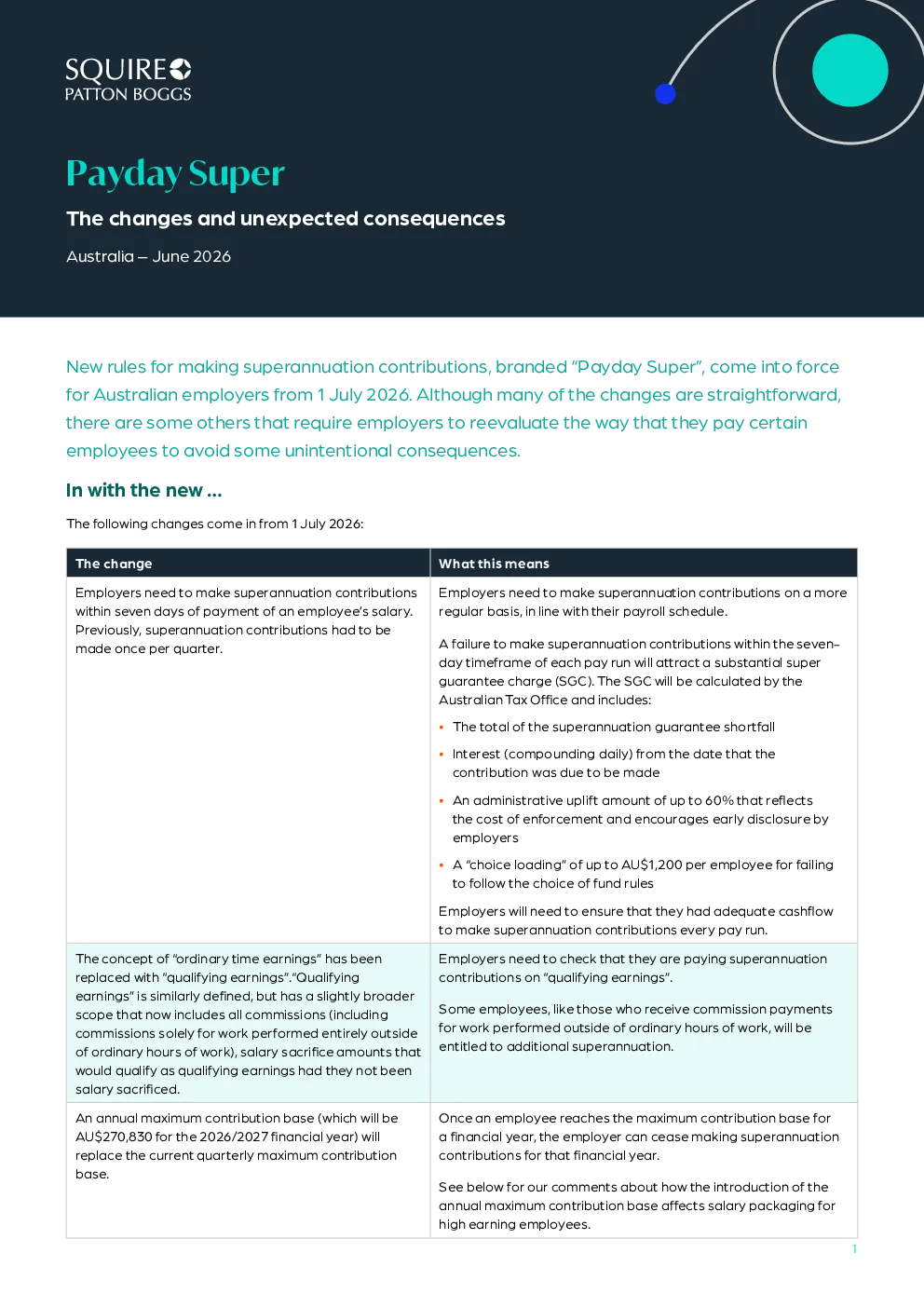
The changes and unexpected consequences Australia – June 2026 New rules for making superannuation contributions, branded “Payday Super”, come into forcefor Australian employers from 1 July 2026. Although many of the changes are straightforward, In with the new … The following changes come in from 1 July 2026: Rethinking annualised salaries The Payday Super changes mean, from 1 July 2026, an employer must make superannuation contributions on behalf of anemployee at 12% each pay period, until the employee’s qualifying earnings reach the maximum contribution base for thatfinancial year. This means, for high-earning employees whose qualified earnings are higher than the maximum contribution base This may give rise to some practical issues for employers. For example, with respect to High Earning Employees, employerswill no longer be able to pay superannuation in equal monthly instalments. This may affect employers using a “total fixed Example: Harry’s base salary is AU$312,000 per annum. This equates to a monthly base salary of AU$26,000. Based on the maximum contribution base of AU$270,830, his total annual remuneration package, comprising base salary and As such, (depending on the contractual arrangements) we are usually recommending that most employers separate thepayment of base salary from superannuation, such that the base salary can be paid in equal instalments over the course of a That said, if an employer wants to continue to package superannuation in a High Earning Employee’s remuneration, werecommend that they obtain advice on structuring their remuneration in light of the Payday Super laws. Our labour and Watch out for bonuses If an employer pays bonuses or commissions, these amounts will be “qualifying earnings”, and so superannuation contributions The timing of these amounts in the financial year will also impact the amount of superannuation contributions payable in Example: If Harry received a bonus of AU$50,000 in September, Harry’s employer would need to make superannuation contributions as Super guarantee opt-out An employee with multiple employers, either at the same time or because they have changed jobs during the course of afinancial year, and who is likely to exceed the maximum contribution base for a financial year, can provide their employer with an If an employer receives an exemption certificate from an employee, then they are released from their super guaranteeobligations for a specified period, which ends at the end of the financial year. The employer may, however, choose to disregard Takeaways With less than three weeks until 1 July, your organisation should be urgently considering the following (if it has not already): •Review payroll systems, processes and provider arrangements– To ensure superannuation contributions can becalculated, processed and remitted within seven days of each salary payment from 1 July 2026. •Audit earnings categories– To confirm super is being calculated on the new “qualifying earnings” basis, including relevant •Identify High Earning Employees and model cap impacts– Particularly where bonuses or commissions may affect when •Review remuneration structures and contract templates– Especially total fixed remuneration or total employment costarrangements, and consider separating base salary from superannuation where appropriate. Your contract templates will If this article raises any questions or issues for your organisation, or you otherwise would like any advice on the matters set out, Contacts Nicola MartinPartner, SydneyT +61 8248 7836nicola.martin@squirepb.com Louise BoyceTax Counsel, SydneyT +61 9429 7802louise.boyce@squirepb.com Erin KiddSpecial Counsel, SydneyT +61 8248 7837